1800 – 1899 · 13 documented scenes
19th Century History Game
The century that leaves evidence everywhere, if you know where to look.
The nineteenth century is where dating a scene becomes a technical exercise. Iron, then steel. Gas, then electricity. Sail, then screw propeller. Daguerreotype, then dry plate. Almost every object in a nineteenth-century panorama has a first year attached to it, and the youngest thing in shot sets the earliest date the scene can be — which is exactly how a good guess is built.
It is also the most global band in the library: a run can move from a Pennsylvania oil field to a Paris exposition to a Melbourne goldfield without leaving the same twenty years. That makes the map half of the round genuinely hard, and rewards paying attention to vegetation, light and building materials before you touch the pin.
5 rounds · free · no account needed · 5 scenes from 19th century
13
Scenes in the band
5
Rounds per run
1800 – 1899
Years covered
How a 19th century round works
- 1
Look around the scene
Every round opens inside a 360° panorama of a real moment. Drag to turn, zoom in on anything that looks datable. There is no caption, no title and no year anywhere on screen.
- 2
Drop a pin, then pick a year
Place your guess on the world map and set the year on the slider — arrow keys nudge a year at a time, the century arrows jump a hundred. Both halves are scored, so a perfect year with the wrong continent still loses points.
- 3
See what dated it
The result screen shows the true place and year, the distance you were out, and the detail in the scene that gives the date away. That explanation is the part that makes the next round easier.
How to date a 19th century scene
Follow the iron
Wrought-iron rails, lattice bridges and glass-and-iron exhibition halls are mid-century. Steel changes the look again after the 1860s: taller frames, thinner members, longer spans. If a structure is doing something that iron could not have done, you are past 1870.
Light sources are a calendar
Oil lamps and candles run out around the 1840s in cities. Gas lamps on cast-iron standards dominate mid-century. Carbon-arc lighting shows up in the 1880s and incandescent bulbs on overhead wires in the 1890s. A street scene lit by wires strung across the road is very late in the century.
The photograph itself is evidence
This band overlaps the invention of photography, so the medium is a clue. Long exposures empty a busy street of people and blur anything that moved; sharp crowds and caught motion mean the 1880s or later. Even the framing shifts — early views are static and architectural because the camera could not be anything else.
Use the exhibition and rail calendar as anchors: the Great Exhibition in 1851, the transcontinental railroad in 1869, the Paris Exposition and its tower in 1889, the Chicago fair in 1893. Most nineteenth-century scenes in the library sit within a decade of one of those moments.
The 13 scenes this run draws on
Every one is a documented moment with a verified place and year. A run deals 5 of them in random order, so no two sessions are the same.
- the United Kingdom collection
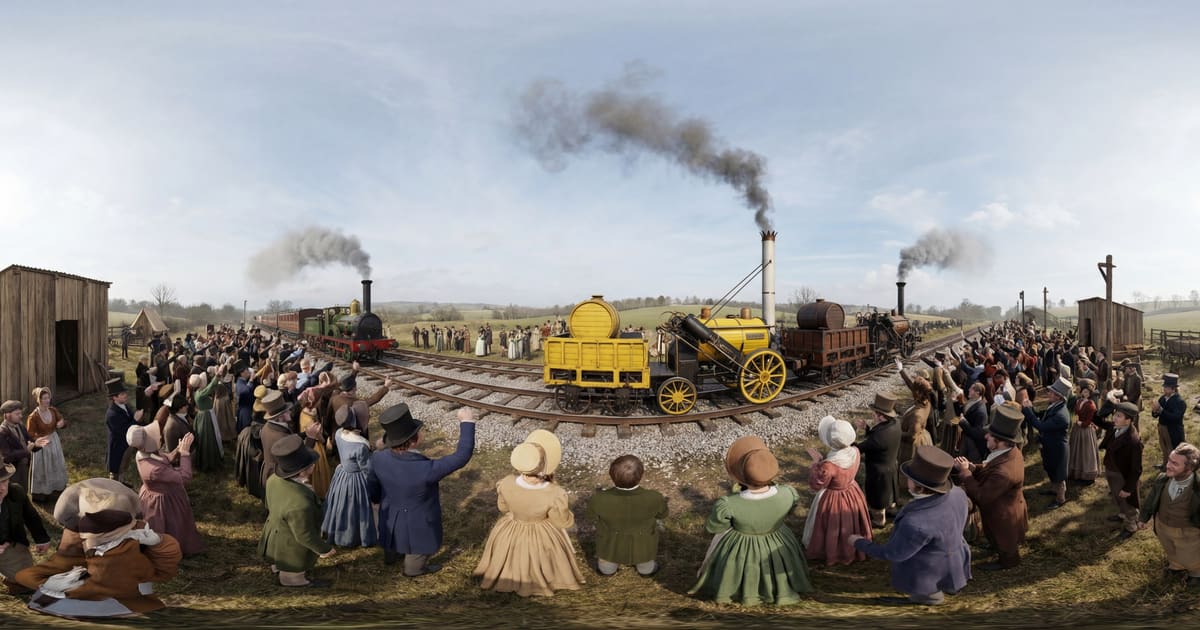
1830Opening of the Liverpool and Manchester Railway
Between Liverpool and Manchester, Lancashire, England
- the United States collection
Mission San Antonio de Valero, San Antonio de Béxar, Texas
- the United Kingdom collection
1851The Great Exhibition at Crystal Palace, London
Hyde Park, London, England
- the United Kingdom collection
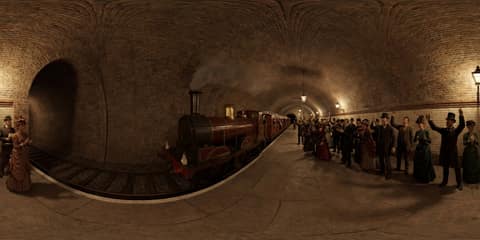
1863Opening of the Metropolitan Railway, World's First Underground
The Metropolitan Railway, Paddington to Farringdon, London
- the United States collection
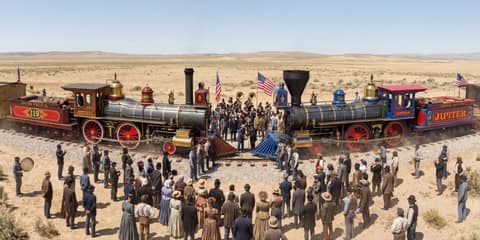
1869Golden Spike Ceremony, Promontory Summit
Promontory Summit, Utah Territory
- Egypt collection
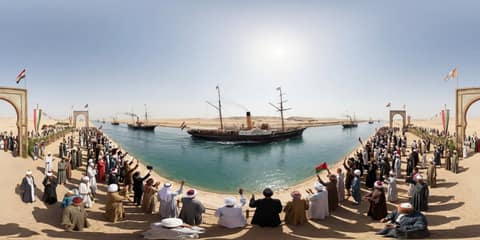
Port Said and the Isthmus of Suez, Egypt
- the United States collection
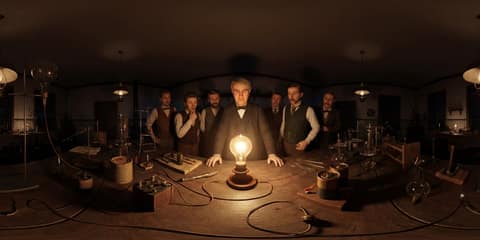
1879Edison's Light Bulb Demonstration, Menlo Park
Menlo Park laboratory, New Jersey
- the United States collection
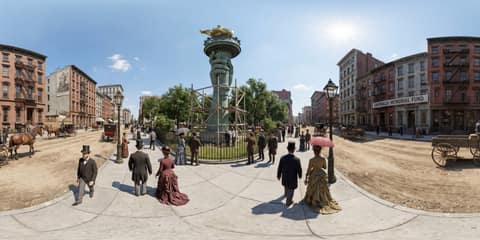
1882Statue of Liberty's Arm on Display in Manhattan
Madison Square Park, Manhattan, New York
- the United States collection
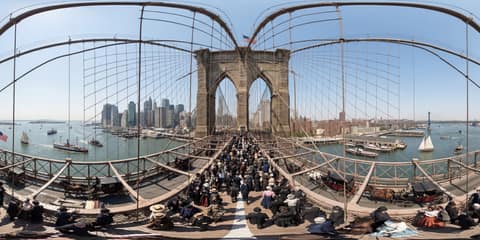
1883Brooklyn Bridge Grand Opening
East River, between Manhattan and Brooklyn, New York
- the United States collection
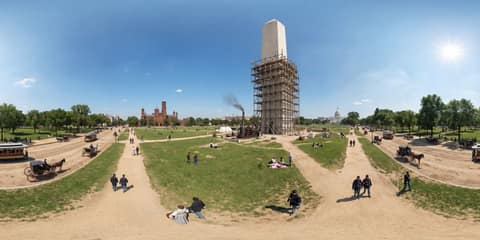
1884Washington Monument Nearing Completion
The National Mall, Washington, D.C.
- the United States collection
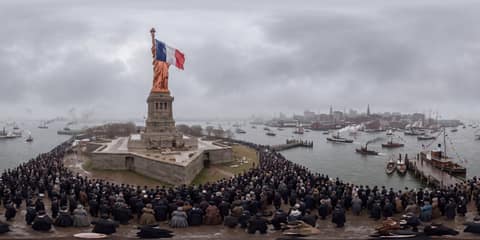
1886Statue of Liberty Dedication
Bedloe's Island (now Liberty Island), New York Harbor
- France collection
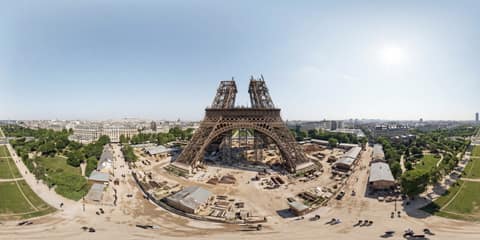
1889Eiffel Tower Construction for World's Fair
Champ de Mars, Paris, France
- Greece collection
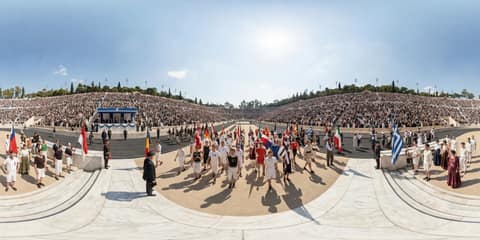
1896First Modern Olympic Games, Athens
Panathenaic Stadium, Athens, Greece
19th Century History Game — common questions
- What is in a 19th century run?
- Five 360° scenes dated 1800 to 1899 — railways and bridges under construction, world's fairs, gold rushes, industrial towns and civil-war era America among them. You guess the place on a world map and the year on a slider; both are scored and both count.
- Why is the year slider so sensitive here?
- Because the evidence is that good. In a band where a lamp post can date a street to a decade, a fifty-year miss is a real error rather than bad luck, so the curve is steeper in practice than it feels in the ancient rounds.
- Does the game include photographs from the period?
- The scenes are 360° reconstructions of documented moments rather than archive photographs, but they are built to be internally consistent with what was actually there in that year — which is why the technology cues in them can be trusted.
- What should I learn first to improve?
- Transport. Rail gauge, rolling stock, ship propulsion and the presence or absence of a tram will settle most nineteenth-century rounds faster than architecture will, and they are visible from anywhere in the scene.
- Is there a matching quiz?
- Yes — the 19th century quiz is the scored multiple-choice version, and the 19th century trivia round is the timed one. Both draw on the same moments as this run, so what you learn here transfers directly.
Keep going with this era
Countries in this band
Every era run
Prefer a mixed run? The main game deals from every era at once, and all the free history games are listed in one place.