A gift with strings, and no pedestal money
France's Franco-American Union had agreed to build and pay for the statue itself, on the understanding that the United States would fund and build the pedestal. American fundraising stalled badly through the 1870s, with committees, benefit exhibitions and even an art auction failing to raise anywhere near the sum needed, despite the involvement of prominent New Yorkers who lent their names to the effort without opening their own chequebooks as generously as organisers had hoped.
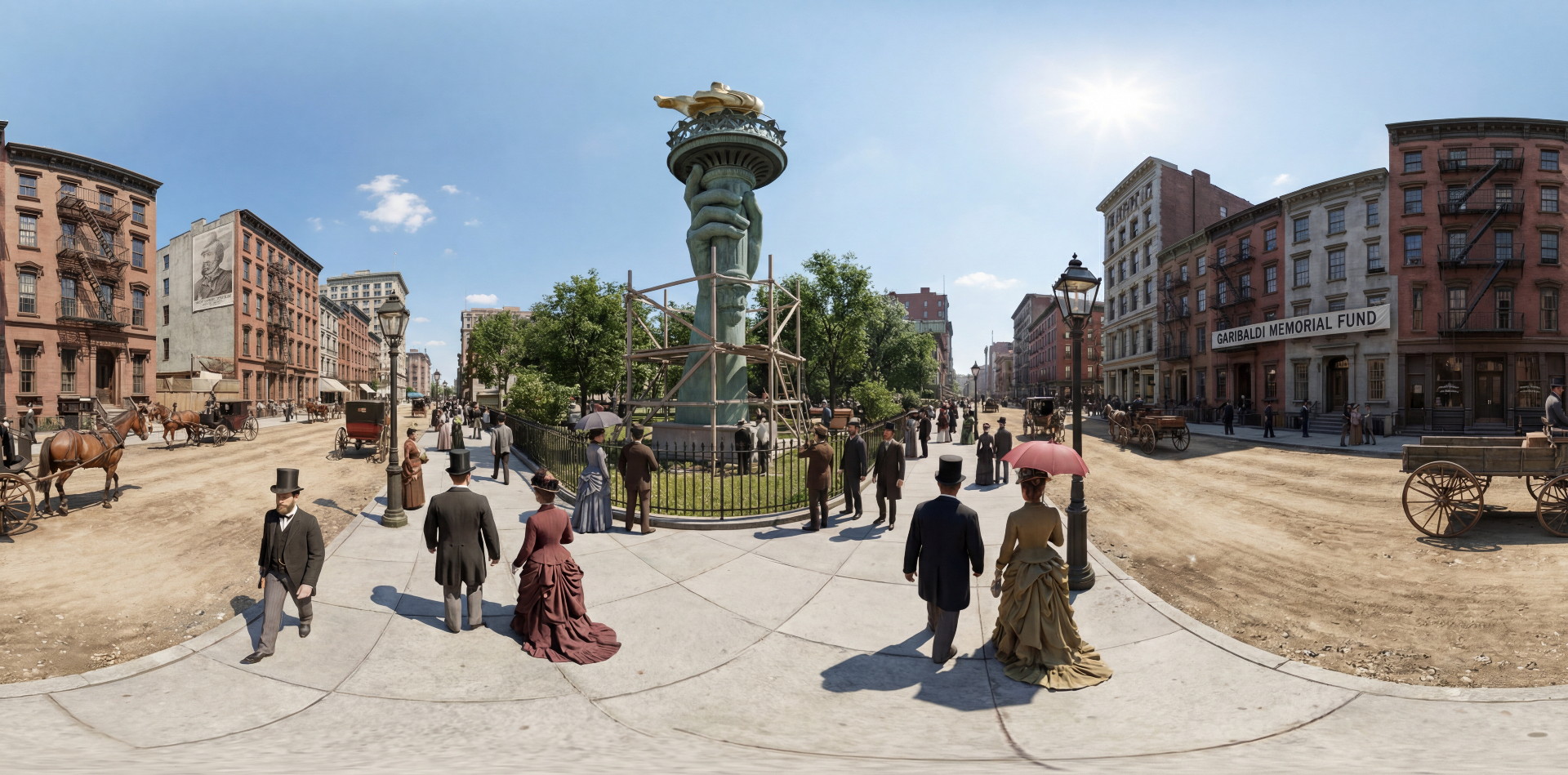
To keep interest and donations alive, the completed right arm and torch, one of the first sections finished in Bartholdi's Paris workshop, were shipped to America and exhibited first at the 1876 Centennial Exhibition in Philadelphia, then moved to Madison Square Park in Manhattan.
Bartholdi himself travelled to America to promote the project directly, lobbying congressmen and newspaper editors in person, convinced that seeing even a single limb at full scale would do more to loosen wallets than any amount of written description, a hunch borne out by the steady stream of paying visitors the arm attracted wherever it was displayed. He had already tested the idea in Paris, where the completed head and shoulders were exhibited at the 1878 Exposition Universelle to similar public fascination before being dismantled and crated for shipping.
6 yrs
the arm stood alone in Madison Square Park
2.4 mm
average thickness of the statue's hammered copper skin
1878
year the head and shoulders were separately exhibited in Paris
50 cents
entrance fee to climb to the torch balcony
120,000+
small donors reached by Pulitzer's fundraising campaign
1886
year the complete statue was finally dedicated
Fifty cents to climb inside a forearm
Visitors paid an entrance fee to climb the internal ladder to a viewing platform around the torch, with proceeds going toward the pedestal fund. The arrangement worked as spectacle if not quite as fundraising: the novelty of an enormous disembodied limb standing in a public park drew steady crowds through the late 1870s and into the 1880s.
Newspaper illustrations of the period show the arm towering well above the surrounding trees and rooftops, and contemporary accounts describe visitors' astonishment at the scale implied by a single forearm and torch, months or years before anyone saw the completed figure, with some newspaper writers openly speculating about just how enormous the finished statue would look once assembled on its pedestal.
Meanwhile the rest of the statue remained assembled and then dismantled again in Paris, its copper sheets numbered and crated, waiting for America to finish its half of the bargain. Bartholdi had built the figure in sections over the repoussé technique, hammering thin copper sheets against wooden forms, with Gustave Eiffel's engineering firm designing the internal iron skeleton that let the thin copper skin flex slightly in wind without cracking.
Give me your tired, your poor, your huddled masses yearning to breathe free.
Pulitzer shames the money loose
By 1885 the pedestal fund was still tens of thousands of dollars short and construction had stalled entirely, with work on Richard Morris Hunt's granite pedestal on Bedloe's Island actually halted for want of cash. Joseph Pulitzer used his newspaper, the New York World, to publicly shame wealthy New Yorkers for their indifference while soliciting small donations from ordinary readers, printing every contributor's name no matter how small the sum.
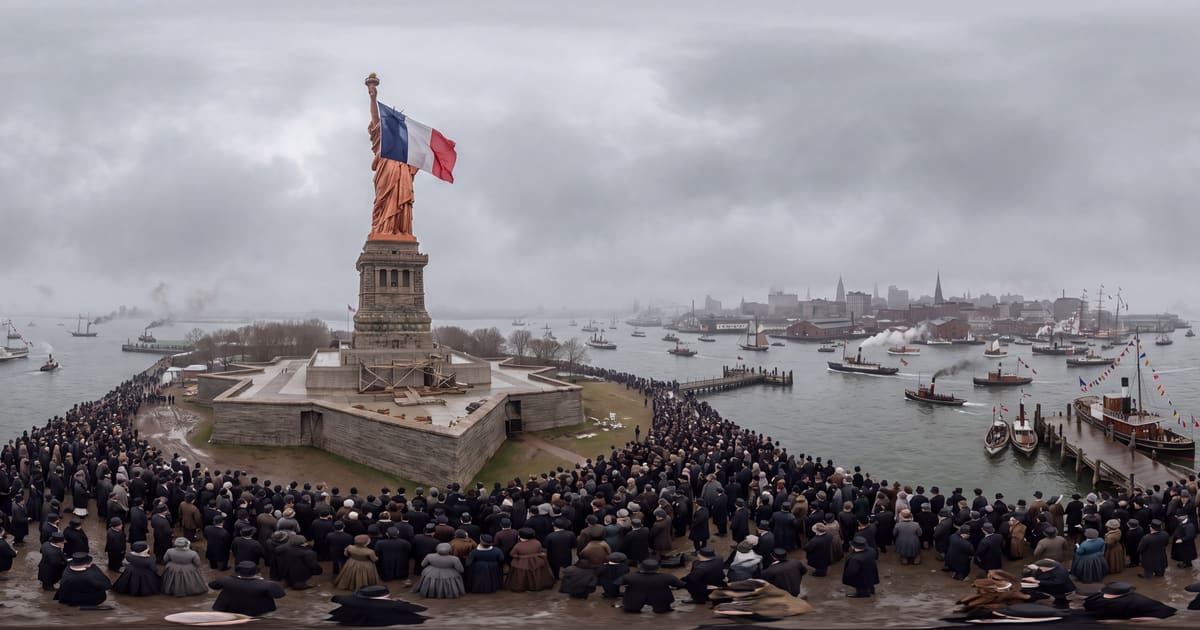
The campaign raised the remaining money from more than 120,000 donors in about five months, most giving less than a dollar apiece, finally closing a gap that formal committees and society galas had failed to close in nearly a decade. The arm returned to Paris to rejoin the completed figure, and the assembled statue, its copper skin already dulling from bright orange toward the green patina familiar today, was dedicated on Bedloe's Island on 28 October 1886.
Most donations recorded in Pulitzer's paper came in amounts under a dollar, often from schoolchildren and factory workers, a detail Pulitzer highlighted deliberately to contrast ordinary generosity against the wealthy donors he had spent months publicly criticising in his own paper's editorial columns.
What everyone says
The Statue of Liberty was a gift from the French government.
What the evidence says
It was funded by French citizens through the Franco-American Union, a private organisation, not the French state, and the pedestal was likewise paid for by private American donations rather than government funds on either side.
The arm's afterlife
The original 1876 torch, replaced during a 1980s restoration because decades of poorly designed alterations, including glass panels cut into it in 1916, had let rainwater into the statue's interior and corroded its iron armature, is now displayed in the monument's museum, the closest surviving relic of the piece that once stood alone in Madison Square Park.
Madison Square Park itself gives no obvious sign today that a bronze forearm once stood there for six years; only period photographs and newspaper accounts preserve the strange sight of a giant severed limb, taller than the surrounding brownstones, standing among the benches, gas lamps and strolling New Yorkers of the late 1870s.
The completed statue's fame quickly eclipsed the memory of its piecemeal fundraising, though the episode remains a rare example of a national monument financed largely by small public donations rather than government money, a fact often repeated whenever the statue's civic symbolism is discussed today.
How it unfolded
1875
Bartholdi's Paris workshop completes the arm and torch first.
1876
The arm is exhibited at the Centennial Exhibition in Philadelphia.
1876–1882· the scene
The scene shown here: the arm on paid display in Madison Square Park.
1884
The complete statue is formally presented to the US ambassador in Paris.
1885
Pulitzer's New York World campaign finally closes the funding gap.
28 October 1886
The assembled statue is dedicated on Bedloe's Island.