One donor rebuilds a ruin
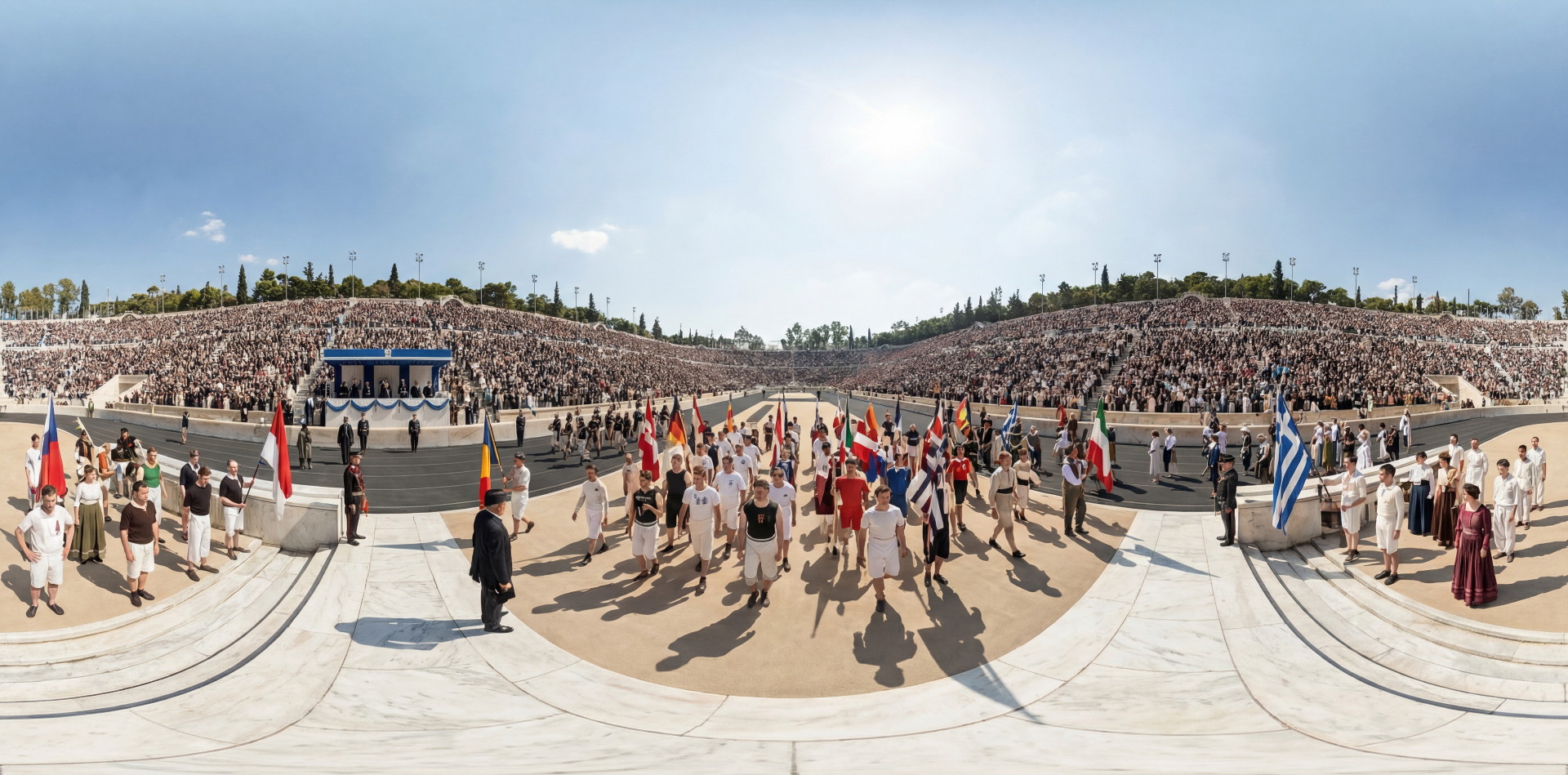
The Panathenaic Stadium had lain buried and overgrown since antiquity, its ancient marble long since stripped for other buildings, when Pierre de Coubertin's revived Olympic idea needed a Greek venue capable of housing tens of thousands of spectators. Georgios Averoff, a wealthy Greek businessman living in Alexandria who had made his fortune in cotton and grain trading, personally funded the full reconstruction in gleaming Pentelic marble, the same stone quarried on the slopes of Mount Pentelicus for the Parthenon two millennia earlier, at a personal cost that reportedly ran to well over 900,000 gold drachmas.
The rebuild kept the ancient horseshoe footprint and its unusually tight turn, a shape no modern stadium architect would choose for track events, which meant every sprint and relay ran a course that punished runners on the bend far more than a standard oval would. Architect Anastasios Metaxas oversaw the reconstruction on the same alignment as the fourth-century-BC stadium built by Lykourgos, so the 1896 track inherited dimensions dictated by ancient Athenian topography rather than by any consideration of fair modern competition.
Averoff never lived to see the Games he had funded reach their later fame; he died in 1899, three years after the opening, and a statue of him still stands outside the stadium entrance, sculpted in his honour by Georgios Vroutos. It remains a rare instance of a single private citizen's donation defining a national monument that continues to host events, from Olympic archery to civic ceremonies, more than a century after he paid for the marble that built it.
241
athletes competing, all men, from 14 nations
9 days
duration of the full 1896 Games
43
medal events contested
2:58
approximate winning time for Spyridon Louis's marathon
An amateur's games
Roughly 241 male athletes from fourteen nations competed across nine days, many of them travelling on their own funds with no national federation behind them and no coaching structure at all beyond whatever club they happened to belong to at home. Some competitors, including at least one American tourist, John Boland, who was visiting Europe on holiday, entered events on a whim after arriving in Athens for other reasons entirely, and Boland went on to win the tennis singles despite never having intended to compete.
There was no marathon in the ancient Games; it was invented specifically for 1896 by the French philologist Michel Bréal, inspired by the legend of Pheidippides, the messenger said to have run from Marathon to Athens with news of victory before collapsing dead. A Greek water carrier named Spyridon Louis, running his first competitive race of any distance, won it in just under three hours in front of a home crowd desperate for exactly that outcome after two Greek runners had already dropped out.
Timing and measurement were inconsistent by later standards: some events used hand-held stopwatches read to the nearest fifth of a second, judges disagreed openly at the trackside, and a few results, including the closely run 100 metres, were disputed for decades afterward because officials from different nations recorded times and finishing order differently at the tape, with no photographic evidence to settle the argument.
Zito Ellas! Zito Louis!
Silver for gold, and a false start on scale
Winners received a silver medal, a crown of olive branches cut from a sacred grove at Olympia, and an engraved diploma; runners-up got a bronze medal and a sprig of laurel, while third place received nothing at all under the original rules. Solid gold medals for first place did not arrive until the 1904 St Louis Games, making the now-famous gold, silver and bronze colour scheme a later invention rather than an original Olympic tradition Coubertin himself designed.
Coubertin had hoped the Games would rotate modestly between nations every four years; instead the Athens organisers, flush with the success of the opening festival and Averoff's marble stadium, pushed hard through the Greek press to keep the event permanently anchored in Greece as its spiritual home. That plan lost out to Coubertin's insistence on international rotation, though Athens got a consolation Intercalated Games in 1906 and hosted the full Olympics again in 2004.
King George I of Greece reportedly proposed making Athens the permanent host during his closing-ceremony address, a suggestion that drew loud, sustained public support inside the packed marble stadium but was quietly overruled by Coubertin's fledgling International Olympic Committee within months, its members determined to keep the Games moving between capital cities to build broader international backing for the revival.
What everyone says
Olympic winners have always received gold medals.
What the evidence says
The 1896 champions received silver medals and an olive wreath; solid gold-topped medals were not introduced until the 1904 Games in St Louis, and even those were largely silver gilt rather than solid gold.
A marble bowl still in use
The Panathenaic Stadium hosted archery events during the 1906 Intercalated Games, held partly to reassert Athens's claim on the Olympic tradition, and, nearly a century after that, the finish of the marathon and the archery competitions at the 2004 Athens Olympics, making it one of the only ancient athletic venues on earth still functioning, on and off, for the sport it was originally rebuilt to host.
Its roughly 50,000 marble seats, carved and fitted without mortar in the ancient dry-stone technique Averoff insisted his masons revive rather than modernise, remain part of the largest structure made almost entirely of marble anywhere in the world, a fact tour guides still cite as proof of the reconstruction's fidelity to methods the original Athenian builders would have recognised.
Spyridon Louis became a national hero overnight and was reportedly offered gifts ranging from free meals for life at Athenian tavernas to a bride's dowry and free haircuts for a decade; he mostly declined them, choosing instead to return to farming and water-carrying in his home village of Maroussi, before returning to the same marble stadium in 1936, aged 63, to carry the Olympic flag ahead of the Berlin Games torch relay.
How it unfolded
1894
Coubertin's Paris congress votes to revive the Olympics, choosing Athens first.
1895
Georgios Averoff funds the Panathenaic Stadium's marble reconstruction.
6 Apr 1896· the scene
Opening ceremony before King George I of Greece.
10 Apr 1896
The inaugural marathon; Spyridon Louis wins to a roaring home crowd.
15 Apr 1896
The scene here: closing ceremonies in the finished stadium.
2004
The stadium hosts archery and the marathon finish at the Athens Olympics.