1600 – 1799 · 8 documented scenes
Age of Exploration & Revolution Game
Two centuries where the whole world starts arriving in one port.
Between 1600 and 1799 the visual record gets crowded. Ports fill with rigging, cargo starts coming from four continents at once, uniforms become standardised enough to identify at a glance, and the first industrial machinery appears in landscapes that still look agricultural. Every one of those is a dating clue, and this run puts five of them in front of you with nothing written down.
It is the band where place and date stop being separate problems. A wharf stacked with sugar barrels, a fort with angled bastions, a crowd around a printing press — each says something about *where* that constrains *when*, and vice versa. Players who do well here guess the trade route first and the year second.
5 rounds · free · no account needed · 5 scenes from Exploration & revolution
8
Scenes in the band
5
Rounds per run
1600 – 1799
Years covered
How a exploration & revolution round works
- 1
Look around the scene
Every round opens inside a 360° panorama of a real moment. Drag to turn, zoom in on anything that looks datable. There is no caption, no title and no year anywhere on screen.
- 2
Drop a pin, then pick a year
Place your guess on the world map and set the year on the slider — arrow keys nudge a year at a time, the century arrows jump a hundred. Both halves are scored, so a perfect year with the wrong continent still loses points.
- 3
See what dated it
The result screen shows the true place and year, the distance you were out, and the detail in the scene that gives the date away. That explanation is the part that makes the next round easier.
How to date a exploration & revolution scene
Rig and hull say which century
High-castled galleons with heavy stern carving are seventeenth century. Flush-decked frigates and sleek merchantmen with long bowsprits are eighteenth. Copper sheathing below the waterline only appears after the 1760s, and a paddle or funnel of any kind puts you past this band entirely.
Fortifications go from tall to flat
Once cannon become reliable, walls stop being high and start being angular: low earth-backed ramparts, arrowhead bastions and ditches designed to catch crossfire. A star fort with sloped glacis is a seventeenth or eighteenth century military engineer's work, and its geometry is often the most precisely datable thing in the scene.
Look for the first machine
A waterwheel is ancient; a beam engine house with a chimney is not. Any brick engine house, iron bridge or multi-storey mill in an otherwise rural view drags the date into the last third of the century. So does a canal with cut-stone locks — those are the 1760s onwards in Britain.
Hang your guess on the political calendar: the Thirty Years' War ends in 1648, the Seven Years' War runs 1756–63, American independence is declared in 1776 and the Bastille falls in 1789. Uniforms, flags and crowd scenes in this band are usually within a few years of one of those.
The 8 scenes this run draws on
Every one is a documented moment with a verified place and year. A run deals 5 of them in random order, so no two sessions are the same.
- the United Kingdom collection
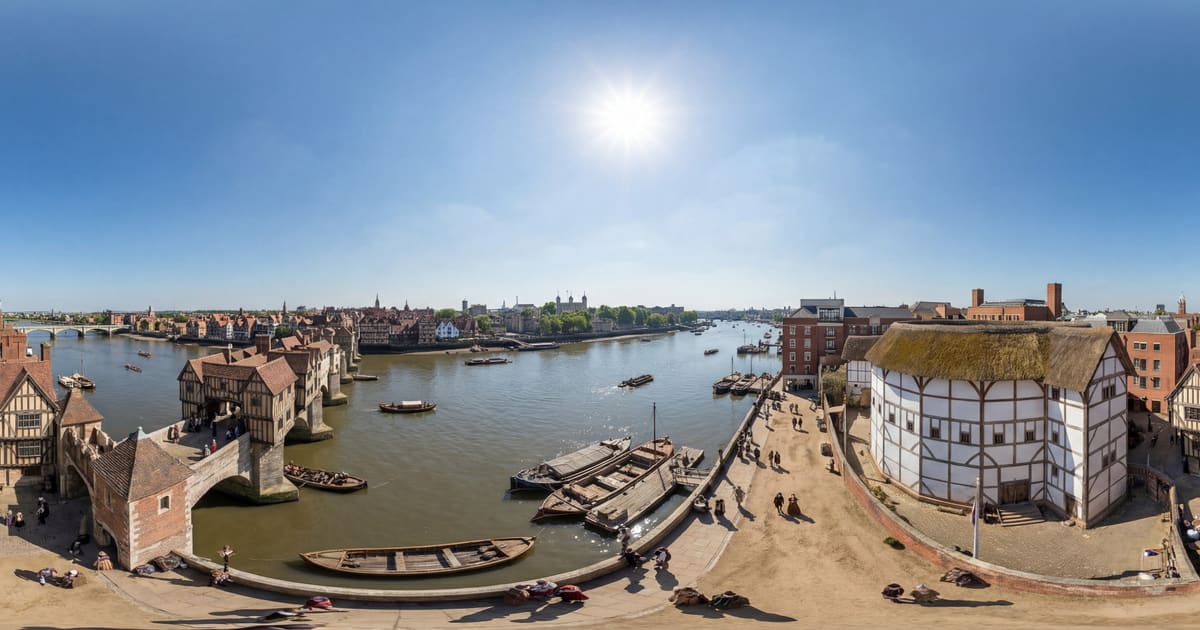
1600Shakespeare's Globe Theatre, London
Bankside, Southwark, London, England
- the United States collection
1620Mayflower Landing at Plymouth Rock
Plymouth harbour, Cape Cod Bay, Massachusetts
- the United States collection
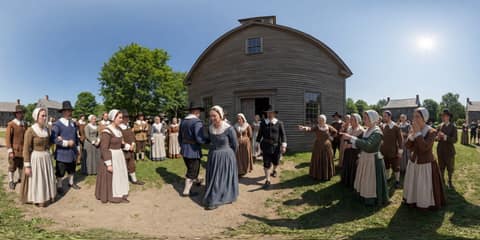
1627Plymouth Colony Settlement
Plymouth Colony, Massachusetts
- the United Kingdom collection
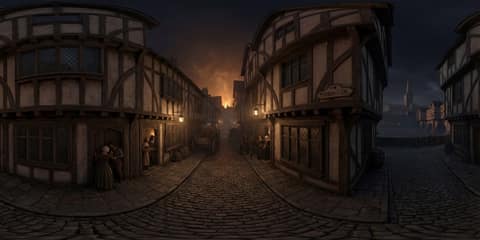
1666Great Fire of London at Pudding Lane
Pudding Lane, City of London, England
- the United States collection
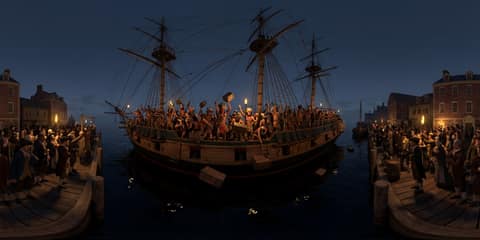
1773Boston Tea Party
Griffin's Wharf, Boston, Massachusetts
- the United States collection
1776Washington Crossing the Delaware
McConkey's Ferry on the Delaware River, Pennsylvania
- France collection
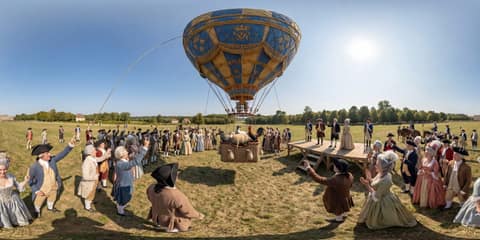
1783Montgolfier Brothers' First Animal Flight at Versailles
Palace of Versailles, France
- Egypt collection
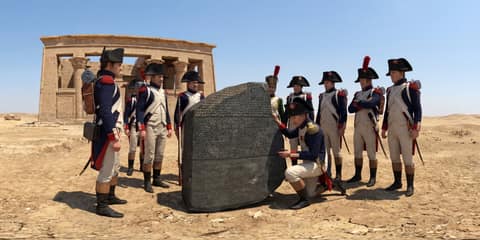
1799Discovery of the Rosetta Stone
Fort Julien, near Rashid (Rosetta) in the Nile Delta, Egypt


Age of Exploration & Revolution Game — common questions
- What does this run cover?
- Scenes dated 1600 to 1799: voyages and trading ports, colonial settlements, the revolutions at both ends of the Atlantic, and the earliest industrial sites. Five rounds per run, each a 360° panorama of a documented moment with a verified place and year.
- Is it about exploration only?
- No. Exploration is the headline because it is what the period is searched for, but the same two centuries carry the scientific revolution, plantation economies, the American and French revolutions, and the first factories. A run mixes them rather than serving five voyages.
- How do I tell 1650 from 1750 in a street scene?
- Windows and roofs. Small leaded panes in heavy timber frames are earlier; large sash windows in regular brick façades are Georgian and eighteenth century. Pavements, street lighting and uniform building lines all point the same way — towards the later date.
- Can I play only this era every time?
- Yes. This page's play button always deals from the same band, so you can run it repeatedly to drill the period. The scene order is reshuffled each time, and if the band runs short a run is topped up with the nearest scenes in date order — the game says so on the HUD rather than pretending.
- Where can I read about these moments?
- Every scene in the library that has a write-up links to a full article with the clues that date it, the numbers behind it and what happened next. The list further down this page links straight to them.
Keep going with this era
Countries in this band
Every era run
Prefer a mixed run? The main game deals from every era at once, and all the free history games are listed in one place.