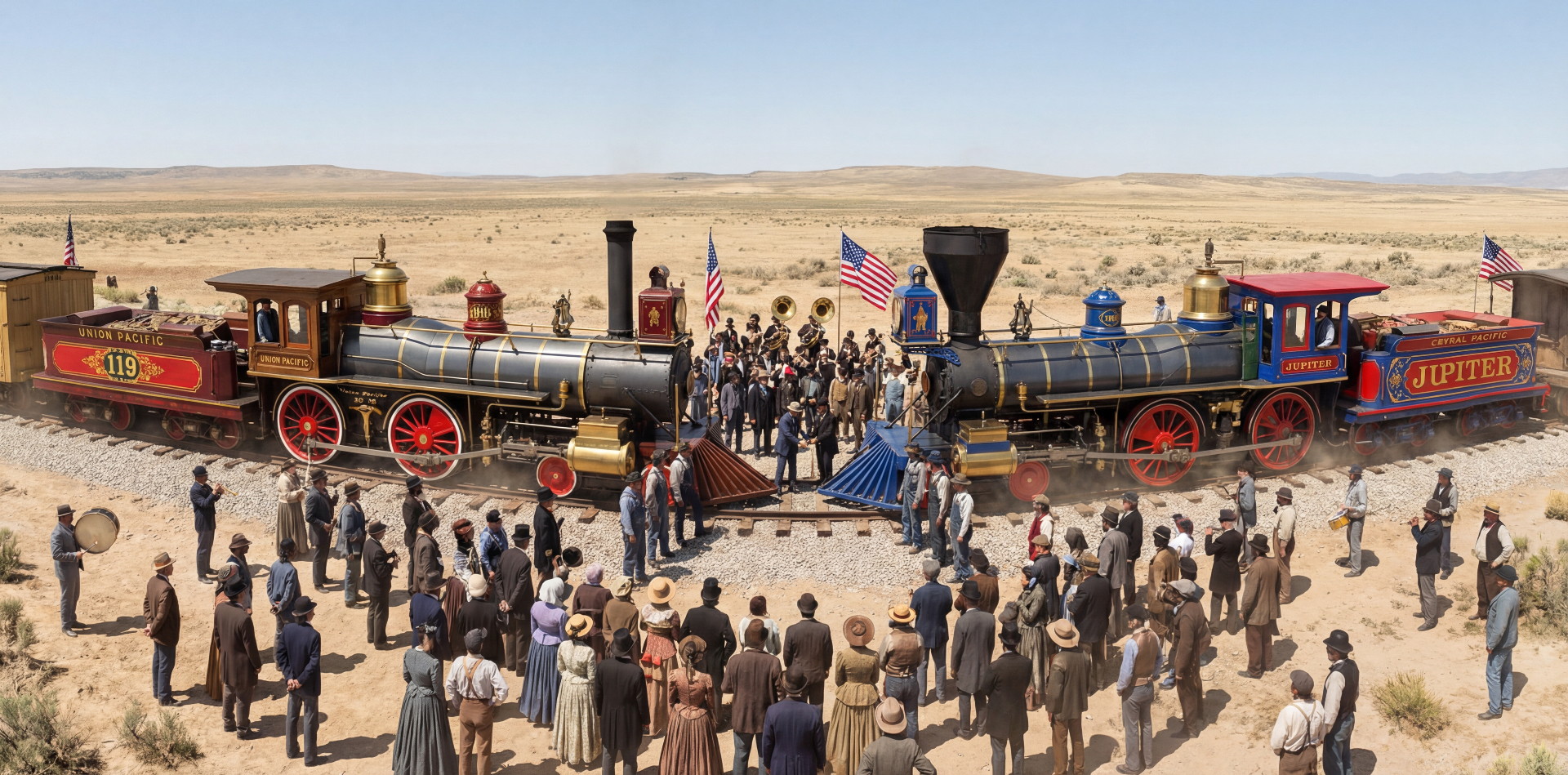
A race with no finish line
The 1862 Pacific Railway Act paid the Union Pacific and Central Pacific by the mile, with no fixed meeting point specified, so both companies kept grading track past each other across Utah in early 1869, in some stretches building parallel embankments a few hundred yards apart. Congress had to step in and fix Promontory Summit as the junction.
Central Pacific crews, roughly 15,000 of them Chinese immigrants by the project's peak, had already forced the harder half of the job: blasting and hand-drilling through the granite of the Sierra Nevada in winter, sometimes digging snow tunnels forty feet deep just to reach the rock face and keep working through blizzards that buried entire camps. Union Pacific crews, largely Irish immigrants and Civil War veterans, crossed easier plains but at their own frantic pace, laying track fast enough that the two companies together built roughly 1,912 miles between them, with the Central Pacific alone accounting for about 690 of the hardest and most expensive miles through mountain terrain.
Both companies had every financial incentive to keep laying track regardless of need, since government bonds and land grants were awarded per mile completed; the resulting overbuilding through Utah cost time and money neither company ever fully recovered once the true junction point was settled, with several miles of duplicate grading simply abandoned once Congress named Promontory the official meeting place. Union Pacific and Central Pacific negotiators finally met and settled the dispute privately in April 1869, weeks before the ceremony itself, agreeing to the Promontory site only after both sides realised Congress would otherwise settle it for them on less favourable terms.
1,912 mi
combined length of the two railroads' track
~15,000
Chinese labourers on the Central Pacific's Sierra crews
6 days
typical coast-to-coast travel time after the line opened
1
word telegraphed to trigger nationwide celebrations
One word, sent twice
On 10 May 1869 officials drove ceremonial spikes of gold and silver into a polished laurel tie, wired to telegraph the blows live; both railroad presidents reportedly missed the final swing, and the actual last iron spike was driven by a regular workman afterward. Telegraph wires had been connected directly to the ceremonial sledgehammer and spike so that each blow, or missed blow, would register instantly on lines running to both coasts. The operator sent a single word, 'DONE', regardless of the fumbled swings the crowd had actually just watched.
That signal triggered coordinated celebrations timed to arrive simultaneously: cannon fire in San Francisco, church bells in Chicago, and a parade in New York, all set off by one wire from a stretch of desert most Americans could not have located on a map.
Leland Stanford of the Central Pacific and Thomas Durant of the Union Pacific led the ceremony, though accounts from the crowd describe a fairly disorganised occasion, with speeches delayed and the crucial telegraph line itself briefly malfunctioning before the historic word finally went out, forcing the operator to send a preparatory signal warning cities to stand by while the ceremony itself ran late. Durant had reportedly been feeling unwell after being briefly kidnapped by disgruntled unpaid workers days earlier near Piedmont, Wyoming, an incident resolved only once his company wired the missing wages ahead to release him in time for the ceremony.
DONE
A photograph with a deliberate omission
The famous photograph of workers toasting champagne between the two locomotives, Jupiter and No. 119, includes almost no Chinese labourers, despite the roughly 15,000 who had done the bulk of the Sierra work. Some accounts suggest they were asked to step out of frame.
The completed line cut a coast-to-coast journey that had taken four to six months by wagon or sea route down to about a week, transforming migration, freight and the pace of American westward settlement almost overnight. Settlers, cattle, mail and manufactured goods that had once moved at the pace of oxen now moved at the pace of a scheduled timetable, reshaping the economics of everywhere the line touched.
Freight rates on staple goods fell dramatically within a few years of the line opening, and towns along the route that had barely existed before the railroad, including Promontory itself, briefly boomed on construction traffic before fading once the workforce moved on, leaving little more today than a small visitor centre and the graded roadbed where the ceremony actually took place.
What everyone says
The golden spike physically joined the two railroads.
What the evidence says
The gold and silver spikes were ceremonial and removed immediately after the photographs, replaced by an ordinary iron spike driven by a workman. The golden spike itself is now held by Stanford University, not embedded anywhere in Utah.
What Promontory left behind
Promontory Summit's importance as a junction lasted barely a few years; a shorter route across the Great Salt Lake built in 1904 bypassed it entirely, and the original rails through the site were pulled up for scrap during the Second World War.
Recognition of the roughly 15,000 Chinese workers who built the Central Pacific's hardest miles grew slowly, with formal commemorations, museum exhibits and additions to the historical record only becoming common in the late twentieth century, more than a hundred years after most of those labourers' individual names had gone unrecorded in the company's own payroll ledgers.
Golden Spike National Historical Park now operates working replica locomotives, Jupiter and No. 119, on the restored original grade each summer, re-enacting the ceremony on the same stretch of graded desert each May, drawing visitors who arrive by the same kind of long-distance travel the original railroad made possible.
How it unfolded
1862
The Pacific Railway Act authorises two companies to build toward each other.
Winter 1866–67
Central Pacific crews tunnel through the Sierra Nevada in deep snow.
Spring 1869· the scene
Parallel grading past each other forces Congress to fix a meeting point.
10 May 1869
The scene shown here: the golden spike ceremony at Promontory Summit.
1869 onward
Coast-to-coast rail travel collapses from months to about a week.
1904
A causeway route across the Great Salt Lake bypasses Promontory for good.