A mission never meant to hold an army
San Antonio de Valero had been a Franciscan mission for a century before anyone thought to fight from it. Its walls were built to keep livestock in and raiders out, not to withstand artillery. When Texian forces occupied it in late 1835, they spent weeks throwing up earthen ramps and gun platforms, including the emplacement for the eighteen-pounder on the southwest corner, just to make the compound defensible at all.
Santa Anna arrived on 23 February 1836 with a force several times the defenders' number and ran up a flag signalling no surrender terms would be offered. Travis is said to have answered with a shot from the eighteen-pounder cannon mounted on the southwest corner, the largest gun inside the walls and the one the garrison relied on most heavily through the siege that followed.
Command inside the walls was uneasy from the start, split between William Travis, a young regular army lieutenant colonel, and Jim Bowie, leader of the volunteer militia. Bowie fell seriously ill within days of the siege beginning, leaving Travis effective sole command for most of the thirteen days that followed, though Bowie continued issuing orders from his sickbed until he was too weak to be moved from the barracks.
13 days
length of the siege before the final assault
~200
defenders inside the walls, by most estimates
32
reinforcements who reached the Alamo from Gonzales
18 min
length of the decisive Battle of San Jacinto that followed
Thirteen days of waiting for reinforcements that never came
Travis sent riders out repeatedly, most famously the letter of 24 February addressed 'To the People of Texas and All Americans in the World', pledging to hold the fort or die rather than surrender or retreat. A relief company of around 32 men from Gonzales did slip through the lines on 1 March, the only reinforcement to arrive.
Everyone else Travis appealed to — commanders with troops closer at hand than Santa Anna's own supply lines — judged the position unwinnable and stayed away, a calculation that in hindsight was almost certainly correct, given how completely the Mexican army had already encircled the town by the time most of those appeals were read.
Santa Anna, meanwhile, tightened the siege methodically, moving his artillery closer each night and subjecting the walls to bombardment that, while rarely lethal on its own, exhausted the defenders and denied them sleep in the days before the final assault, a deliberate tactic that left the roughly two hundred defenders physically depleted long before the Mexican columns actually moved.
I shall never surrender or retreat... I am determined to sustain myself as long as possible and die like a soldier who never forgets what is due to his own honor and that of his country.
The assault and what it bought
The final attack came before dawn on 6 March, when Mexican infantry advanced in four columns under cover of darkness toward walls too long and too low for two hundred men to hold everywhere at once. Defenders fired the eighteen-pounder and their muskets into the advancing lines until the columns broke through, and the fighting moved room to room inside the compound; it was over within about ninety minutes.
Santa Anna lost thirteen days and hundreds of men taking a position of no real strategic value, time Sam Houston used to organise and train the army that trapped and defeated him at San Jacinto barely six weeks later, on 21 April, ending the war in a rout that lasted only about eighteen minutes.
Mexican losses in the final assault alone are usually put at several hundred, a toll high enough that Santa Anna's own officers privately questioned the cost of storming a mission garrison rather than simply starving it into surrender, given how few defenders remained capable of offering serious resistance by dawn and how little the position itself was actually worth holding.
What everyone says
Every defender died fighting to the last man on the walls.
What the evidence says
Most accounts, drawn from Mexican officers' reports and the testimony of survivors like Susanna Dickinson, describe a handful of defenders, possibly including Davy Crockett, being captured and executed after the fighting stopped rather than dying in combat.
What the walls became afterward
News of the fall spread through Texas alongside exaggerated and accurate accounts alike, carried in part by Susanna Dickinson herself, and 'Remember the Alamo' became the rallying cry Houston's smaller army carried into San Jacinto six weeks later, turning a military defeat into the war's defining slogan.
The mission compound itself passed through decades of neglect, military use as an army quartermaster depot, and partial demolition before preservation efforts in the late nineteenth century secured the surviving church building, which today stands in the middle of modern downtown San Antonio, dwarfed by the office towers built up around it.
Susanna Dickinson, the wife of an artillery officer and one of the few survivors sent by Santa Anna to carry word of the defeat to Sam Houston, gave testimony that remains one of the primary eyewitness accounts historians still rely on for what happened inside the walls that night, describing the final minutes of fighting and the fate of several defenders in detail she repeated consistently, with only minor variations, for decades afterward.
How it unfolded
23 February 1836· the scene
Santa Anna's army arrives and raises the no-quarter flag.
24 February
Travis writes his appeal 'To the People of Texas and All Americans'.
1 March
The Gonzales relief company slips through the siege lines.
5 March, night
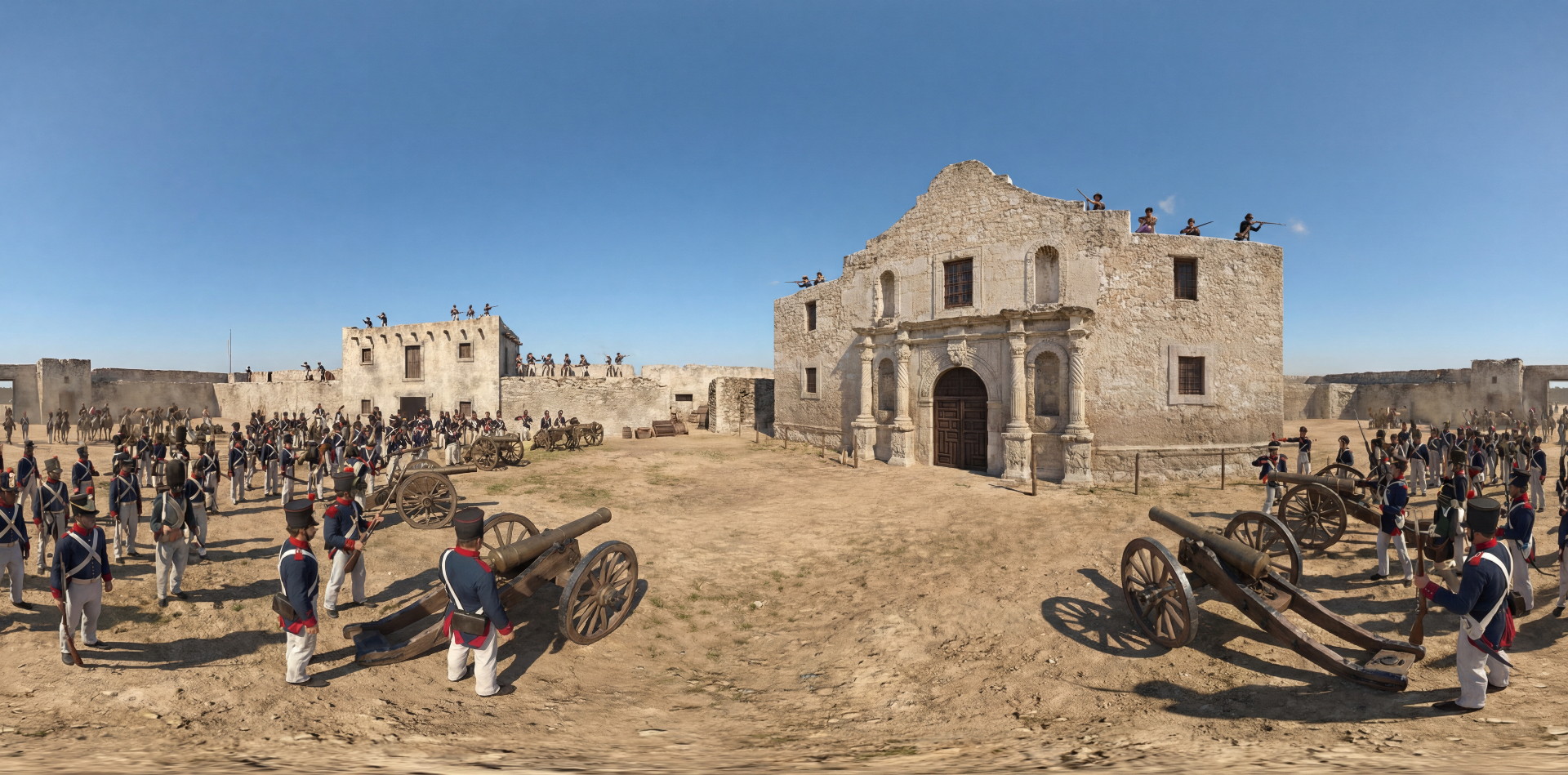
The scene shown here — defenders holding the walls under bombardment.
6 March, dawn
The final assault; the compound falls within about ninety minutes.
21 April 1836
Houston's army defeats Santa Anna at San Jacinto, securing independence.