An engineer's answer to a centenary
France wanted a centrepiece for the 1889 Exposition Universelle marking a hundred years since the Revolution, something that would outdo anything built for a previous world's fair. Gustave Eiffel's company won the commission with a design largely worked out by two of his engineers, Maurice Koechlin and Émile Nouguier, refined for aesthetics by the architect Stephen Sauvestre. Eiffel kept a private apartment for himself on the third floor, furnished plainly, where he received guests including Thomas Edison rather than pretending the tower was purely a technical exercise.
Eiffel chose wrought iron over the newer steel deliberately: puddled iron from the Pompey works had decades of known, predictable behaviour under wind load, which mattered more to him than novelty on a tower nobody had built at this height before. Levelling the four legs onto a single horizontal plane required hydraulic jacks capable of adjusting each foundation independently, since the site's slight slope toward the Seine meant the piers could not simply be poured to a uniform height.
The competition brief specified a base measuring 125 metres square, and more than a hundred designs were submitted before Eiffel's engineers won, partly because their curved, wind-tapered profile solved the load problem more elegantly than the rival plans, several of which proposed a simple rigid pyramid. Visitors who reach the top today still climb past 1,710 steps in total from ground level, though lifts have carried the overwhelming majority of tourists since opening day.
18,038
individual wrought-iron pieces in the structure
2.5m
rivets holding the tower together
2 yrs, 2 mo
construction time, start to opening
300m
original height, tallest structure on Earth until 1930
The letter of the three hundred
Before construction finished, a group of prominent writers and artists — including Charles Gounod, Guy de Maupassant and Alexandre Dumas fils — published a protest in Le Temps denouncing the 'odious column of bolted sheet metal' rising over Paris. Maupassant reportedly ate lunch in the tower's restaurant afterward, he said, because it was the one place in the city from which he could not see it.
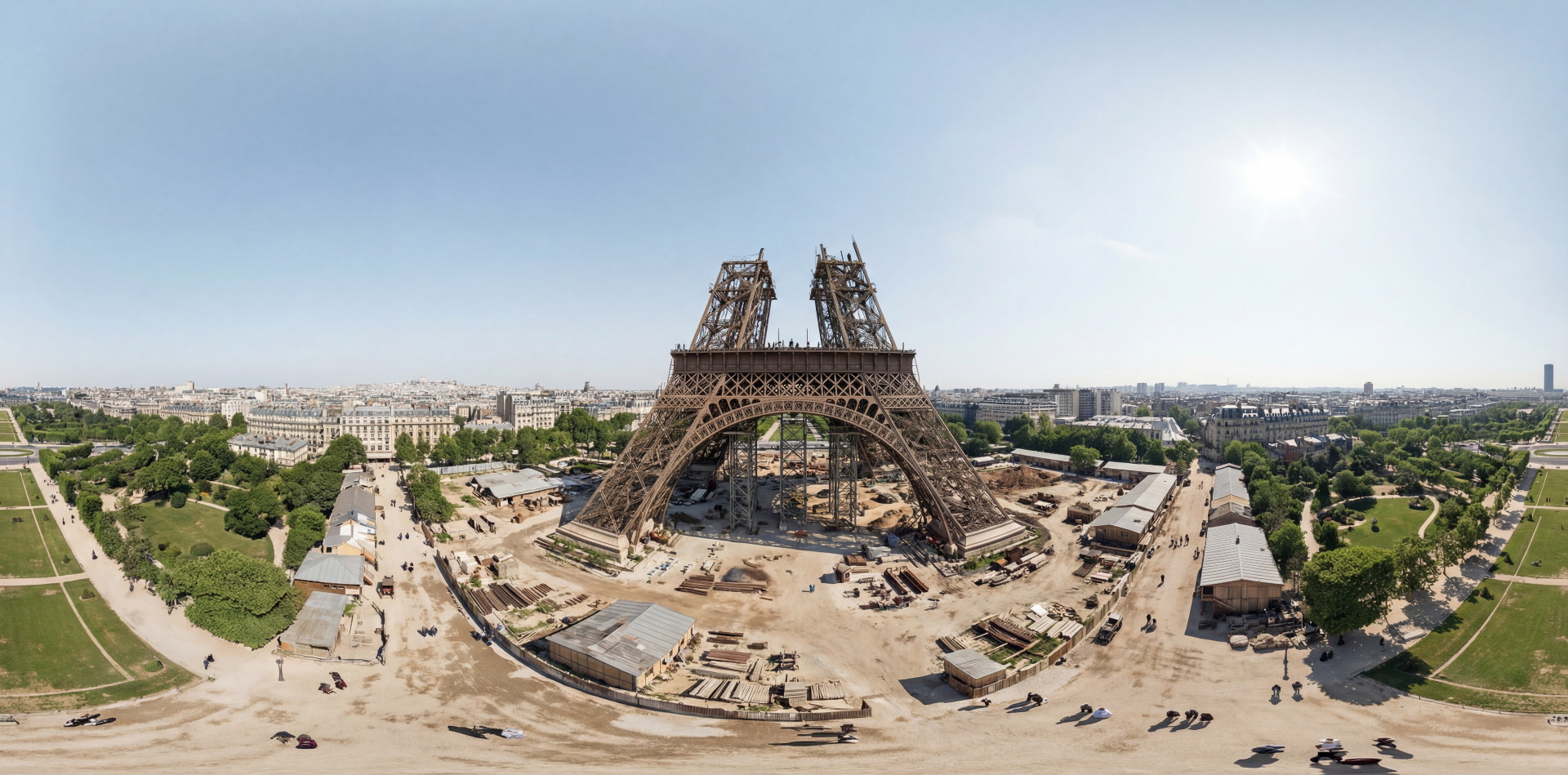
The tower went up anyway, in two years, two months and five days, using prefabricated components assembled with extraordinary precision: components were built to tolerances of a tenth of a millimetre so that on-site riveting would go smoothly at height. Around three hundred steelworkers assembled the pieces, many of them experienced ironworkers recruited from French bridge-building crews rather than novices, which contemporaries credited for the project's unusually low casualty rate.
Only one worker died during construction, and he was off duty at the time, a remarkably low toll for a project of this height and era, attributed by contemporaries to Eiffel's insistence on guardrails, screens and movable stagings, safety measures unusual enough at the time to draw comment from visiting engineers.
This truly tragic lamppost.
Saved by the wireless
The city's permit for the tower ran twenty years, after which it was meant to be dismantled and sold for scrap. Eiffel spent the intervening years promoting it for scientific use — meteorology, aerodynamics, and above all radio — and by the time the permit lapsed in 1909, the tower had become indispensable as a transmission antenna.
It kept that role through the First World War, when French military intelligence used tower-relayed transmissions to help intercept German communications, reportedly contributing to the case against the spy Mata Hari. No demolition order was ever seriously pursued again, and the two hydraulic lift companies, including an Otis Elevator contract that had drawn xenophobic complaints about American machinery running a French monument, kept operating largely unchanged for decades.
Eiffel also used the tower himself for scientific experiments, dropping objects from its upper platform to study air resistance and installing a wind tunnel laboratory at its base in 1909, work that fed directly into early French aeronautical research.
What everyone says
Parisians loved the tower from the start.
What the evidence says
Serious cultural figures campaigned against it before it was even finished, and it was widely mocked as an eyesore through the 1890s. Public affection grew gradually, helped considerably by the tower's usefulness for radio rather than any change of aesthetic heart.
A landmark that outgrew its critics
By the time of the 1900 Exposition, only eleven years after the protest letter, the tower had become the fair's central attraction, drawing visitors who a decade earlier had signed petitions against its existence, a reversal Eiffel himself noted with some satisfaction in later interviews. Otis lifts installed in the two front legs, controversial at first for being American-built machinery on a French national monument, carried the bulk of visitors to the upper platforms and remain in continuous operation today, regularly modernised behind their original cladding.
It now draws roughly seven million visitors a year, more than any other paid monument on Earth, and has been repainted some twenty times in a distinctive bronze shade chosen specifically to read correctly against the Paris sky in different seasons.
The tower's survival past its original twenty-year permit is now treated as the model case for adaptive reuse in engineering history: a structure justified on utilitarian grounds that became, almost by accident, the enduring symbol of the city that once wanted it gone.
How it unfolded
1884
Koechlin and Nouguier sketch the initial design in Eiffel's office.
Jan 1887
Construction begins on the Champ de Mars.
Feb 1887
The protest letter of the three hundred is published in Le Temps.
31 Mar 1889· the scene
The scene here: Eiffel raises the French flag atop the finished tower.
6 May 1889
The Exposition Universelle opens to the public.
1909
The original demolition permit lapses; the tower stays for its radio antenna.