A father's calculation kills him first
John Roebling surveyed the crossing himself in 1869, standing on a ferry piling when a boat crushed his foot. He refused to have the toes amputated, treating the wound himself with a water cure, and died of tetanus three weeks later, before a single caisson had gone into the river. His son Washington, chief engineer at thirty-two, inherited a design that had never been built at this scale in wire-rope suspension, along with a grieving family and a board of trustees uncertain whether the son could finish what the father had only sketched.
The caissons were the real danger. Compressed-air chambers sunk to bedrock let men dig in dry conditions fifty feet under the East River, but nobody yet understood what the pressure did to a body brought up too fast. Washington himself was disabled by it in 1872, watching the rest of the build through a spyglass from a Brooklyn Heights window.
At least a hundred men worked the caissons on any given shift, laying brick and digging through quicksand and boulders by candlelight in air thick enough to make matches burn oddly. Foremen called the crippling pain that followed decompression 'the bends', a term that stuck in medical usage long after the bridge was finished. A supplier named J. Lloyd Haigh compounded the danger separately, secretly substituting inferior, weaker wire for the cable strands he had contracted to deliver; the fraud was discovered only after much of it was already woven in, and engineers compensated by adding extra wire rather than tearing out what could not be recovered.
486m
main span, half again the longest suspension bridge then standing
14 yrs
from survey to opening day
5,434
parallel steel wires bundled into each main cable
20+
workers killed during construction, mostly in the caissons
Emily Roebling runs the site
For the following eleven years Emily Warren Roebling carried her husband's instructions to the engineers, learned enough stress calculus and cable mechanics to answer their questions herself, and fielded the board members who wanted Washington replaced. Contemporary accounts and later histories agree she was, in practice, running daily operations on America's largest engineering project, riding out to the towers daily while Washington tracked progress from his sickroom window with a telescope, sending notes back with her each evening on what he had observed.
She was given the honour of the first carriage ride across on opening day, 24 May 1883, carrying a rooster as a symbol of victory. Washington watched from his window again, this time by choice, too frail to stand in the crowd of some 150,000 who came out for it.
Emily had studied under professors at Columbia's School of Mines to prepare herself, and site engineers later said she could discuss stress diagrams, cable strength calculations and the specifications of steel wire as capably as any of them, a rare position for a woman to hold on any nineteenth-century construction site.
The near approach to chaos, the wild confusion, the imminent peril to life and limb, seem to trouble no one but yourself.
Twenty deaths and a stampede
At least twenty workers died building it, mostly from decompression sickness or falls; the true toll is disputed because record-keeping on immigrant labourers was patchy. Then, on Memorial Day 1883, less than a week after opening, a woman tripped on the crowded promenade stairway and screamed; the sound convinced others the bridge was collapsing, and the resulting stampede crushed twelve people to death against the railings before anyone realised there had been no structural failure at all.
P. T. Barnum's answer, in May 1884, was to march twenty-one elephants, seven camels and ten dromedaries across the deck in a publicity stunt arranged with the bridge company, settling public doubt about the structure's strength more thoroughly than any engineer's report had managed. Newspapers covered the parade as proof positive that the panic of the previous year had been baseless, and the bridge company welcomed the free advertising after months of lingering public unease.
The bridge's own chief engineer, William Kingsley, and the trustees had spent years fending off accusations of graft tied to the corrupt Tweed-era contracts that first funded the project, so a very public demonstration of safety mattered commercially as much as scientifically to the men who had staked their names on it.
What everyone says
Washington Roebling designed the bridge from his sickroom.
What the evidence says
The core design was his father John's. Washington's real contribution after 1872 was engineering judgment relayed through Emily, who visited the site daily on his behalf and became fluent enough in the calculations to be treated by contractors as the acting chief engineer.
A cathedral of cable that never fell out of use
Unlike most Victorian engineering marvels built for a single era's traffic, Brooklyn Bridge simply adapted: horse carriages gave way to trolleys, then automobiles, then the roughly 100,000 vehicles and thousands of cyclists and pedestrians who cross it on an average day now, still on cables inspected regularly rather than replaced.
The granite towers, quarried in Maine, and the limestone approaches have needed only maintenance, not rebuilding, in over 140 years, a durability the Roeblings' generation of engineers took as a point of professional pride rather than an accident.
It was declared a National Historic Landmark in 1964, and the promenade Emily once walked to check on progress is now one of the most photographed public spaces in New York, crossed daily by people who mostly do not know her name.
How it unfolded
1869
John Roebling is injured surveying the site; he dies of tetanus weeks later.
1870
Caisson work begins; Washington Roebling takes over as chief engineer.
1872
Washington is disabled by decompression sickness; Emily takes over daily supervision.
24 May 1883· the scene
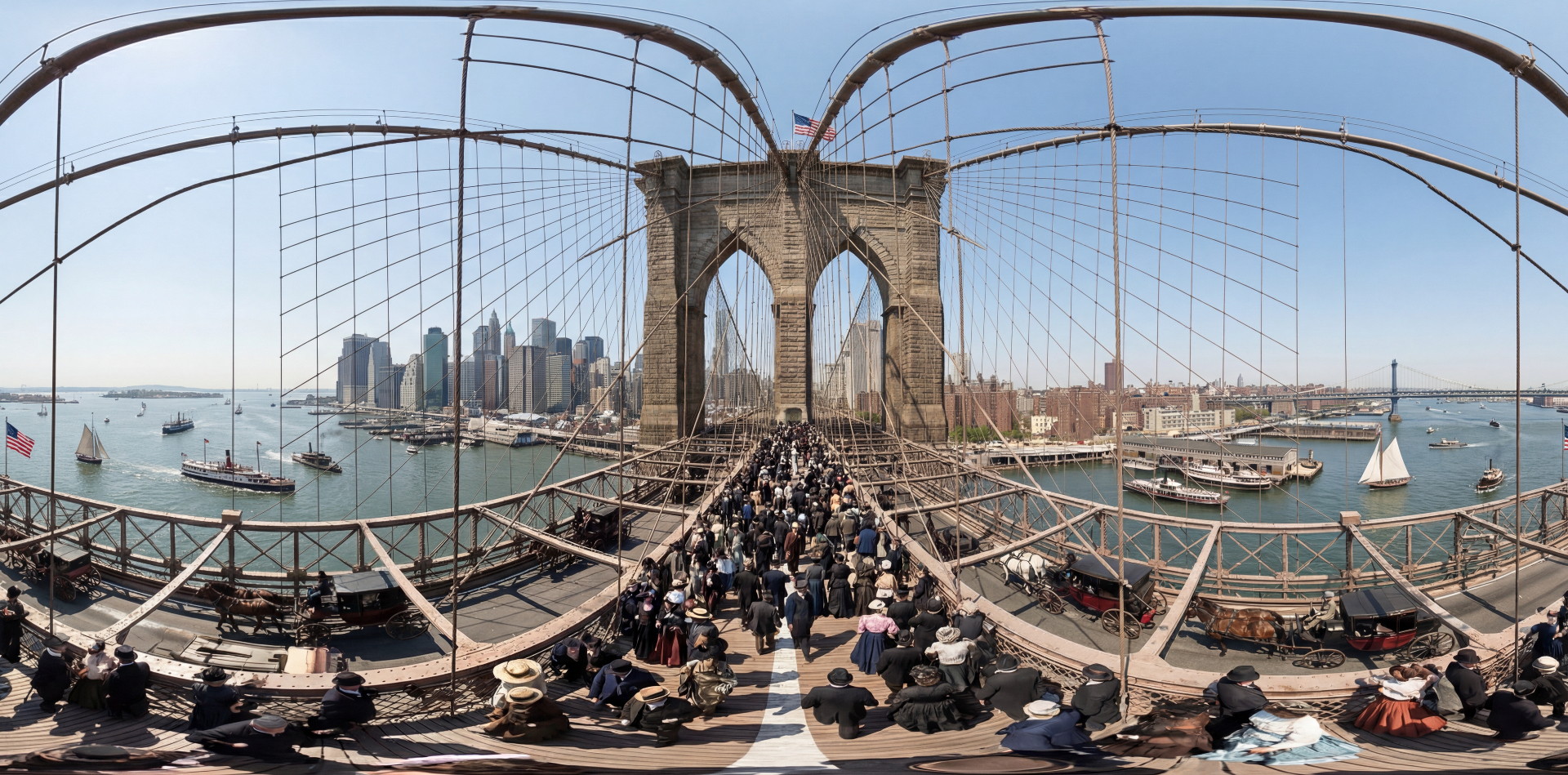
The scene here: opening day, Emily Roebling crossing first by carriage.
30 May 1883
A stampede on the crowded promenade kills twelve.
May 1884
Barnum leads twenty-one elephants across to prove the span sound.