2570 BC – AD 499 · 4 documented scenes
Ancient History Game
Five rounds drawn from the oldest scenes in the library.
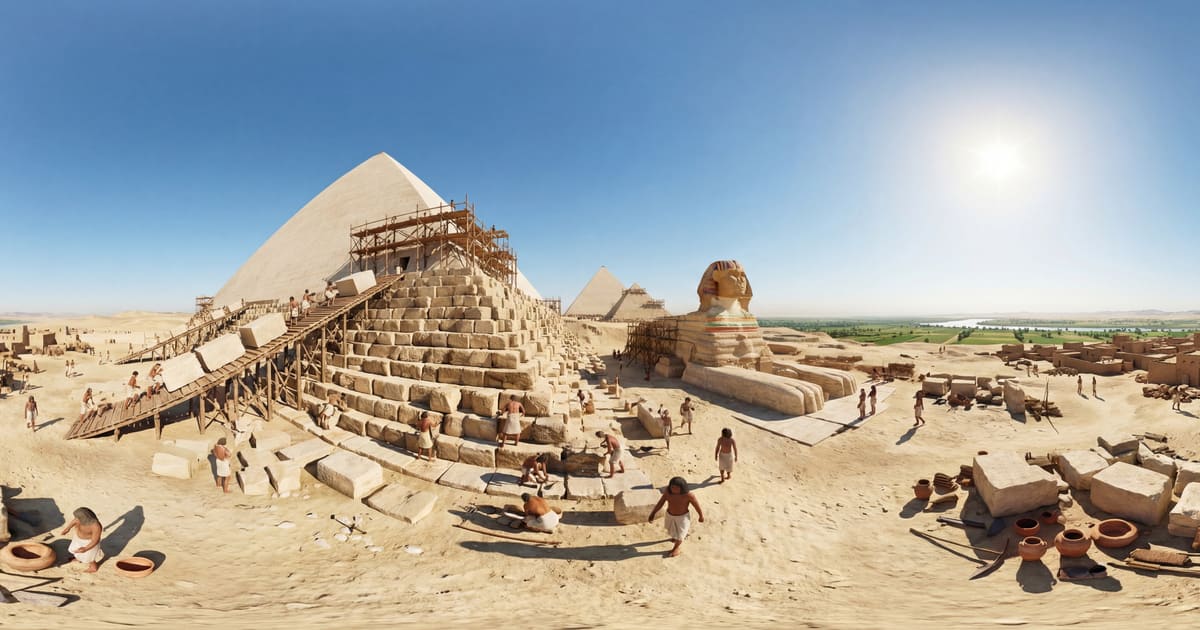
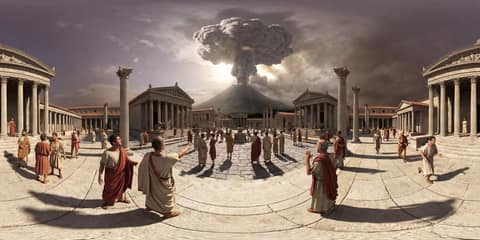
This is the ancient world with the captions removed. Each round drops you inside a 360° scene — the Giza plateau while the casing stones are still white, the Acropolis mid-scaffold, a Roman street the year before Vesuvius — and asks two questions: where on Earth is this, and what year is it? Nothing on screen tells you. The answer is in the stonework, the tools, the clothes and the skyline.
Ancient rounds punish the same mistake every time: treating three thousand years as one blurry period. Egypt's pyramids are further from Cleopatra than Cleopatra is from the Moon landing, and Periclean Athens is half a millennium older than the Colosseum. Play a few runs and the plateau stops being 'old' and starts being a date you can defend.
5 rounds · free · no account needed · 4 from Ancient & classical, then the nearest scene
4
Scenes in the band
5
Rounds per run
2570 BC – AD 499
Years covered
How a ancient & classical round works
- 1
Look around the scene
Every round opens inside a 360° panorama of a real moment. Drag to turn, zoom in on anything that looks datable. There is no caption, no title and no year anywhere on screen.
- 2
Drop a pin, then pick a year
Place your guess on the world map and set the year on the slider — arrow keys nudge a year at a time, the century arrows jump a hundred. Both halves are scored, so a perfect year with the wrong continent still loses points.
- 3
See what dated it
The result screen shows the true place and year, the distance you were out, and the detail in the scene that gives the date away. That explanation is the part that makes the next round easier.
This band holds 4 scenes, fewer than the 5 a run needs. Rather than refuse to start, a run plays every ancient & classical scene first and then the closest history to it, in date order — and the in-game header says exactly what the run contains so padding is never passed off as the era.
How to date a ancient & classical scene
The way stone is cut dates the century
Huge dressed limestone blocks, laid dry and moved by ramp, are Bronze Age Egypt. Fluted marble columns carrying a painted frieze are classical Greece. Brick-faced concrete stacked into tiers of arches only exists once Rome has hydraulic concrete, so an arcade is centuries later than a colonnade — and a dome later still.
Look for the unfinished side
Half the library's ancient scenes are construction sites, and scaffolding is the single most precise clue in the game. A monument with ramps still against it, blocks queued on sledges and a working camp beside it is being built, not visited — that narrows a pyramid or a temple from a thousand-year lifespan to the couple of decades it went up in.
Read the horizon, not the monument
The famous thing in shot is usually the thing you already half-know. The date lives at the edges: whether the Nile still runs where the causeway ends, whether the hills around Rome are farmed or built over, whether the harbour is timber or cut stone. Turn around before you guess.
Once you have the century, anchor to a build. The Great Pyramid is around 2570 BC, the Parthenon is finishing in the 430s BC, the Colosseum opens in AD 80 and Pompeii dies in AD 79 — put your year against the nearest of those and adjust by what the scene shows.
The 4 scenes this run draws on
Every one is a documented moment with a verified place and year. A run deals 5 of them in random order, so no two sessions are the same.
- Egypt collection
2570 BCConstruction of the Great Pyramid of Giza
Giza plateau, west bank of the Nile, Egypt
- Greece collection
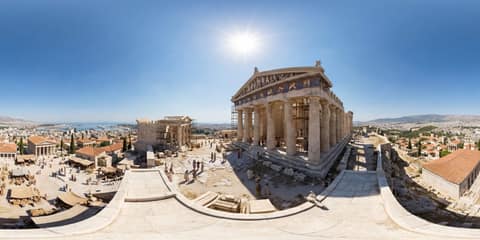
430 BCParthenon Under Construction, Athens
The Acropolis, Athens, Greece
- Italy collection
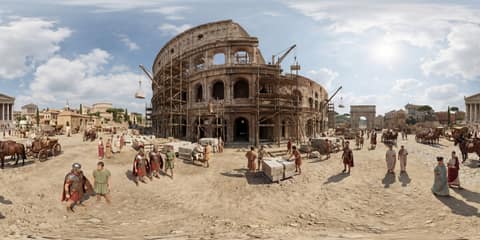
78Colosseum Construction, Ancient Rome
The Flavian Amphitheatre, Rome, Italy
- Italy collection
79Eruption of Mount Vesuvius, Pompeii
Pompeii, Bay of Naples, Italy
Ancient History Game — common questions
- What is the ancient history game?
- Five rounds of HistoryGuesser drawn only from scenes dated before AD 500. Each round is a 360° panorama of a real, documented moment with no label on it. You look around, drop a pin on the world map and choose a year; points come from how close you are on both. It runs in a browser and needs no account.
- How close does my year have to be?
- Scoring is a decay curve rather than a pass mark, so an ancient scene missed by twenty years still scores well and one missed by three centuries scores almost nothing. That is deliberate — in this period, ordering the world correctly matters far more than pinning an exact year nobody records.
- Which places show up in ancient rounds?
- The band covers Egypt, Greece, Rome and the classical Mediterranean, plus anything else in the library dated before AD 500. Every scene is a specific event — a monument going up, a city on its last ordinary day — not a generic view of a ruin as it looks now.
- Is this the same as the ancient history trivia round?
- No, and they train different things. The trivia round is multiple choice against a clock and rewards recall. This is the panorama game: no options, a map and a year slider, and it rewards observation. Most players who are shaky on the period use the trivia round to learn the order and this to practise dating.
- Can I play it with a class?
- Yes. It is free, needs no sign-in, and works projected on one screen with the room shouting guesses. The printable sheets on the classroom hub are built around the same scenes if you want the evidence written down before anyone commits to a year.
Keep going with this era
Every era run
Prefer a mixed run? The main game deals from every era at once, and all the free history games are listed in one place.