Ten years late and short of money
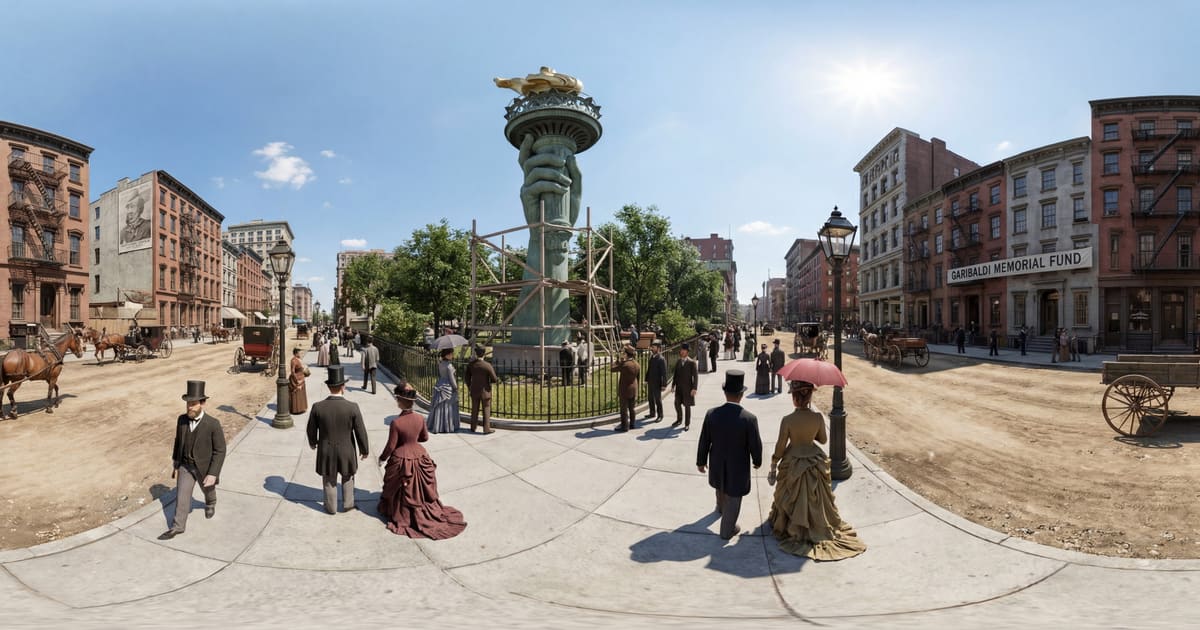
The statue was meant to mark the American centennial of 1876. Instead it took another decade to finish. Frédéric Auguste Bartholdi's design needed a vast copper skin hammered by hand in Paris, and France raised the money for it through public subscriptions, lotteries and banquets. The hand and torch were finished first and toured America to drum up support, standing in Madison Square Park for six years.
The American side had agreed to supply the pedestal, and that is where the project stalled. Wealthy donors held back, Congress refused funding and work on Bedloe's Island stopped in 1884. Joseph Pulitzer used his New York World to shame the city, promising to print the name of every donor however small the gift. More than 120,000 people gave, many less than a dollar, and the fund passed $100,000 in August 1885.
The statue had already crossed the Atlantic by then. It arrived in June 1885 aboard the French frigate Isère, packed in 214 crates, and waited in pieces for almost a year while the granite pedestal was completed.
214
crates the statue was shipped in from France
120,000+
donors to Pulitzer's pedestal fund
~300
vessels in the dedication-day flotilla
2.4 mm
thickness of the copper skin
A skin hung on Eiffel's skeleton
Inside, the statue is held up by an iron framework designed by Gustave Eiffel's firm, three years before his tower. A central pylon carries a lattice of iron bars, and flat iron straps connect it to the copper skin, which is only about 2.4 millimetres thick. The skin is not welded into one shell; each sheet hangs from the frame, so the whole surface can flex in the wind and expand in summer heat without tearing.
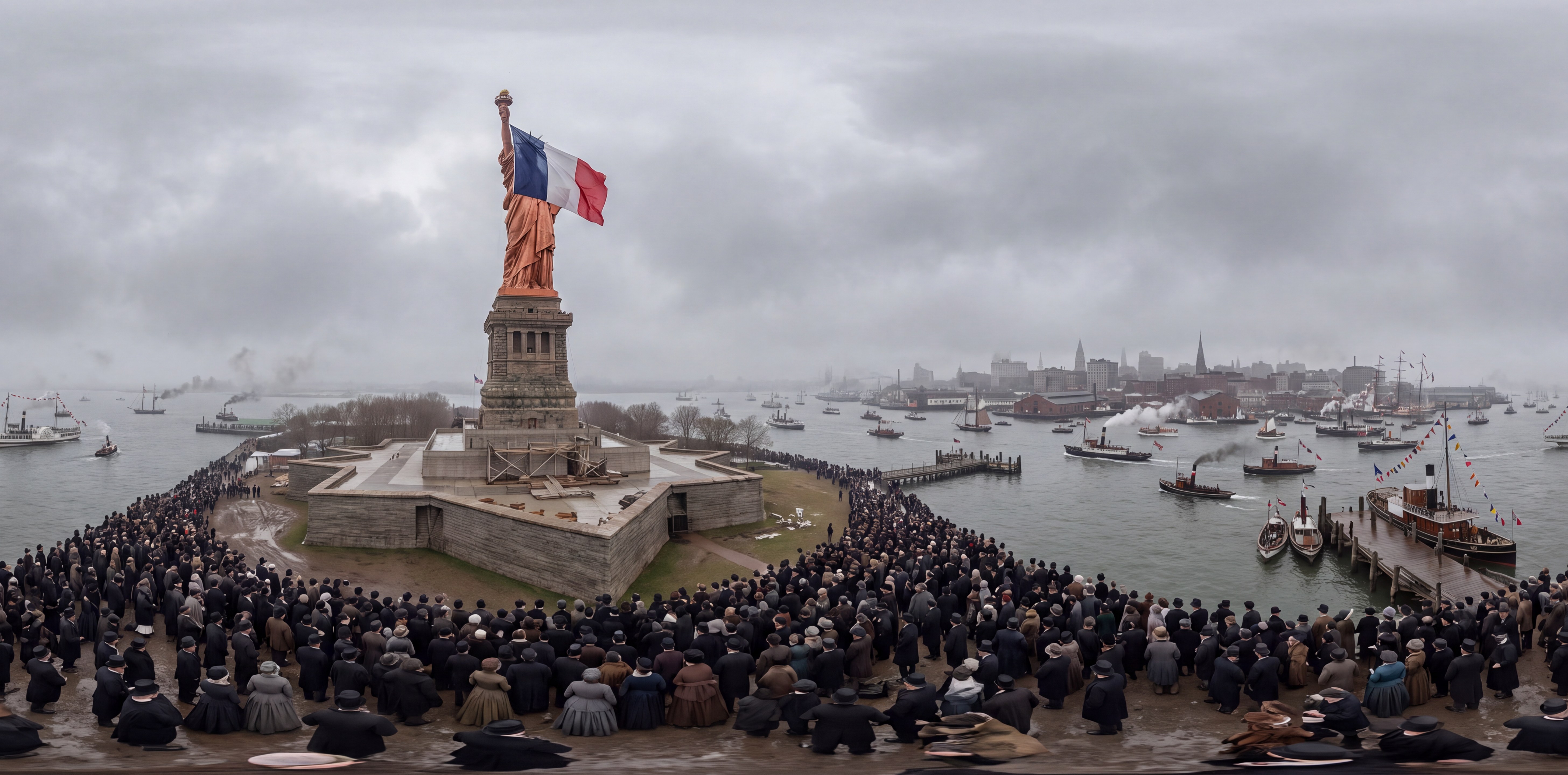
Workers riveted the 300-odd copper sheets back together on the island through the summer and autumn of 1886, without scaffolding on the outside, hanging from ropes. The finish was a warm, metallic brown. Nobody at the dedication saw the green statue we know today; that patina formed slowly over the following decades as the copper reacted with harbour air.
We will not forget that Liberty has here made her home; nor shall her chosen altar be neglected.
Dedication day in the fog
28 October 1886 was declared a holiday in New York. A morning parade wound down Fifth Avenue and Broadway, and office workers threw ticker tape from windows along the route, the first time the city greeted a celebration that way. In the afternoon a naval and civilian flotilla of around 300 ships steamed to Bedloe's Island.
Rain and fog smothered the harbour. Most of the crowd on the water could barely make out the statue. Bartholdi waited inside the head to pull the cord releasing the tricolour from its face once Senator William Evarts finished speaking. When Evarts paused, a boy on the ground signalled too soon; Bartholdi dropped the flag, the harbour erupted with whistles and gun salutes, and the senator's speech was never finished.
President Grover Cleveland then accepted the statue on behalf of the nation, promising that 'we will not forget that Liberty has here made her home'. Apart from Bartholdi's wife and a young girl, women were barred from the island for the ceremony; suffragists chartered their own boat and protested from the water that a female figure of liberty was being dedicated in a country where women could not vote.
What everyone says
The Statue of Liberty was always green.
What the evidence says
It was unveiled the colour of a new penny. The green copper-carbonate patina built up over about 30 years, and by 1906 it covered the statue so completely that Congress dropped a proposal to paint it.
From lighthouse to symbol of arrival
For its first 16 years the statue was officially a lighthouse, run by the Lighthouse Board, though its torch was too dim to guide many ships. In 1892 the immigration station opened on nearby Ellis Island, and the statue became the first landmark millions of arriving passengers saw.
Emma Lazarus's sonnet 'The New Colossus', written in 1883 to raise money for the pedestal, was hardly noticed at the dedication. It was only in 1903 that a plaque with the poem was mounted inside the pedestal, and the lines about the 'huddled masses' slowly became the statue's meaning.
The island itself kept its old name for decades. Bedloe's Island, named after a seventeenth-century Dutch colonist, was only renamed Liberty Island by Congress in 1956, by which time the statue had long outgrown its lighthouse role. Fort Wood, the star-shaped army fortification of 1811 whose walls form the base of the pedestal, remained an active military post until 1937, so soldiers and their families lived in the statue's shadow for half a century.
The statue also became a template for how America celebrates. The ticker-tape parade improvised on dedication morning was repeated for returning generals, astronauts and championship teams, and the flotilla of 1886 was echoed by the great harbour parades of 1976 and 1986. Each later celebration looked back to that rainy afternoon when a fog-shrouded copper figure, not yet green and barely visible, was handed from one republic to another.
How it unfolded
1876
The torch-bearing arm is shown at the Centennial Exhibition in Philadelphia.
1884
The statue is completed in Paris; work on the pedestal stops for lack of money.
1885
Pulitzer's campaign funds the pedestal; the statue arrives in 214 crates.
28 Oct 1886· the scene
Dedication by President Cleveland in rain and fog — the scene here.
1892
Ellis Island immigration station opens beside the statue.
1924
The statue is declared a national monument.