Coal owners against canal owners
Liverpool's cotton merchants had spent years paying what they considered extortionate tolls to the canal companies that controlled the only route to Manchester's mills. A group of them backed George Stephenson to build something the canals could not touch: a double-tracked line carrying both freight and, almost as an afterthought, paying passengers. Among the scheme's promoters and eventual company directors was William Huskisson, the Liverpool MP whose death on opening day would give the railway its first, unwanted headline.
The route crossed Chat Moss, a bog thought too soft to bear a railway at all. Stephenson floated it instead, laying brushwood and heather hurdles under the ballast until the line effectively rode on a raft. Sceptical engineers had told Parliament the crossing was impossible, citing borehole surveys that found no solid bottom to the moss for over thirty feet in places.
Parliament itself proved the harder obstacle. An earlier bill failed in 1825 after landowners and canal proprietors lobbied hard against it, and Stephenson's own survey work came under withering cross-examination over faulty levels taken in the dark. A second bill, backed by a more careful survey from Charles Vignoles, finally passed in May 1826, letting construction begin in earnest that summer.
35 mi
length of the double-track line
~24 mph
opening-day average speed, faster than any road coach
6,000+ mi
railway open in Britain within twenty years
1
cabinet minister killed on opening day
Rainhill settles an argument
The company had not decided whether trains should be hauled by fixed steam engines and cable, or by locomotives running under their own power. The Rainhill Trials of October 1829 settled it: Stephenson's Rocket, with its multi-tube boiler and separate firebox, averaged around 12 mph hauling a load and reached nearly 30 mph alone, beating every rival.
That single design decision — locomotives hauling trains along fixed rails, rather than engines hauling cable over fixed distances — became the template every railway in the world would copy for the next century. The company's own directors had leaned toward the cable system before the trials, judging locomotives too unreliable for regular service, and only Stephenson's insistence on a public contest overturned that assumption in time for opening day.
Rocket's prize was £500, and its victory was not a formality: rival engines Sans Pareil and Novelty both broke down during the week-long trials, leaving Stephenson's machine as the only entrant to complete every required run without a serious mechanical failure. The trials drew huge public crowds to a stretch of ordinary track near Liverpool, turning an engineering procurement decision into something close to a sporting event.
It was a magical machine, with its flying white breath and rhythmical unvarying pace... I stood up and with my bonnet off drank the air before me.
A death in front of the cameras of the age
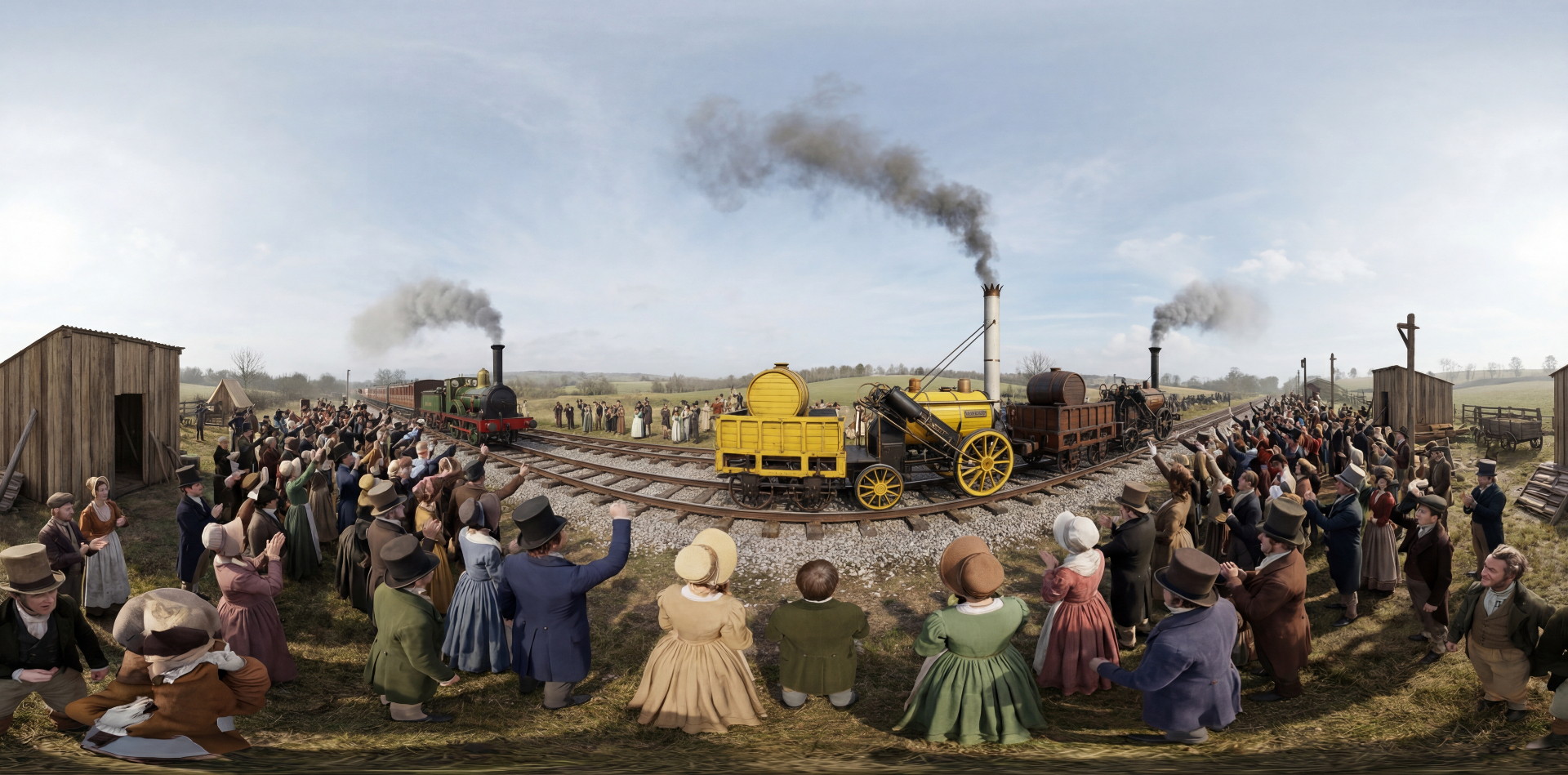
Opening day, 15 September 1830, brought eight locomotives and a parade of dignitaries in open carriages, the Duke of Wellington among them, watched by crowds estimated at half a million lining the route between the two cities. At Parkside the trains stopped to take on water; William Huskisson, the local MP, stepped down to greet Wellington and was struck by the oncoming Rocket, dying that evening at a nearby vicarage.
The railway opened anyway, on schedule, that same afternoon, carrying Huskisson's body onward to Manchester on the same day the crowds had gathered to celebrate. Newspapers reported both the triumph and the horror in the same columns, and the juxtaposition — a machine that could kill a statesman and still get the mail there faster than any horse — became the story people actually told for years afterward.
Fanny Kemble, the young actress who had ridden on Stephenson's footplate days earlier, wrote to a friend describing the sensation of speed itself as something entirely new to human experience, a description that circulated almost as widely as the accounts of Huskisson's death, and her letters remain among the most quoted first-hand impressions of what early rail travel actually felt like to a passenger accustomed only to horses.
What everyone says
The Liverpool and Manchester was the first railway in the world.
What the evidence says
Earlier lines, including the Stockton and Darlington of 1825, already used steam locomotives. What made this one different was scheduled, double-tracked, steam-hauled passenger service between two major cities — the first railway that behaved like a modern one.
What the line proved within a decade
Freight revenue overtook passenger revenue within the first year, but it was the passenger traffic that surprised investors: intended as a secondary source of income, it instead generated profits that justified railway building across the country almost overnight, with the company soon paying dividends far beyond what its original subscribers had dared expect.
By the early 1840s more than 6,000 miles of track were open or under construction in Britain, financed by investors who had watched the Liverpool and Manchester's shares climb and drawn the obvious conclusion about where capital should go next, touching off a speculative railway mania that reshaped British finance as much as British transport.
The original line survives today folded into the modern rail network between Liverpool and Manchester, and sections of Stephenson's Chat Moss embankment still carry trains on essentially the same floating foundation he engineered nearly two centuries ago, a detail modern engineers inspecting the line have confirmed with some astonishment during later resurveys.
How it unfolded
1824
Liverpool merchants raise capital for a line to bypass canal tolls.
1825
An initial parliamentary bill for the railway fails under lobbying pressure.
October 1829
The Rainhill Trials pick Stephenson's Rocket over rival designs.
Summer 1830· the scene
Chat Moss crossing and Sankey Viaduct completed after years of doubt.
15 September 1830
Opening day: the scene shown here, and Huskisson's death at Parkside.
1830s
Passenger numbers and freight receipts outstrip every projection.