The unglamorous part: resistance and vacuum
Working incandescent lamps had existed for decades before Edison. Humphry Davy had demonstrated arc lighting as early as 1802, and Joseph Swan in England was independently developing a carbon-filament lamp at almost the same moment Edison was, but earlier designs burned out within minutes or drew current too heavy to distribute economically to more than one lamp at a time. Edison's team instead pursued a high-resistance carbon filament that could run on low current spread across many parallel lamps, sealed inside a far better vacuum than any rival had managed to pull.
Getting there took, by Edison's own account, thousands of filament trials: platinum wire tried and largely abandoned earlier in 1879 because it melted at the currents needed for useful brightness, then dozens of carbonised vegetable fibres tested one after another through the autumn. A filament of carbonised cotton sewing thread, tested in October 1879, burned for roughly 13.5 hours before failing, the first result good enough to justify building a public demonstration around it, and it was later improved with carbonised bamboo that pushed bulb life past a thousand hours by 1880.
Francis Upton, a physicist Edison hired specifically because he lacked one himself, ran the mathematics behind the parallel-circuit system that let many lamps share one generator without each pulling down the others' brightness, a problem rival inventors never fully solved, since most competing systems still wired lamps in series, meaning one failed bulb could darken an entire circuit. Lewis Latimer, then working for a rival firm before later joining Edison's own company, patented an improved method of manufacturing durable carbon filaments in 1882, and his engineering drawings and expertise helped install early incandescent lighting systems in New York, Philadelphia and Montreal.
3,000+
filament materials reportedly tested by Edison's team
14 hrs
life of the first successful carbon-thread filament, October 1879
1,200 hrs
life achieved with carbonised bamboo filaments by 1880
1882
year Pearl Street Station began commercial electricity sales
A system, demonstrated whole
On New Year's Eve 1879, Edison opened the Menlo Park laboratory complex to the public, lighting dozens of lamps at once from a central dynamo strung along overhead wire between buildings, deliberately built as a working demonstration rather than a lab curiosity. Special trains reportedly brought crowds out from New York to see it.
The display was meant to answer sceptics, including gas company engineers, who doubted electric lighting could ever be divided safely among many separate users the way gas was already piped from one source into many households. Edison strung his wiring deliberately along paths visitors could see, rather than hiding it, so the crowd could trace how one central dynamo fed dozens of separately glowing lamps at once.
Gas company shares reportedly wobbled on the news out of Menlo Park, an early sign that investors, not just curious visitors, understood the demonstration as a direct commercial threat to an entire existing industry rather than a mere scientific novelty, and several utility executives reportedly visited Menlo Park in person to judge the threat for themselves. English gas shares fell too, prompting a British parliamentary committee to investigate Edison's claims within months, and its cautious, sceptical report was later read by Edison's rivals as evidence that his system would not scale as easily as the New Year's Eve demonstration suggested.
We will make electricity so cheap that only the rich will burn candles.
Selling power, not lamps
Edison understood before most rivals that the business was not the bulb but the utility behind it: metered generation and distribution, sold like gas but delivered by wire. That model reached commercial reality with Pearl Street Station in lower Manhattan in September 1882, the first central power plant serving paying customers.
Within a generation, gas street lighting, still visible right beside the Menlo Park demonstration in 1879, was in retreat across every major city that could afford the new wiring. Gas companies fought back with cheaper rates and brighter mantles, but the case for electricity — no soot, no naked flame, no smell of coal gas indoors — proved impossible to reverse once households had a wired alternative.
Pearl Street's opening day served just 85 customers and about 400 lamps from a single station, a modest start that nonetheless proved the metering and billing system Edison had designed around his lamps could actually run as a business, with growth in subscriber numbers accelerating steadily once the initial technical faults at the station were resolved.
What everyone says
Edison invented the light bulb.
What the evidence says
Working incandescent lamps were demonstrated by others, including Humphry Davy and Joseph Swan, decades earlier. Edison's achievement was a commercially durable lamp paired with the generation and distribution system needed to run it profitably at scale.
What Menlo Park left running
Edison's laboratory complex itself, sometimes called an invention factory, became the model for organised industrial research, employing dozens of specialised staff, including machinists, glassblowers and mathematicians like Upton, rather than relying on a single inventor working alone in a workshop.
The Edison Electric Light Company and its successors eventually merged with Thomson-Houston in 1892 to form General Electric, a corporate lineage still traceable directly back to the dynamo running on New Year's Eve 1879 at Menlo Park, long after Edison himself had lost effective control of the company that bore his name.
Menlo Park itself was later dismantled and partially reconstructed at Henry Ford's Greenfield Village in Michigan, where visitors can still see the recreated laboratory buildings where the demonstration first took place, reassembled down to salvaged fittings Ford's team tracked across several states.
How it unfolded
1878
Edison announces work on a practical incandescent lamp.
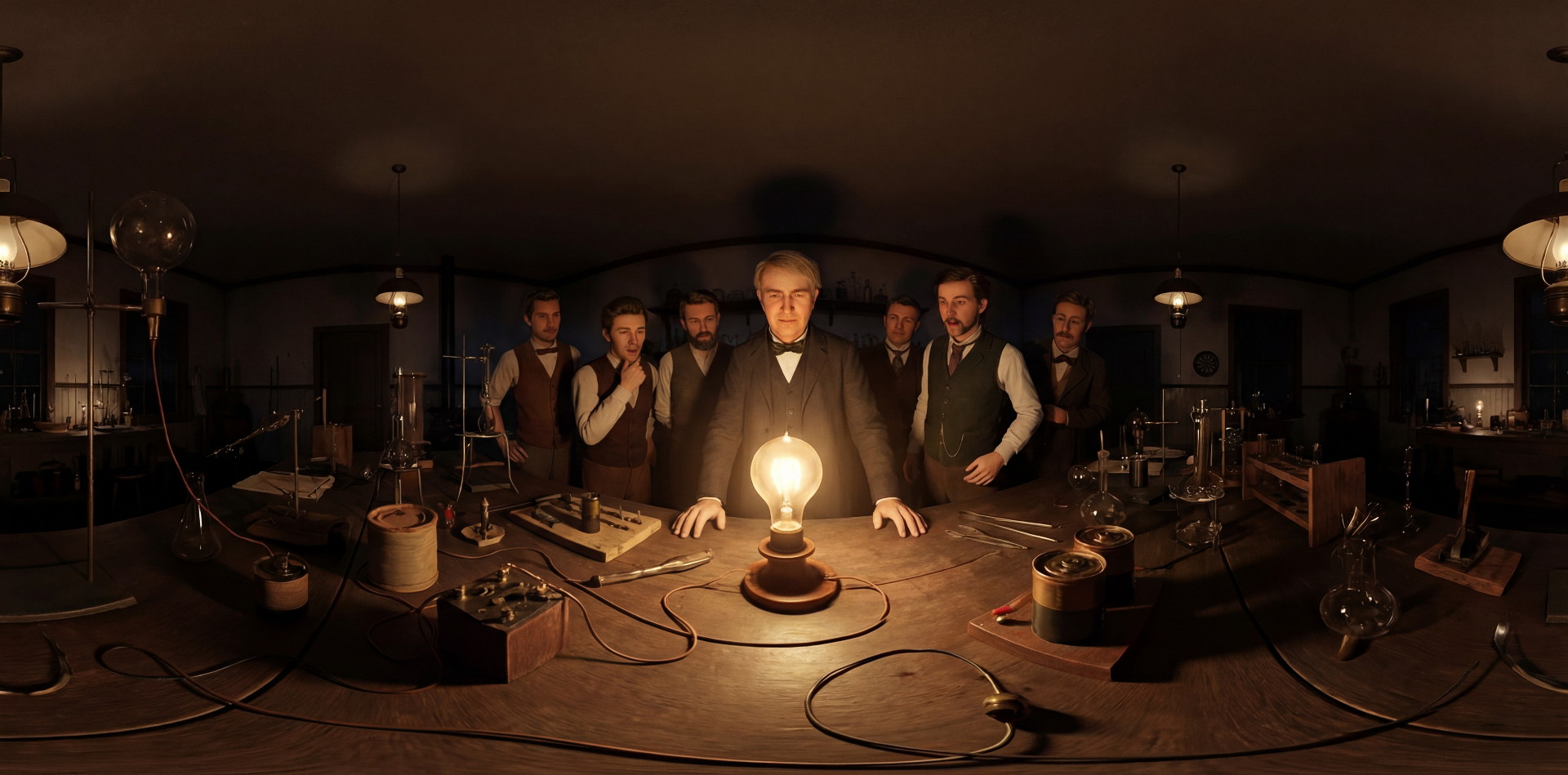
October 1879· the scene
The carbonised-thread filament burns for around 14 hours in tests.
31 December 1879
The scene shown here: public demonstration lighting Menlo Park.
1880
Carbonised bamboo filaments extend bulb life dramatically.
September 1882
Pearl Street Station opens, selling metered electricity in New York.