A private society, and then nothing
The Washington National Monument Society began collecting donations in 1833, capping individual gifts at a dollar so the memorial would belong to the whole public rather than the wealthy few. It raised enough to start in 1848, laying the cornerstone with the same trowel George Washington had used at the Capitol, but the money ran out by 1854 at around 150 feet, leaving an ungainly stump that stood untouched for the next twenty-two years while Congress argued over federal funding.
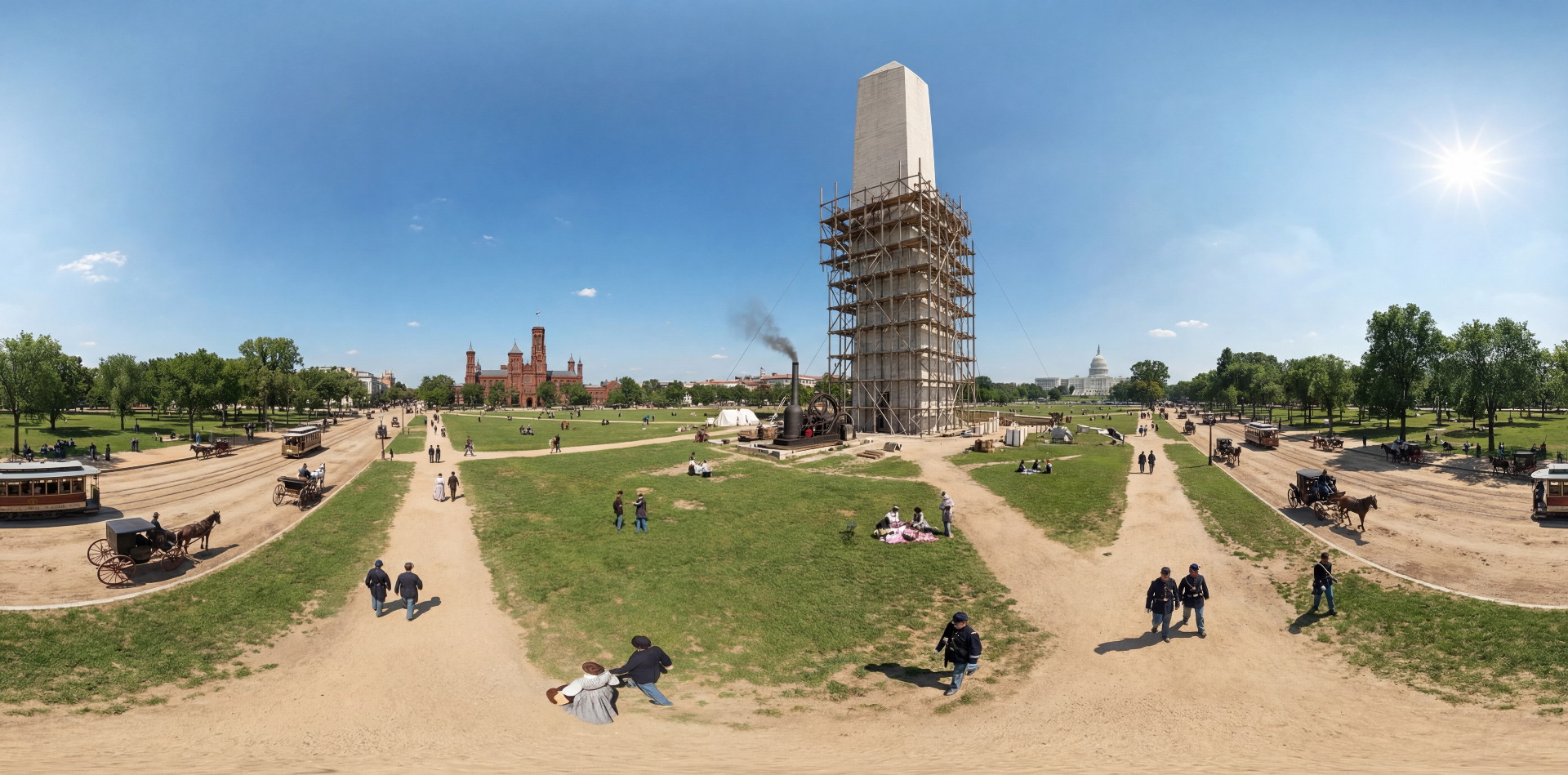
The stub then stood through the Civil War as a cattle pen and a punchline — Mark Twain compared it to a factory chimney with the top broken off, 'a factory chimney with the top broken off' being close to the actual phrase he used in print. Congress finally authorised federal funds and took over construction in 1876, the nation's centennial year, more than two decades after work had stopped.
Part of the earlier stall traced to the Society itself: in 1854 a group linked to the nativist Know-Nothing movement seized control of the project's board in a nighttime coup, angered that Pope Pius IX had donated a block of marble from the Temple of Concord for the interior. Members of the same movement stole that Pope's Stone and reportedly threw it into the Potomac, a scandal that further discouraged donors and stalled fundraising even before money ran dry entirely.
555 ft
final height, plus 5⅛ inches
36 yrs
from cornerstone to public opening
23 yrs
construction stood idle before Congress resumed funding
100 oz
of aluminium cast for the pyramidion's capstone
New engineers, new stone, a visible seam
Lieutenant Colonel Thomas Lincoln Casey of the Army Corps of Engineers redesigned the foundation, widening it to bear the full planned height safely, and switched the design ratio of the pyramidion to match ancient Egyptian obelisks more closely. He also had to source new marble, since the original Maryland quarry could no longer supply a matching stone, and his team spent nearly four years underpinning and enlarging the existing footing before construction above could safely resume.
Marble from a Massachusetts quarry, then Maryland stone again, produced colour bands still visible about a third of the way up — an accidental diary of the project's interrupted finances, left unpainted and unhidden because there was no good way to disguise it. Weathering over the following century made the seam even more visible than it was on completion day, since the newer stone aged at a different rate than the older courses laid decades earlier.
Casey's foundation work required underpinning the existing structure without halting construction above, a delicate operation using timber and concrete that engineers of the day considered nearly as impressive as the visible masonry, since a mistake risked toppling 150 feet of finished shaft.
It looks like a factory chimney with the top broken off.
A capstone, then an aluminium tip
The final capstone went on 6 December 1884, an event marked with an aluminium apex — then a genuinely rare and expensive metal, more precious per ounce than silver — cast to serve as a lightning conductor. William Frishmuth, a Philadelphia metallurgist, cast the nine-inch pyramidion by hand using one of the only furnaces in the country then capable of refining aluminium at that scale. It was, briefly, the largest single piece of aluminium ever cast.
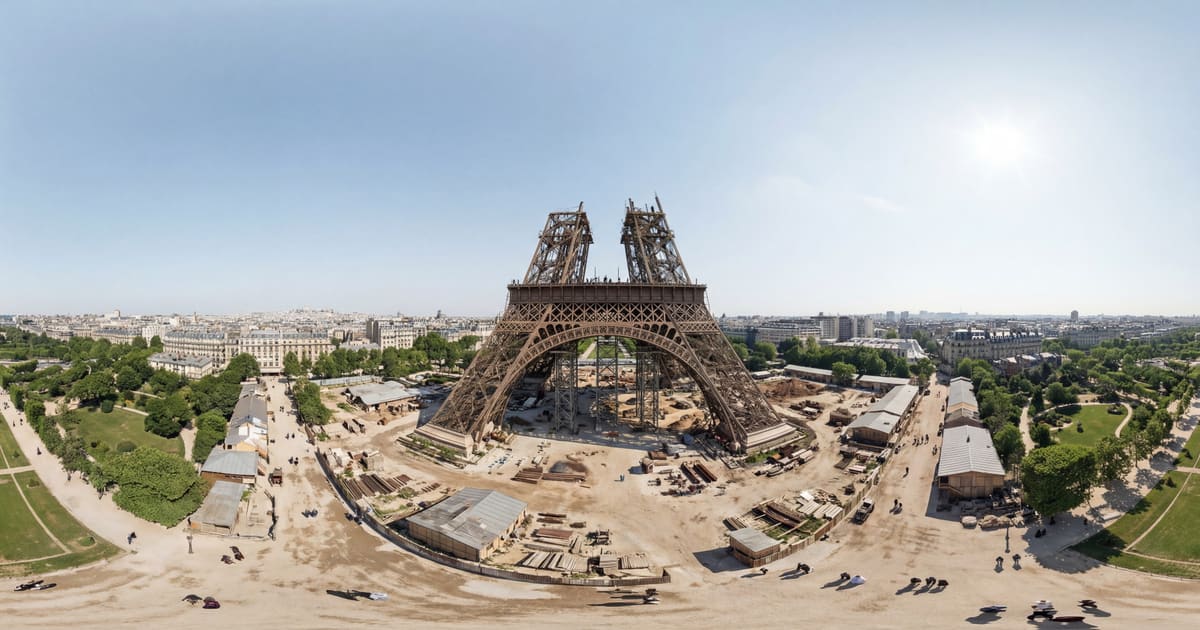
The monument opened to the public in October 1888 as the tallest structure in the world, a record it held for barely five years until the Eiffel Tower overtook it in 1889. It remains, even so, the tallest stone structure and the tallest obelisk anywhere on Earth, a distinction unlikely to be challenged given how few builders still work in solid masonry at that scale.
Workers atop the shaft that December morning worked in a stiff wind with no safety harnesses beyond rope, setting the nine-inch aluminium tip by hand while a small crowd gathered far below on the still largely undeveloped Mall to watch the capping ceremony through field glasses.
What everyone says
The two colours of marble were a design choice.
What the evidence says
They resulted from a twenty-three-year funding gap. The original Maryland quarry's stone had weathered differently from the marble available when work resumed in 1879, and the mismatch became permanent rather than being re-clad.
A shaft that still anchors the Mall
The Mall around the monument filled in gradually over the following decades: the Lincoln Memorial in 1922, the reflecting pool soon after, and eventually the museums and memorials that now radiate outward from Casey's marble shaft as the fixed point of the whole composition, a role the original Society could scarcely have imagined for a project it had once nearly abandoned as a lost cause.
An earthquake in August 2011 cracked stones near the pyramidion and closed the monument for repairs lasting nearly three years, a reminder that Casey's nineteenth-century masonry still bears real structural loads rather than serving purely as a symbol, and that the same foundation redesign engineers praised in 1880 was still doing structural work more than a century later.
It reopened in 2014, and remains, by National Park Service rule, the tallest building permitted in Washington, D.C., a height limit enacted partly to preserve its dominance over a skyline that might otherwise have crowded it out.
How it unfolded
1848
Cornerstone laid using George Washington's Masonic trowel.
1854
Funds exhausted at roughly 150 feet; work halts.
1861–65
The unfinished stump stands through the Civil War.
1876
Congress funds federal completion under Thomas Lincoln Casey.
6 Dec 1884· the scene
The scene here: capstone and aluminium apex set atop the finished shaft.
9 Oct 1888
The monument opens to the public.