A diplomat's project, not an engineer's
Ferdinand de Lesseps was a former French consul with no engineering training, who secured concession rights from the Egyptian viceroy Said Pasha through personal friendship rather than technical credentials, dating back to when de Lesseps had tutored the future ruler as a boy. Britain, protective of its route around the Cape and suspicious of French influence in Egypt, refused to invest and lobbied against the project internationally for years, arguing at the Ottoman court in Constantinople that the canal would destabilise the region.
Financing came almost entirely from French small investors and the Egyptian state itself, which bought a large shareholding it could barely afford — a debt burden that would help push Egypt toward bankruptcy and British financial control within a decade.
De Lesseps proved a relentless promoter even when his engineering judgment was shaky, touring European courts and newspapers for a decade to keep the project's finances afloat whenever technical setbacks or British diplomatic pressure threatened to sink it entirely, at one point travelling to Constantinople himself to counter Ottoman objections stirred up by British diplomats. Khedive Ismail of Egypt backed the project enthusiastically, borrowing heavily from European banks on ruinous terms to fund both the canal shares and a wave of parallel infrastructure spending that left Egypt owing far more than it could ever service from canal tolls alone.
164 km
length of the canal from Port Said to Suez
10 yrs
from first digging to the opening ceremony
7,000 km
distance saved on a London–Bombay voyage
44%
of canal shares Britain bought from Egypt in 1875
Forced labour, then steam shovels
Early digging relied on the corvée, a system requiring Egyptian peasants to labour on state projects for a fixed number of days a year without pay; at its peak an estimated 20,000 conscripted labourers a month worked the canal route under compulsion before Egypt's ruler, under British and Ottoman pressure, abolished the practice in 1864.
The project then shifted to imported steam dredgers and bucket-ladder excavators, which did most of the remaining volume of digging through 1869 far faster than manual labour ever had, though at considerable additional cost to the French shareholders funding it. The switch also delayed completion by roughly a year, since the specialised dredging machinery had to be designed, built and shipped from European workshops before it could replace the conscripted labour force Egypt could no longer legally supply.
Disease and heat took a heavy toll on the workforce throughout construction, with outbreaks of cholera at points along the route killing labourers by the thousand, a cost rarely mentioned in the celebratory accounts written once the canal was finished, though company records from the period do acknowledge repeated interruptions to digging caused by illness among the workforce.
Today, thanks to the intelligence and energy of the men who have accomplished this great task, the East and the West are joined together forever.
A convoy through a channel with no locks
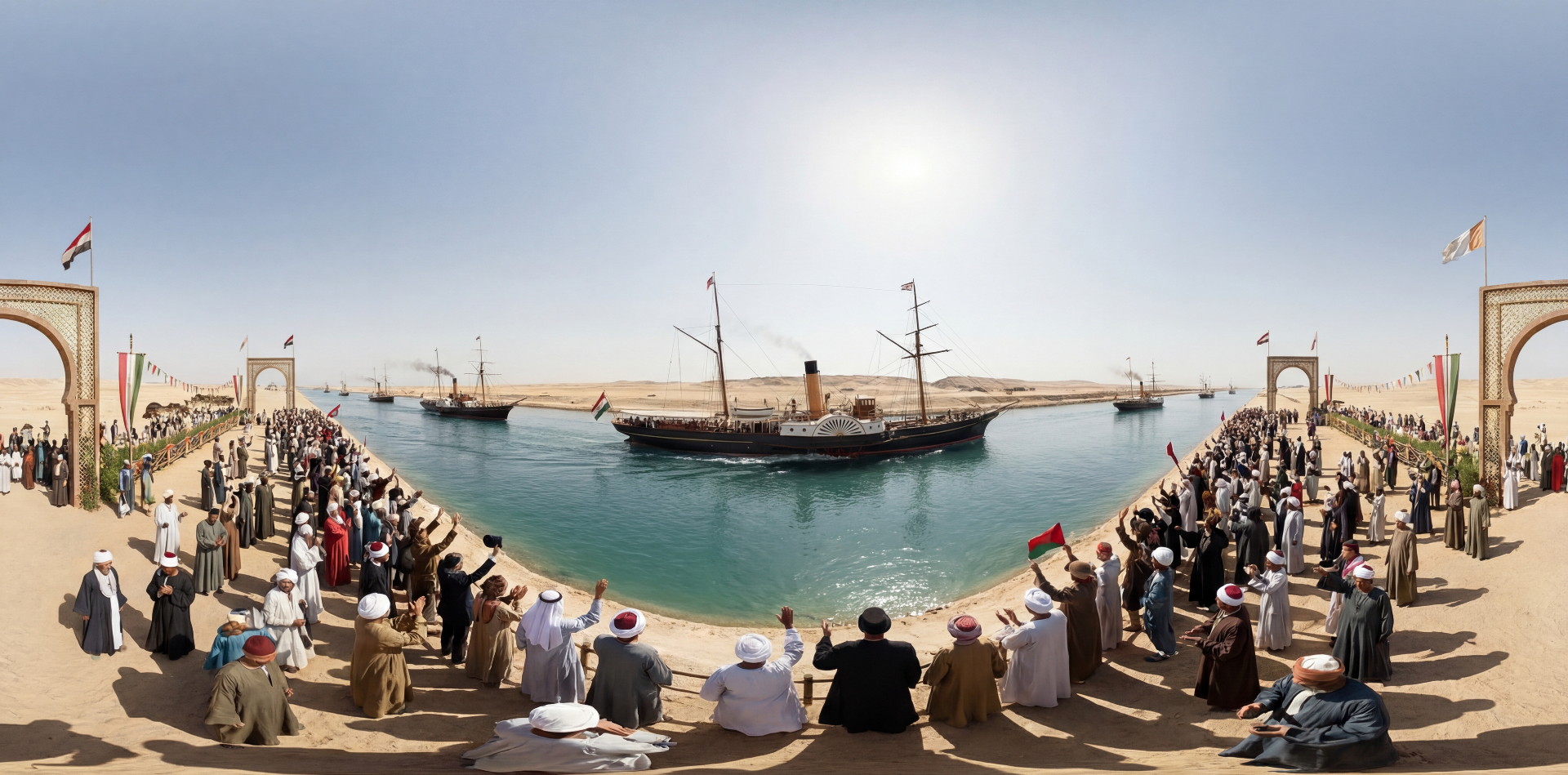
The opening ceremony on 17 November 1869 sent a convoy of some forty ships, led by the French imperial yacht L'Aigle carrying Empress Eugénie, through the full length of the canal over several days, watched by crowds gathered at Port Said and Ismailia. Because the Mediterranean and Red Sea sit at nearly the same level, the canal needed no locks at all.
De Lesseps stood on L'Aigle's deck as it entered the canal, reportedly declaring the moment the fulfilment of a decade's struggle against engineers, financiers and the British government who had all doubted the project could ever be finished, a claim greeted with cheers from the assembled crews and dignitaries lining the banks at Port Said. Verdi's opera Aida, commissioned by the Khedive to mark the opening, arrived too late for the ceremony itself and was not staged in Cairo until 1871, missing the celebration it was meant to crown by nearly two years.
Within six years Egypt's debts forced the sale of its canal shares to Britain, and by 1882 British troops occupied Egypt outright, partly to secure the waterway — the canal that France had built and Britain had once tried to sabotage ended up controlled, for the following seven decades, by the very country that had opposed it from the start.
What everyone says
The canal was a purely French achievement built with modern machinery throughout.
What the evidence says
Its first several years relied on compulsory Egyptian peasant labour under the corvée system, and only shifted decisively to steam-powered dredging after that forced-labour arrangement was ended under diplomatic pressure in 1864.
A century of contested control
British and French management of the canal continued for decades under the Suez Canal Company, generating enormous toll revenue while Egypt itself received only a fraction of the profit from a waterway cut through its own territory.
President Gamal Abdel Nasser's nationalisation of the canal in 1956 triggered a brief war and finally ended nearly ninety years of foreign control, a reversal de Lesseps could not have imagined as he watched his convoy pass through in 1869.
The canal has been widened and deepened repeatedly since, most recently in 2015, and still carries roughly ten percent of global seaborne trade along essentially the same course surveyed by de Lesseps' engineers in the 1850s, a testament to how accurately that original, largely self-taught survey team read the desert terrain.
How it unfolded
1858
De Lesseps' Suez Canal Company is formed and begins raising capital.
1859–1864
Corvée labour digs the canal's early stretches by hand.
1864
Forced labour is abolished; steam dredgers take over excavation.
17 November 1869· the scene
The scene shown here: the opening convoy passes through.
1875
Egypt sells its canal shares to Britain to service its debts.
1882
Britain occupies Egypt, securing control of the waterway by force.