AD 500 – 1599 · 5 documented scenes
Medieval History Game
A thousand years where fifty of them can look identical.
The medieval run is the hardest band in the game and the most satisfying to get good at. From AD 500 to 1599 the vernacular barely moves: the same timber frames, the same stone, the same fields. Two scenes four centuries apart can share a skyline. Winning a round here means finding the one detail that could only exist in a narrow window — a window tracery, a weapon, a ship's rig, a scaffold on a cathedral that took two hundred years to finish.
It is also the band where the map matters most. Medieval Europe is a mosaic of small polities with distinct building habits, and knowing that a hall is Norman rather than Lombard often places you before it dates you. Get the country right and the century usually follows.
5 rounds · free · no account needed · 5 scenes from Medieval & Renaissance
5
Scenes in the band
5
Rounds per run
AD 500 – 1599
Years covered
How a medieval & renaissance round works
- 1
Look around the scene
Every round opens inside a 360° panorama of a real moment. Drag to turn, zoom in on anything that looks datable. There is no caption, no title and no year anywhere on screen.
- 2
Drop a pin, then pick a year
Place your guess on the world map and set the year on the slider — arrow keys nudge a year at a time, the century arrows jump a hundred. Both halves are scored, so a perfect year with the wrong continent still loses points.
- 3
See what dated it
The result screen shows the true place and year, the distance you were out, and the detail in the scene that gives the date away. That explanation is the part that makes the next round easier.
How to date a medieval & renaissance scene
Arches move from round to pointed
A semicircular arch on a heavy wall with tiny windows is Romanesque — think eleventh and twelfth century. A pointed arch with flying buttresses and glass where the wall used to be is Gothic, thirteenth century onwards. Tracery then gets busier decade by decade, so the shape of a window is a rough clock face for the later Middle Ages.
Castles stop being fortresses
Motte-and-bailey earthworks with a timber tower are early. Concentric stone curtain walls with round towers are the thirteenth-century peak. Once you see large glazed windows, chimneys and a symmetrical front, defence has lost to comfort and you are in the fifteenth or sixteenth century — the building is a house pretending to be a castle.
Ships and cargo date a port to a decade
A single-masted cog with a steering oar is high medieval. Three masts, a stern rudder and a lateen mizzen mean the late fifteenth century and open-ocean voyaging. In a port scene the rigging is more precise than the buildings behind it, because ship design changed fast while towns did not.
Anchor to the events everyone remembers: 1066, the great cathedral campaigns of the 1200s, the Black Death in 1347–51, Constantinople in 1453, printing in the 1450s, and the high Renaissance around 1500. Decide which side of the nearest anchor your scene sits on, then move fifty years at a time rather than guessing a round number.
The 5 scenes this run draws on
Every one is a documented moment with a verified place and year. A run deals 5 of them in random order, so no two sessions are the same.
- the United Kingdom collection
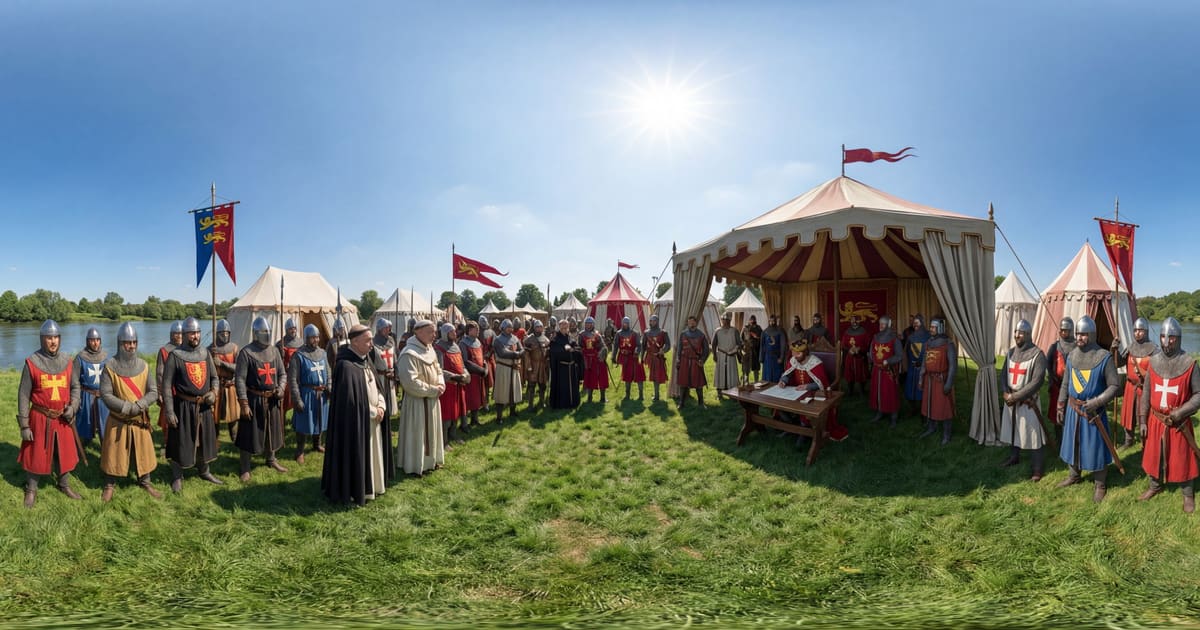
1215Signing of Magna Carta at Runnymede
Runnymede meadow, on the Thames near Windsor, England
- China collection
1420Zheng He's Treasure Fleet Expedition
Longjiang shipyards and the Yangtze at Nanjing, China
- Germany collection
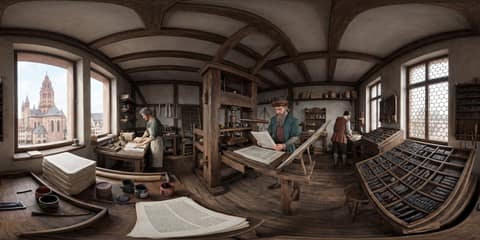
1455Gutenberg's Print Shop, Mainz
Johannes Gutenberg's workshop, Mainz, Germany
- Italy collection
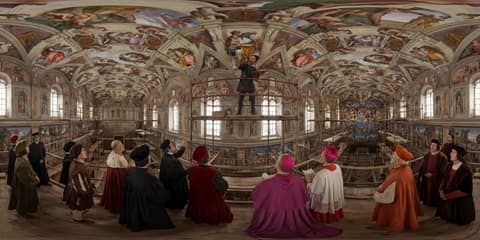
1510Michelangelo Painting the Sistine Chapel Ceiling
Sistine Chapel, Vatican Palace, Rome
- Mexico collection
1519Cortés Arrives in Tenochtitlan
Tenochtitlan, Lake Texcoco, in modern Mexico City


Medieval History Game — common questions
- What years count as medieval here?
- AD 500 to 1599, which folds the Renaissance into the same band. That is deliberate: the library's fifteenth and sixteenth century scenes share their visual language with the late Middle Ages far more than with the age of sail, and splitting them would leave both halves too thin to fill a run.
- Why is dating medieval scenes so hard?
- Because ordinary building barely changed for centuries. Cathedrals, ships and armour are the exceptions, and they are where every reliable clue in this band comes from. If a scene has none of the three, expect a wide guess to be a good guess.
- Do I need to know European history to play?
- No. The scoring rewards getting close, not being right, and the result screen explains what dated each scene after you commit. Most players learn the cues by being wrong four or five times in the same century.
- Is there a medieval quiz as well?
- Yes — the ancient and medieval quiz is a scored multiple-choice topic, and the medieval trivia round is a timed run of questions built from these same moments. The game trains dating by eye; those two train recall.
- How long does a run take?
- Five rounds, about five to eight minutes without the timer on. You can switch a per-round clock on from the game menu if you want the pressure, and either way the final screen breaks down where each guess lost its points.
Keep going with this era
Countries in this band
Every era run
Prefer a mixed run? The main game deals from every era at once, and all the free history games are listed in one place.