The world's most recognisable structures, caught mid-build
Famous Monuments and Landmarks, Caught Mid-Build
A finished monument tells you almost nothing about its own time. Scrub off the scaffolding and the Parthenon, the Washington Monument and the Sydney Opera House all read as timeless — which is exactly the effect their builders wanted. Under construction they are the opposite: a monument site is a snapshot of what a society could lift, cut, cast and pay for in one specific decade. These eleven scenes are all set during the build or the unveiling, so the cranes, ramps, derricks, guy wires and half-clad frames are still visible. That is the version worth walking around in, and it is the version that can actually be dated.
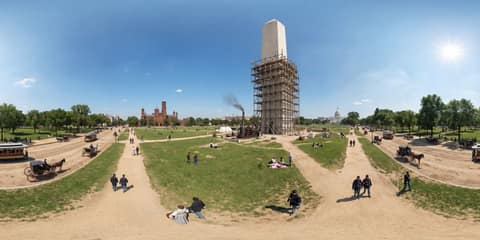
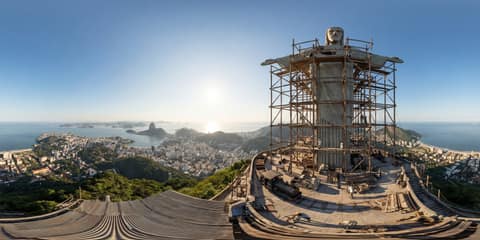
Utility buildings solve a problem; monuments make a claim. The Great Pyramid claims that a king outranks time. The Parthenon claims that one city speaks for a civilisation. The Washington Monument claims a republic can produce a figure worth an obelisk, and it took so long to build that you can see the claim wobble — the stone changes colour a third of the way up because the money ran out in the 1850s and work restarted in 1879 from a different quarry. Christ the Redeemer claims a new nation's identity in reinforced concrete and soapstone tiles. Reading a monument scene means reading the claim as well as the masonry, and the claim is usually easier to date than the stone.
Scaffolding dates a monument better than the monument does
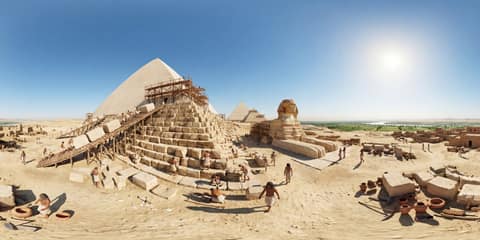
The structure itself is designed to look permanent, so it resists dating. The temporary works around it do not. Earth and rubble ramps mean the ancient world. Timber falsework with treadwheel cranes means a medieval or early modern site. Iron derricks on guy wires, steam hoists and riveting gangs put you in the nineteenth century. Tubular steel scaffolding with couplers, tower cranes on a climbing mast and concrete pumps put you after 1950. In these scenes the fastest read is almost always to ignore the famous silhouette and look at the machine standing next to it.
The ones everybody hated first
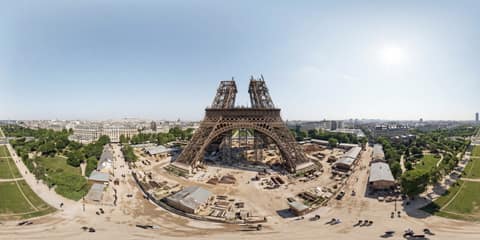
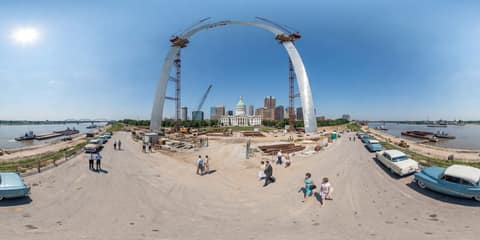
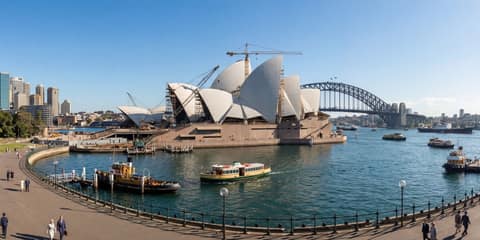
Parisian writers called the Eiffel Tower a metal asparagus and signed a public protest against it; it was licensed to stand for twenty years and survived because it made an excellent radio mast. Sydney's opera house went fourteen times over budget and drove its architect off the project in 1966 — he never came back to see it finished. The Gateway Arch was mocked as a stainless-steel croquet hoop. That hostility is a useful dating signal in itself, because it belongs to the years around completion: once a structure becomes a postcard, the arguments vanish from the record and only the silhouette survives.
Why so many of them are unfinished here
Half the pleasure of a monument scene is catching it before the reveal. The Statue of Liberty's raised arm stood alone in Madison Square for six years while the rest of the statue was funded. Christ the Redeemer's head and hands were shipped from France and assembled on a mountain. The Sydney Opera House's shells were still open ribs when the tile lids went on. Those states existed for months or years, they were photographed and written about, and they are far more informative than the finished object — a completed landmark could be any year from its opening to now, while a half-built one is pinned to a season.
What puts a structure on this list
It was meant to be seen from far away
Every entry was designed as a landmark rather than a shelter. Height, silhouette and siting were the point, which is why they end up on coins, stamps and skylines.
The construction is documented
We only build a scene when the method is known — ramp or crane, cast iron or steel, quarried block or poured concrete. Guesswork about the scaffolding would make the scene undatable.
It changed the local skyline permanently
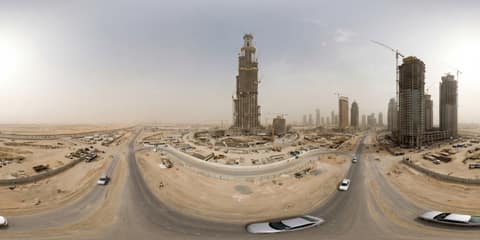
The Eiffel Tower doubled the height of Paris. The Burj Khalifa did the same to Dubai four thousand years after Giza did it to the Nile floodplain. Each one reset what its city thought was possible.
The build itself was an event
Crowds came to watch. The Statue of Liberty's arm was displayed in Manhattan as a fundraiser; the Great Exhibition sold tickets to a building. Spectatorship is part of the story.
It survived long enough to be argued about
Almost every monument here was called ugly, wasteful or doomed by someone with a byline. That argument is usually the most human part of the record.
11 scenes in this collection
Listed oldest first. Every entry is a real location with real coordinates, rebuilt as a 360° panorama — read the full story, or drop into the scene and try to date it with nothing but what you can see.
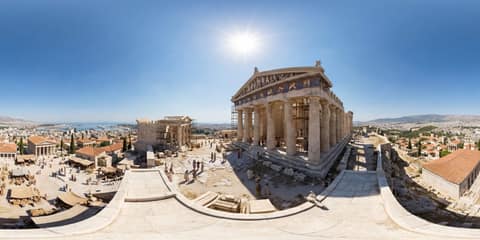
The Parthenon nears completion on the Acropolis during Athens' Golden Age.
What dates it: Painted sculpture: Greek marble was brightly coloured, so red, blue and gilding on the frieze date the scene to its own time, not to a ruin.
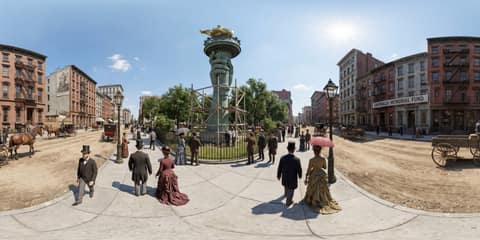
New Yorkers stroll through Madison Square Park where the torch-bearing arm of the unfinished Statue of Liberty is displayed to raise funds for its pedestal.
What dates it: A copper forearm three storeys tall, alone in a city park with a viewing ladder.
Ramps and levers mean antiquity; treadwheel cranes mean medieval; steam derricks and guy wires mean the 1800s; a tower crane on a climbing mast means post-war.
Surface finish
Dressed stone laid in courses, riveted iron plate, welded steel and glass curtain wall each belong to a different century, and the joint detail gives it away before the shape does.
The crowd
Monument scenes usually come with spectators. Hats, hemlines and whether anyone is holding a camera narrow the date faster than the structure ever will.
What is around the site
A landmark's neighbours age faster than the landmark. Low masonry blocks, tram wires, parked cars or glass towers behind the monument set the earliest possible year.
The Great Pyramid of Giza, set in 2570 BC while the casing stones are still going on. It was the tallest structure on earth for roughly 3,800 years, which is longer than the gap between the Parthenon and today.
Why show monuments under construction instead of finished?
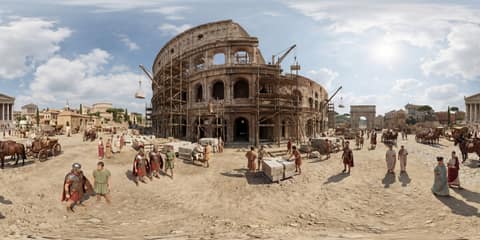
Because a finished monument is undatable. The Colosseum looks much the same in 80 AD and 1880 AD apart from its surroundings, whereas a construction site carries the tools, materials and labour of one particular decade.
Are these reconstructions or photographs?
Reconstructions. Most of these builds predate photography, so each scene is assembled from documented construction methods, surviving plans and contemporary descriptions, then rendered as a full 360° panorama.
Which monument here took longest to build?
The Washington Monument, on and off. Work began in 1848, stopped for over twenty years, and only finished in 1884 — the visible colour change in the marble is the seam between the two campaigns.