The state invents itself here
Egypt in 2570 BC has been a unified kingdom for less than five hundred years, and the pyramid is the machine that proves it. To finish Khufu's tomb, someone has to know how many loaves a stonemason eats in a week, how long a Tura limestone barge takes to cross the river at low water, and how to keep thousands of men fed in a desert.
That accounting is the real invention. The oldest inscribed papyri ever found in Egypt — the Diary of Merer, recovered at Wadi al-Jarf in 2013 — are the logbooks of a boat captain ferrying casing stone to Giza. They read like a shipping manifest, because that is exactly what they are.
Merer's diary logs a round trip to the Tura quarries most days that spring, ten days of rowing and loading measured out against the names of officials and the rations issued at each stop. It is bureaucracy as much as engineering, and it is the bureaucracy that makes the engineering possible at this scale. Merer even names the harbour installations his crew used at Giza, a detail that let archaeologists locate the pyramid's own port basin decades after it had silted over and vanished beneath the desert. His crews also worked out of Wadi al-Jarf on the Red Sea coast, a purpose-built port with rock-cut galleries for storing ship timbers, the oldest harbour structure known anywhere in the world; a man-made canal, dug and maintained by conscripted labour, linked the Nile to a basin at the pyramid's foot so barges could unload within a few hundred metres of the build.
2.3m
limestone blocks, averaging 2.5 tonnes each
146.6m
original height — 8m taller than today
3,800 yrs
spent as the tallest structure on Earth
1/20 mm
typical joint gap in the surviving casing stones
Not slaves — shifts
South of the plateau lies a purpose-built town of bakeries, breweries, granaries and dormitories, excavated from the 1990s onwards. The bones tell the story better than any inscription: healed fractures set by someone who knew what they were doing, spines compressed by decades of load-bearing, and burials arranged with grave goods, in the shadow of the king's own tomb.
The workforce rotated. Gangs took names — 'Friends of Khufu', 'Drunkards of Menkaure' — and daubed them on blocks in red ochre where the stone would never be seen again. Those graffiti are how we know the crews had an identity, and a sense of humour about it.
Archaeologists estimate the bakeries in the workers' town could turn out enough bread and beer to feed several thousand men a day, on rotations tied to the farming calendar. When the Nile flood put the fields underwater, villages sent labour to the plateau instead — a tax paid in muscle rather than grain. Cattle bones found in the settlement's rubbish heaps show workers ate beef several times a month, a diet richer than most farmers saw at home, which suggests service on the pyramid carried real, tangible privileges. The bakeries used thick, bell-shaped pottery moulds, stacked by the thousand and fired in batches, to bake a coarse bread that doubled as the base for the beer mash brewed alongside it, and excavators found entire dumps of these single-use moulds, which is how output estimates were reached in the first place.
Man fears time, but time fears the pyramids.
The last two metres are the hard part
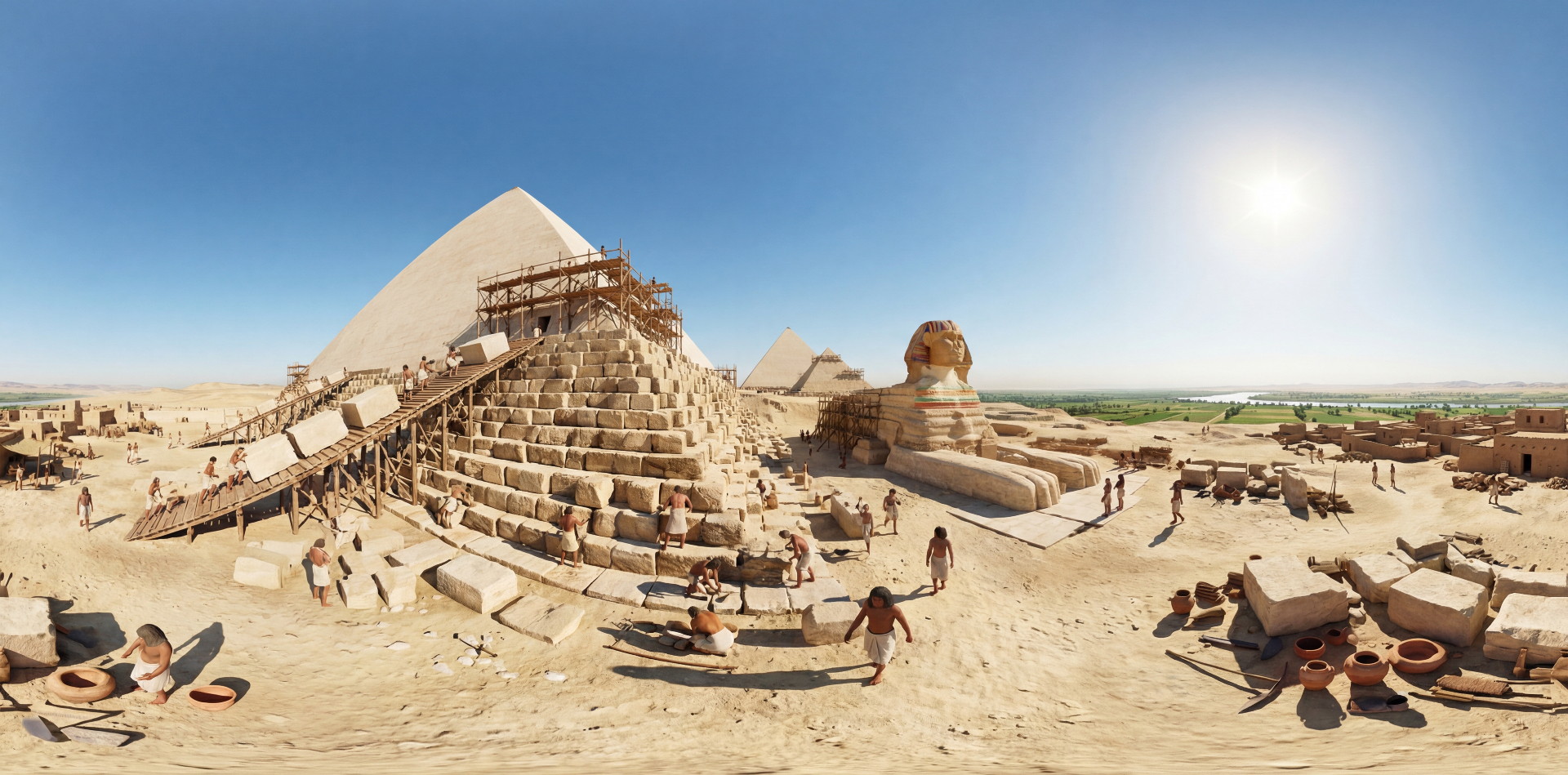
The core is rough. What makes the pyramid extraordinary is the skin: white Tura limestone, dressed so precisely that the joints on surviving casing blocks run under half a millimetre. Fitting that skin means lifting finished stone up a structure that is already 140 metres tall and getting it flush, in the open, without a crane in the modern sense.
No one has proved which ramp system did it. Straight, spiral, internal, or a combination that changed as the pyramid narrowed — each theory explains part of the evidence and stumbles on the rest. The one thing every model has to accommodate is speed: roughly twenty years, start to finish.
Whatever the method, the margin for error shrank as the courses rose. A block set fractionally out of true near the base is invisible; the same error repeated near the apex, 140 metres up, would have thrown the whole silhouette off. The builders never let that happen: surveys of the base show its four sides vary in length by less than twenty centimetres, and the whole platform is level to within a couple of centimetres across more than two hectares.
What everyone says
Slaves built the pyramids.
What the evidence says
Herodotus said so two thousand years after the fact, and Hollywood agreed. The workers' town, the medical care, the rations and the burials all point to a paid, rotating, largely agricultural labour force — men working the months when the Nile flood made farming impossible.
What outlasted the kingdom
Khufu's pyramid stood as the tallest structure on Earth for roughly 3,800 years, a record no other building of the ancient world came close to matching. The casing that made it gleam white in the sun stayed largely intact until a fourteenth-century earthquake loosened the blocks, after which Cairo's builders quarried it for mosques and forts.
The workers' town, the tool marks, the ramps' vanished traces and the Merer papyri together turned the pyramid from a mystery into a construction project with a payroll. That shift in understanding, more than any new theory of levers, is the discovery of the last thirty years.
Tourists today climb a monument stripped to its rough core, but the numbers behind it — the tonnage, the labour rotations, the twenty-year schedule — are better documented than for almost any other ancient structure of comparable age, thanks to a boat captain's logbook that was never meant to survive.
How it unfolded
c. 2589 BC
Khufu takes the throne; surveyors level the plateau bedrock.
c. 2585 BC
The King's Chamber granite is quarried at Aswan, 800km upriver.
c. 2570 BC· the scene
The scene you are standing in: casing stone going on, town at full size.
c. 2566 BC
Khufu dies; the pyramid is sealed and the causeway completed.
AD 1303
An earthquake loosens the casing; Cairo's builders quarry it for centuries.