Treasure fleets, landfalls and the first machines to leave the ground
From the Age of Exploration to the First Flights
Two eras of the same obsession. Between 1420 and 1627 the scenes here are about crossing water: a Chinese treasure fleet whose flagships dwarfed anything Europe would launch for centuries, a Spanish column walking into a lake city bigger than any in Spain, and a small ship arriving on the wrong coast in the wrong season. Between 1783 and 1927 they are about leaving the ground: a sheep, a duck and a rooster over Versailles, twelve seconds at Kitty Hawk, thirty-seven minutes across the Channel, and thirty-three and a half hours to Paris. Same instinct, different fluid.
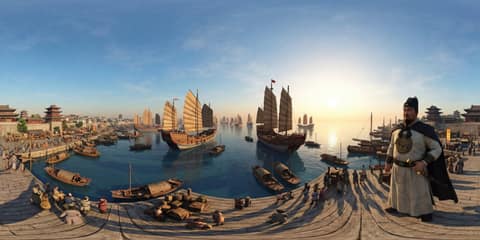
Zheng He's expeditions between 1405 and 1433 reached Southeast Asia, India, Arabia and East Africa with fleets of hundreds of vessels, the largest of them several times the length of the ships Columbus took west seventy years later. The 1420 scene shows an anchorage of junk-rigged treasure ships with battened sails, transom sterns and watertight bulkheads — a shipbuilding tradition entirely unlike the European carrack, and one of the easiest silhouettes in the whole game to identify. The voyages stopped by imperial decision, not by failure, which is the part most timelines skip.
Landfall is a bad day, not a triumph
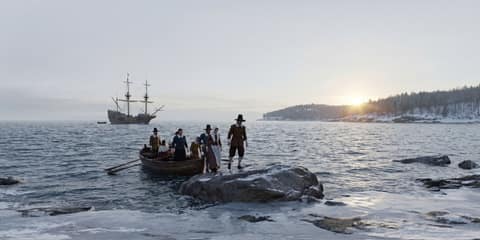
The Mayflower aimed for the Hudson, was pushed north by weather, and put people ashore at Cape Cod in November — the worst possible month to start. Of 102 passengers, 53 survived to the following autumn. The Plymouth scene of 1627 is deliberately set seven years later, when the settlement is a working street of timber-framed houses with thatch and palisades rather than a heroic first step. Arrival scenes reward looking at the ground: what has been cleared, what has been planted, what has been built out of what was to hand.
Balloons before wings, by 120 years
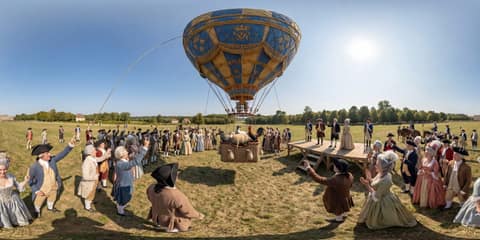
The first passengers to fly were a sheep, a duck and a rooster, sent up from Versailles in September 1783 in front of the king to test whether altitude was survivable. The Montgolfier envelope is paper-lined linen with a brazier below it, hand-painted and enormous, and nothing else in the eighteenth century looks remotely like it. Human flight followed within two months. It is worth remembering that ballooning was routine for four generations before anyone flew a powered aircraft — an 1850s scene with an airship or a balloon in it is not an anachronism.
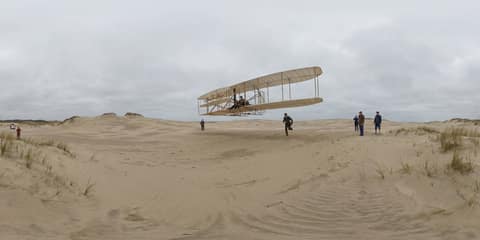
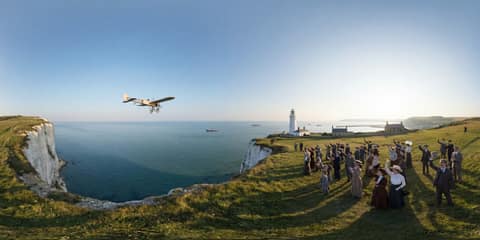
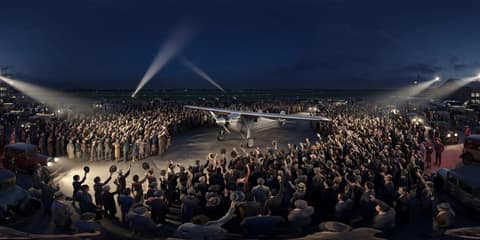
Powered flight expands fast enough that the aircraft alone dates the scene. Kitty Hawk in 1903 is a wire-braced biplane with a forward elevator, launched from a rail across sand. Blériot's 1909 Channel crossing is a monoplane with a tractor engine and a tailplane at the back, the layout that eventually won. Lindbergh's arrival at Le Bourget in 1927 is a single-engine monoplane with no forward windscreen, met by a crowd of over a hundred thousand people who broke through the fences. Twenty-four years separate the first two; eighteen more produce a transatlantic flight.
What makes a scene about getting there first
Somebody crossed something for the first time
An ocean, a strait, a channel or the air itself. The crossing has to be new for the people doing it, not merely long.
The vehicle is the story
A treasure ship, a shallop, a hot-air balloon, a spruce-and-muslin biplane, a single-engine monoplane. Each machine dates the scene to within a few years on its own.
The arrival is documented
Log books, port records, newspapers, crowd photographs. Where an arrival is legendary rather than recorded, the scene shows the recorded part of it.
It has consequences on both sides
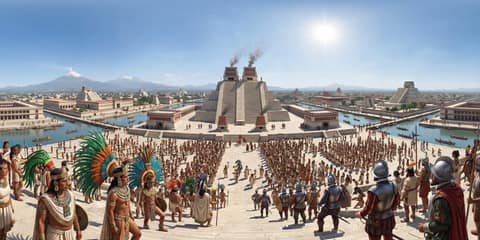
Contact scenes are not just about the traveller. Tenochtitlan in 1519 is a functioning city of a quarter of a million people, shown as the arrivals actually found it.
The risk was real and understood
Everyone in these scenes knew the odds. Roughly half the Mayflower's passengers died in the first winter, and Blériot landed on a broken ankle.
8 scenes in this collection
Listed oldest first. Every entry is a real location with real coordinates, rebuilt as a 360° panorama — read the full story, or drop into the scene and try to date it with nothing but what you can see.
A magnificent hot air balloon ascends before King Louis XVI and Marie Antoinette at the Palace of Versailles, carrying the first aerial passengers: a sheep, a duck, and a rooster.
What dates it: A paper-and-linen envelope painted with royal blue and gold devices, inflated over a straw fire.
French aviator Louis Blériot's monoplane approaches the white cliffs of Dover after completing the first flight across the English Channel from France.
What dates it: A single-wing aircraft with wing-warping controls and a three-cylinder Anzani engine — no biplane struts.
Thousands of spectators surround Charles Lindbergh's Spirit of St. Louis at Le Bourget airfield after his historic solo flight across the Atlantic Ocean.
What dates it: A single-engine high-wing monoplane with no forward windscreen — a fuel tank sat where the view should be.
Battened junk sails, square-rigged carracks, full-rigged ships and steam auxiliaries each belong to distinct centuries and are visible from any angle.
Wing layout
Canard biplane with wing warping means the mid-1900s; braced monoplane means around 1910; cantilever monoplane with a cowled radial means the mid-1920s onward.
The crowd's clothing
Arrival scenes come with spectators, and hats do the dating: tricornes, top hats, boaters, flat caps and cloches each sit in a narrow band of years.
Ground handling
Horses and hand ropes, then motor tenders, then airfield vehicles with electric lighting — the support equipment ages faster than the vehicle being celebrated.
Zheng He's fleets reached East Africa in the 1410s and 1420s, decades before Portuguese ships rounded the Cape. The voyages ended by imperial decision in 1433, which is why the European age of exploration is the one most timelines describe.
What was the first flight with passengers?
A sheep, a duck and a rooster, in a Montgolfier hot-air balloon at Versailles in September 1783. All three survived the eight-minute flight, which is why humans went up two months later.
How long was the Wright brothers' first flight?
Twelve seconds and about 120 feet — shorter than the wingspan of a modern airliner. Three more flights followed the same morning, the longest running 59 seconds.
Why is Tenochtitlan in this collection?
Because 1519 is a contact scene, and the city is the point. Tenochtitlan held perhaps 200,000 to 400,000 people on an island laced with canals and causeways, and the arrivals compared it to Venice before it was destroyed to build Mexico City on top.