An empire's accounts, carved in stone
The Delian League began as an alliance against Persia, with a treasury on the sacred island of Delos. In 454 BC Athens moved that treasury to the Acropolis 'for safekeeping'. The allies kept paying; Athens started building. One-sixtieth of every tribute payment went to Athena, and Athena, conveniently, needed a temple.
The Athenians published the accounts on marble slabs, year by year, because public money demanded public reckoning. Those fragments survive, which is why we can still argue about what a talent of silver bought in 440 BC.
Roughly 150 allied cities paid tribute by the 430s, some in coin, some in ships, and the surviving assessment lists read like a tax roll for the whole Aegean. Critics inside Athens called it theft dressed as devotion; Pericles is said to have answered that the allies had bought protection, not a say in how the change was spent. Plutarch preserves that exchange, along with the jab that Athens was decking herself out like a vain woman, hung about with precious stones and statues costing a thousand talents. The building accounts themselves survive as fragmentary marble stelai, listing payments to quarrymen, carters, sculptors and pigment-grinders down to individual drachmas, including wages for the men who hauled column drums from Mount Pentelicon on wagons with wheels wider than a man is tall, to keep the marble from sinking into the dirt roads.
22,000 t
of Pentelic marble, quarried 16km away
15 yrs
from first block to final pediment figure
12m
height of the lost gold-and-ivory Athena inside
1 talent
of tribute in every 60 went to Athena's fund
Every straight line is a lie
There is almost no true straight line in the Parthenon. The floor bows upward by about 11cm across its length. The columns lean inward and swell at the middle. The corner columns are fractionally thicker than the rest. Extend the axes of the long sides and they would meet, in theory, a couple of kilometres above the building.
These are optical corrections — refinements meant to make a rigid rectangle look alive rather than sagging. Executing them in marble means every drum of every column is cut to its own specification. It is a mason's nightmare disguised as serenity.
The architects Iktinos and Kallikrates worked with the sculptor Phidias, who oversaw the pedimental figures and the frieze as well as the gold-and-ivory Athena inside. No single drawing could specify curves this fine; masons cut and checked each block against wooden templates on site, correcting by eye as the building rose. Phidias himself later fell from favour, accused of embezzling ivory meant for the statue, and reportedly died in prison or exile. His Athena Parthenos stood almost twelve metres tall inside the cella, her flesh carved from ivory plates and her robe and armour sheathed in more than a tonne of removable gold, weighed periodically so no one could claim it had been quietly stolen; Pausanias, visiting five centuries later, still described the shield's carvings and the sphinx on her helmet in enough detail that reconstructions rely on his account today.
We are lovers of the beautiful, yet simple in our tastes, and we cultivate the mind without loss of manliness.
Fifteen years, and then the plague
Work started in 447 BC and the building was structurally done by 438; the pediment sculpture was finished by 432. That is fast for a temple of this size, and it happened because Pericles staked his political survival on it, against opponents who called it dressing the city up 'like a vain woman'.
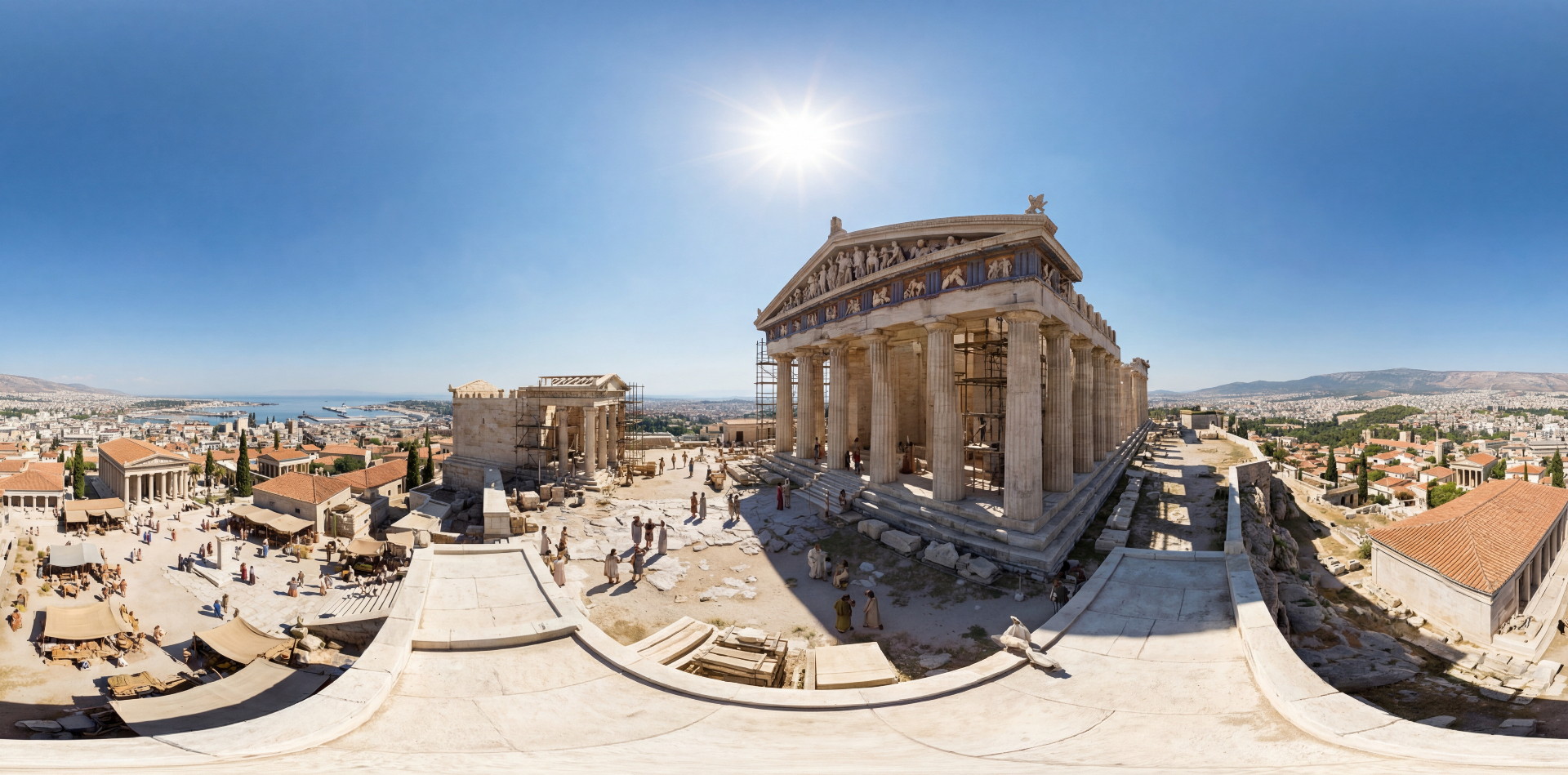
The scene here sits at the very top of the arc. Sparta invades Attica in 431. In 430 plague sweeps a city packed with refugees behind its own walls and kills perhaps a quarter of the population. Pericles is dead by 429.
The historian Thucydides, who caught the disease and survived it, described bodies piled at the temple precincts because the usual funeral rites had broken down. The Parthenon, finished only two years earlier, looked down on a city burying its dead faster than custom allowed. He put the death toll at roughly a quarter of the city's fighting men and noted that even the sanctuaries themselves, meant to be inviolable, filled with corpses as families abandoned proper burial for whatever pyre was nearest.
What everyone says
Classical Greek temples were pure white marble.
What the evidence says
Traces of pigment survive on sculpture from the Acropolis and elsewhere: strong blues, reds and greens, with gilded bronze fittings. The austere white look is weathering plus eighteenth-century taste, which preferred its antiquity clean.
A ruin with four afterlives
The Parthenon outlived the empire that built it by nearly two thousand years, serving in turn as a temple to Athena, a Byzantine church, a Catholic cathedral under the Franks, and a mosque under the Ottomans, with a minaret added at one corner. Each conversion left its own scars and its own repairs.
In 1687 a Venetian mortar shell struck an Ottoman gunpowder store housed inside the cella, blowing out the centre of the building and scattering the roof across the Acropolis in a single detonation. Much of what tourists now see as ruin dates from that one night, not from twenty-three centuries of ordinary decay.
Restoration since 1975 has used titanium dowels and computer-matched marble from the original Pentelic quarry, reversing nineteenth-century iron clamps that had rusted and cracked the stone from within. It is, in its slow way, still an active construction site — the longest-running one in the building's history.
How it unfolded
480 BC
Persians burn the Acropolis; the ruins are left as a war memorial.
447 BC
Iktinos and Kallikrates begin the Parthenon under Pericles.
438 BC
Phidias's Athena Parthenos is dedicated inside the finished cella.
432 BC
The last pediment sculpture goes up.
430 BC· the scene
The scene shown here: plague and war arrive together beneath a finished temple.
AD 1687
A Venetian mortar hits Ottoman gunpowder stored inside; the roof goes.