A statue paid for in small donations
The idea dated to 1921, proposed by Rio's Catholic Circle to mark a century of Brazilian independence, and it was funded overwhelmingly through public subscription rather than government money — church collections, raffles and donations from ordinary Brazilians over the better part of a decade of construction.
Engineer Heitor da Silva Costa designed the reinforced-concrete figure with arms outstretched in the form of a cross, and commissioned the head and hands from French-Polish sculptor Paul Landowski, working in Paris, whose full-scale plaster models were shipped to Brazil for casting.
Silva Costa considered several designs before settling on the open-armed cross, including versions holding a globe and a pedestal cross, and travelled to Europe himself to consult engineers on wind loading for a concrete figure that would stand exposed on an 710-metre peak. He also studied French Art Deco sculpture directly, which is why the finished statue's simplified, geometric drapery reads as distinctly of its decade rather than as classical religious statuary. Landowski himself modelled the head on no single sitter, working instead from his own sense of a serene, symmetrical face that would read clearly from miles away across Guanabara Bay rather than up close, where visitors often find the features surprisingly plain.
9 yrs
from the first foundation work to the 1931 dedication
30 m
height of the statue on its 8-metre pedestal
28 m
arm span, cross-shaped, visible across the bay
6m tiles
roughly, of triangular soapstone forming the outer skin
Building a monument by mule and cable car
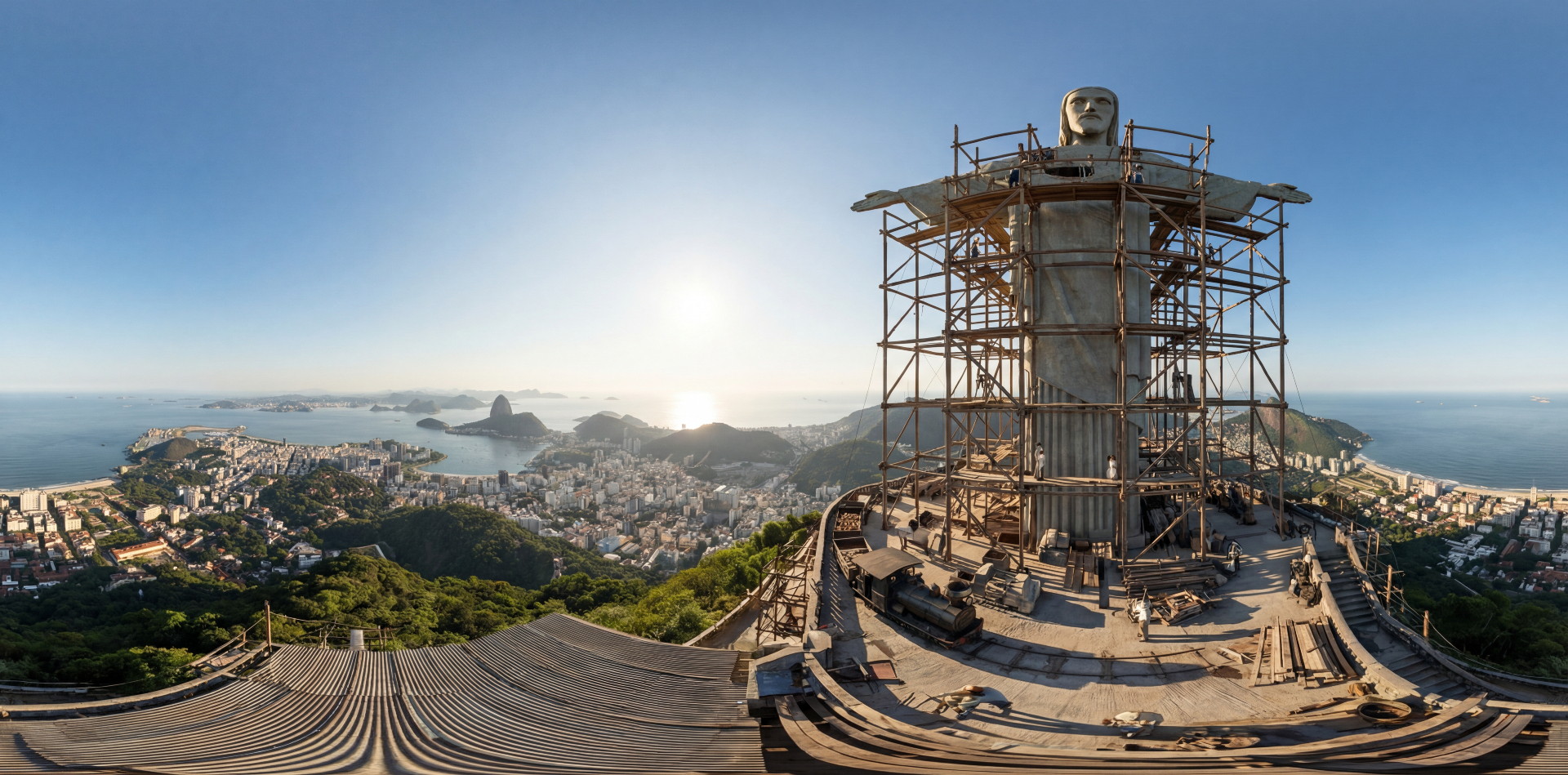
Corcovado's summit had no road wide enough for heavy machinery, so materials went up on the mountain's rack railway, built originally in 1884, and were hauled the last stretch by hand or mule. There was no way to pour concrete on this scale using anything but manual labour and small mixers carried in sections.
The outer skin uses thousands of small triangular soapstone tiles rather than poured or carved stone, chosen because soapstone resists the mountain's humidity and temperature swings without cracking, and because its light colour could be quarried and shaped locally at Ouro Preto, far cheaper than imported marble.
Landowski's Paris studio cast the three-and-a-half-metre head and the hands, each finger reportedly longer than an adult arm, in sections that had to be crated, shipped across the Atlantic, and reassembled at altitude, a logistical relay that took roughly two years between sculpting and installation. Customs officials in Rio reportedly had to be shown photographs of the plaster models before they would believe the enormous crates contained a religious statue rather than industrial machinery.
The mammoth statue represents ten years of planning and construction at a cost of $250,000 donated in small amounts by the Brazilian faithful.
Names left where no one would look
Many of the tile-setters were women from local parishes, working under scaffolding at real height with none of the safety equipment a modern building site would require. Several wrote messages, prayers or their own names on the unglazed backs of tiles before setting them, inscriptions that stayed hidden until later restorations found them.
The statue was dedicated on 12 October 1931, nine years after the first stone was laid, standing 30 metres tall on an 8-metre pedestal with an arm span of 28 metres — dimensions that made it, at the time, the largest Art Deco statue in the world.
At the dedication ceremony floodlights were meant to be switched on by a remote shortwave signal sent by Italian inventor Guglielmo Marconi from a station near Rome; heavy storm clouds over Corcovado that night disrupted the transmission, and engineers on the mountain reportedly had to throw the switch by hand once it became clear Marconi's signal was not going to arrive, leaving the ceremony to unfold in an ordinary blaze of local electric light rather than a transatlantic one.
What everyone says
The statue is carved from solid stone.
What the evidence says
The structure is reinforced concrete, chosen for strength and buildability at that scale and height; the soapstone is a thin decorative cladding of small tiles, not the load-bearing material, and has had to be periodically replaced after lightning damage and weathering.
What stands there now
The statue has needed repeated restoration since 1931: lightning strikes have chipped fingers and toes on several occasions, including one bolt in 2014 that damaged the head and right hand, and soapstone tiles are periodically replaced as weather and pollution wear the surface down.
In 2006, on the statue's seventy-fifth anniversary, a small chapel was consecrated at its base, and in 2007 it was voted one of the New Seven Wonders of the World, cementing its place alongside the Great Wall and the Colosseum in global tourist itineraries. TIME's own report the week of the dedication put the crowd on and around Corcovado at roughly 250,000 people, nearly a sixth of Rio's entire population at the time, climbing through drizzling rain to see the unveiling.
Roughly two million visitors now ride the rack railway or minivans up Corcovado each year, retracing, in a few minutes, the same route that once took mule teams hours to carry soapstone tiles and cement one crate at a time to the summit. The statue was declared a UNESCO World Heritage Site in 2012 as part of Rio's Carioca Landscapes listing, recognition of a monument that began as a local parish fundraising drive and ended up defining the skyline of an entire nation abroad.
How it unfolded
1921
Rio's Catholic Circle proposes a monument for the independence centenary.
1922
Public subscription funding begins; construction starts on Corcovado.
1926–1928
Paul Landowski sculpts the head and hands in Paris; casts are shipped to Brazil.
1930· the scene
The scene here: soapstone cladding underway on the near-complete figure.
12 October 1931
The statue is dedicated, lit for the first time by remote switch from Rome.
2007
Christ the Redeemer is named one of the New Seven Wonders of the World.