Printing, painting, decipherment, electric light, stage and stadium
Famous Inventions and Cultural Moments in History
This is the collection about what people read, saw, heard and watched — and about the machinery that made those things spreadable. A print shop in Mainz turns writing into a manufactured product. A scaffold in the Vatican turns a ceiling into an argument about the human body. A timber playhouse on the Thames turns drama into a paying business. A slab of granodiorite in a Nile delta fort unlocks fourteen centuries of lost writing. A lamp in New Jersey ends the working day's dependence on daylight. Then a revived Olympics, a muddy dairy farm, a rooftop in Mayfair and a zebra crossing in St John's Wood.
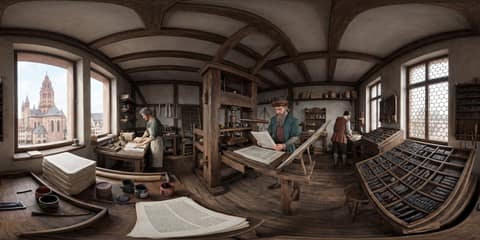
The Mainz workshop of the 1450s is a factory floor: cases of cast metal sorties, a composing stick, a forme locked in a chase, a screw press adapted from wine-making, and sheets hanging to dry on lines above head height. A scribe copying a Bible took months; a press could produce hundreds of copies in the same period at a fraction of the price per copy. Everything downstream — reformation, scientific correspondence, newspapers, literacy as a mass condition — depends on that shift from copying to manufacturing, and the room where it happens looks satisfyingly industrial two centuries before industry.
Two ways to read a stone and a ceiling
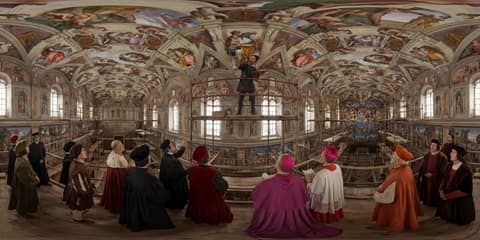
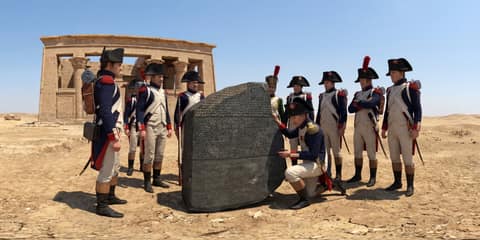
The Rosetta Stone is a boring text — a priestly decree from 196 BC — repeated in hieroglyphic, Demotic and Greek. Because scholars could read the Greek, the repetition gave them a lever, and Champollion turned it in 1822, opening three thousand years of Egyptian writing. The Sistine ceiling is the opposite problem: everything is visible and nothing is labelled. Michelangelo worked standing on a scaffold of his own design from 1508 to 1512, painting into wet plaster in daily sections. Standing on that scaffold, you notice how close the surface is and how little of the composition anyone could see while making it.
The playhouse and the electric evening
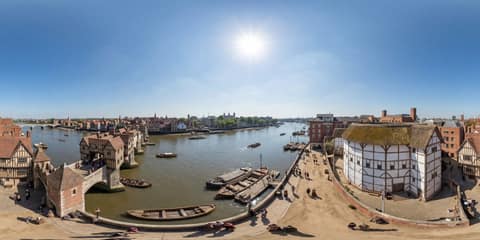
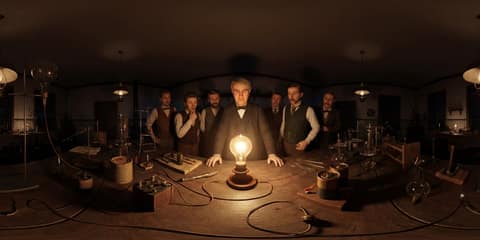
The Globe of 1600 is an open-air polygon with three galleries, a thrust stage and a yard where the cheapest audience stood in daylight, because performances ran in the afternoon. Artificial light changes that. Edison's Menlo Park demonstration on New Year's Eve 1879 lit a whole complex at once — the point was never the bulb alone but the system of generation, wiring, sockets and meters that made it sellable. Within a generation theatres, factories and streets stop obeying the sun, which is why the arrival of electric light is the single most reliable dating clue in the whole nineteenth-century library.
Mass culture: stadium, field and rooftop
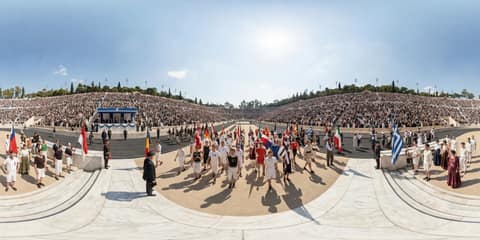
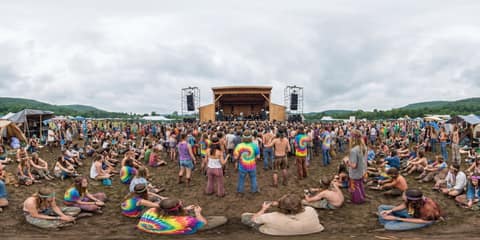
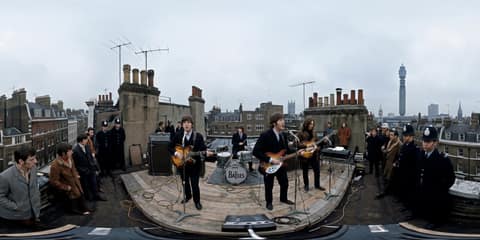
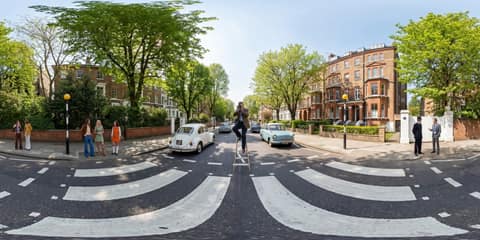
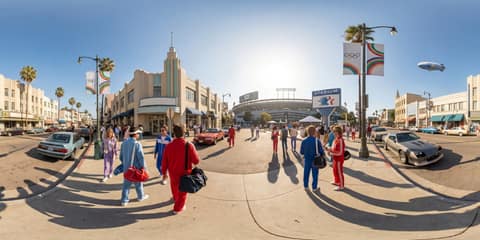
The revived Olympics of 1896 filled a marble stadium in Athens with 241 athletes from 14 nations, all male, in a horseshoe of Pentelic marble with a sharply pointed turn that ruined running times. Woodstock in 1969 planned for 50,000 and got something near 400,000 on a dairy farm, with two deaths and two births. The Beatles played a rooftop in Savile Row that same January and stopped traffic below. Abbey Road's cover was shot in about ten minutes on 8 August 1969 with a policeman holding the traffic. Los Angeles in 1984 turned the Games profitable for the first time on private sponsorship. Together they trace how culture became something a very large number of people did at once.
What makes a cultural moment historic
It changed the distribution, not just the work
Gutenberg did not invent writing; he made copies cheap. Most entries here are about reach — how many people could suddenly see, hear or read something.
It produced an object still in use
A printed book, a painted ceiling, a decoded script, a light bulb, a record sleeve. The artefact survives and is still doing its job.
The workspace is as interesting as the result
The press bed, the scaffold, the tiring house, the lamp bench, the mixing desk. These scenes put you where the work happened rather than in the gallery afterwards.
It was public
Demonstrations, performances, exhibitions and festivals. Every entry involved an audience that turned up in person.
The date is well fixed
Print runs, papal accounts, playhouse records, patent filings, festival tickets and studio logs make these among the best-documented scenes in the library.
10 scenes in this collection
Listed oldest first. Every entry is a real location with real coordinates, rebuilt as a 360° panorama — read the full story, or drop into the scene and try to date it with nothing but what you can see.
Daylight-only interiors mean before the 1800s; oil and gas mean the nineteenth century; filament bulbs and neon push you past 1880 and 1920 respectively.
Tools of reproduction
A hand press, a rotary press, a gramophone horn, a tape machine or a mixing desk each pin a workspace scene to a few decades.
Audience posture
Standing in a yard, seated in tiered stone, sprawled on a hillside or crowded on a pavement — how an audience is arranged is itself a period marker.
Cameras in the crowd
Plate cameras, press cameras with flashbulbs, 8mm home movie cameras and television rigs arrive in a known order and are usually visible in cultural scenes.
Not printing itself, which existed in East Asia, but a workable European system: durable cast metal type in a reusable matrix, an oil-based ink that stuck to metal, and a screw press adapted for even impression. Together they made cheap copies possible.
Why is the Rosetta Stone so important?
It carries the same decree in hieroglyphic, Demotic and Greek. Scholars could read the Greek, which gave Champollion the leverage in 1822 to decipher hieroglyphs and recover roughly 1,400 years of Egyptian writing.
Did Edison invent the light bulb?
He made it practical rather than inventing it. Incandescent lamps existed; Edison's team tested thousands of filament materials for a long-lived version and, crucially, built the generation and distribution system that made electric light a service you could buy.
How long did the Abbey Road cover shoot take?
About ten minutes on 8 August 1969. Photographer Iain Macmillan took six frames from a stepladder while a policeman held traffic; the fifth was chosen because it was the only one where all four were walking in step.