A winning drawing rescued from a wastebasket
Eero Saarinen's design won the 1947 competition for a monument to westward expansion, but the story that his entry was fished out of a reject pile by a competition official belongs to a different, earlier Saarinen anecdote and has been wrongly attached to the arch for decades. What is true is that funding stalled for years, and ground was not broken until 1963 — sixteen years after the design was chosen.
Saarinen never saw it built. He died of a brain tumour in 1961 at fifty-one, four years before the final section closed the gap over the river, and his practice was left to see the design through construction under his partners, working from drawings and models he had already approved before his death.
In his written statement explaining the winning entry, Saarinen described wanting a monument that would be 'of the beauty of pure engineering' rather than a static memorial, arguing that a great arch could hold its own against the grandeur of the Mississippi and the St Louis skyline without competing with either.
630 ft
height and width of the arch, identical by design
142
stainless steel sections forming the two legs
1/64 in
the tolerance engineers needed to make the legs meet
40 blocks
of 19th-century riverfront cleared to make way for the site
Building a curve nobody had built before
The arch's shape is a weighted catenary, the curve a chain makes if you hang it and then turn the drawing upside down, adjusted so the legs are heavier and wider at the base than at the top. Each of the 142 triangular sections was fabricated in Pennsylvania, shipped to St Louis, and hoisted by cranes that literally climbed the structure they were building, gripping the steel and inching skyward a section at a time.
Crews worked overnight in summer because steel expands in the heat; a temperature swing of a few degrees could throw the alignment out by enough to matter over 630 feet. Fire hoses sprayed the sunward leg with water on hot days just to keep both sides at the same temperature.
Forty city blocks of nineteenth-century riverfront warehouses had been demolished in the 1930s and 1940s to clear the site, a decision made decades before Saarinen's design existed, on the gamble that some suitable memorial would eventually justify the empty ground left behind.
The Arch is of the beauty of pure engineering.
The last eight feet
By October 1965 the two legs stood apart by a gap of about eight and a half feet at the top, and thousands of St Louisans watched from the riverbank as hydraulic jacks spread the legs just enough to slide the keystone section into place — the margin for error was famously said to be within 1/64th of an inch. Firefighters hosed the north leg to cool it and match the south leg's temperature before the final piece went in.
The keystone slotted home on 28 October 1965. A visitor tram of barrel-shaped capsules, since replaced, began carrying people to the observation deck in 1967, and the arch has held the record for tallest monument in the United States ever since.
Local newspapers ran the closing of the gap as front-page news the next morning, describing crowds that had gathered before dawn on both banks simply to watch two pieces of stainless steel meet in the air, a moment engineers had spent two years of drawings trying to guarantee. A jack that had been straining to hold the legs apart was released only once surveyors confirmed the keystone section fit within its narrow tolerance, and workers reportedly cheered when the final bolts went in without needing to be forced.
What everyone says
Saarinen's winning design was almost thrown out by a judge who then rescued it from the bin.
What the evidence says
That anecdote is often repeated but belongs to confusion with other competition stories; there is no reliable documentation that Saarinen's entry was discarded before being reconsidered. It did, however, wait sixteen years between winning and breaking ground, for reasons of funding and politics rather than any early rejection.
A monument that outlived its designer
Saarinen had already built Dulles Airport's terminal and the TWA Flight Center by the time he entered the 1947 competition, but the arch was, by his own account, the project he considered his most ambitious response to a brief. He submitted his entry under a number rather than his name, as the rules required, and later joked that he mistakenly celebrated a different, incorrect entry number before learning his own drawing had actually won.
The 1965 topping-out involved more than engineering triumph on the day: firefighters stood by with hoses through the whole final week, cooling whichever leg had spent longer in direct sun so that both sides of the keystone gap stayed within a few degrees of each other, since even a modest difference in steel temperature could throw off the fit by more than the tolerance allowed.
The National Park Service closed the arch's grounds for a major renovation completed in 2018, replacing the old visitor entrance with an expanded museum and green parkland connecting the riverfront to downtown St Louis, a design meant to finally deliver the public plaza Saarinen had sketched but never lived to see landscaped.
How it unfolded
1947
Saarinen wins the design competition for a Jefferson National Expansion memorial.
1961
Saarinen dies before construction begins.
Feb 1963
Ground is broken on the riverfront.
1964, mid-build· the scene
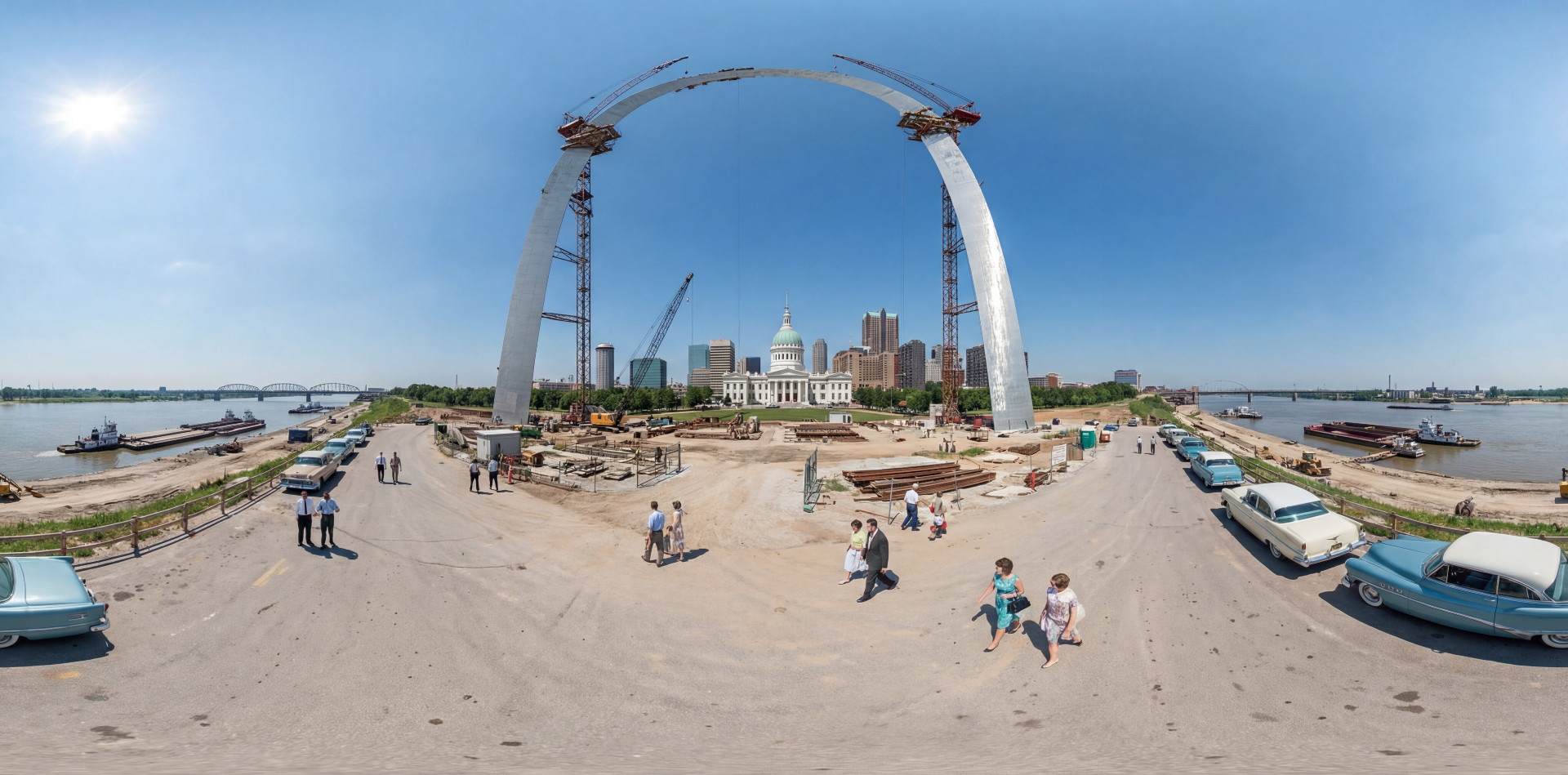
The scene here: both legs climbing, creeper cranes riding the steel.
28 Oct 1965
The keystone section closes the gap between the two legs.
1967
The internal tram opens to visitors.