Charters, crossings, sieges and marches that moved power
Famous Battles, Revolutions and Protests in History
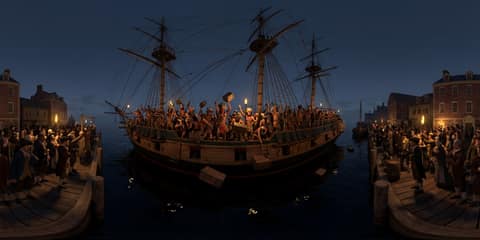
Power rarely changes hands in a single dramatic afternoon, but it does leave single dramatic afternoons behind. These eight scenes are the ones that got remembered: a meadow negotiation that limited a king, a night raid on a tea cargo, a river crossing in a snowstorm, a mission compound that held for thirteen days, a palace entered almost without a shot, a square full of people who had just learned a war was over, a city cut in half overnight, and a quarter of a million people standing in front of a memorial. Some are battles. Most are the moment just before or just after one.
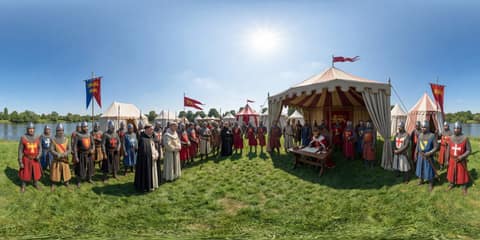
Runnymede in 1215 is a field with tents, horses and a river crossing, and nothing about it looks decisive. What matters is a parchment that says the king is under the law, sealed by a king who had no intention of honouring it and who got it annulled by the Pope within weeks. It failed as a peace treaty and succeeded as a precedent. The same pattern repeats: the Declaration that follows the tea in Boston harbour, the ruling that follows the march in Washington. In these scenes look for the paperwork infrastructure — clerks, seals, printing, lecterns — because that is usually where the durable change is happening.
Revolutions are quieter than their paintings
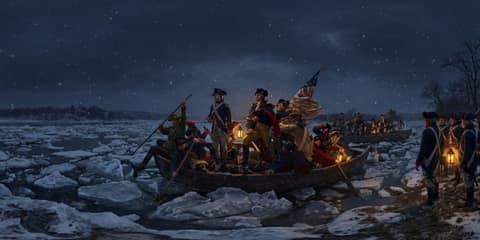
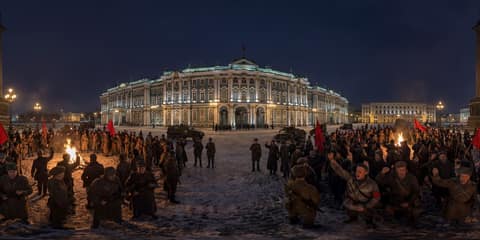
Eisenstein's 1927 film of the Winter Palace is the image everyone carries: a roaring mass swarming the gates. The 1917 reality was closer to a night of confused occupation with more injuries during the filming of the reenactment than during the event. Washington's Christmas crossing was not a heroic tableau in a calm river but an overnight slog through a nor'easter with ice floes, artillery and horses. Getting the scale right is part of the point of a 360° scene: you stand in it and discover that history's loudest moments were often mid-sized, cold and badly lit.
Sieges make the best dating puzzles
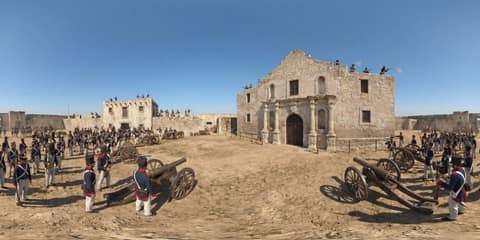
The Alamo in 1836 is a Spanish mission compound — a chapel, a long barracks, low adobe walls never designed as a fortress — which is why its defences look improvised, with earth ramps and gun platforms wedged into a religious building. That mismatch is a dating gift: mission architecture places you in the Spanish colonial period, while the artillery, uniforms and flags place the event in the 1830s. Most military scenes work the same way. The buildings tell you where and roughly when; the weapons and clothing tell you exactly when.
The twentieth century adds crowds and cameras
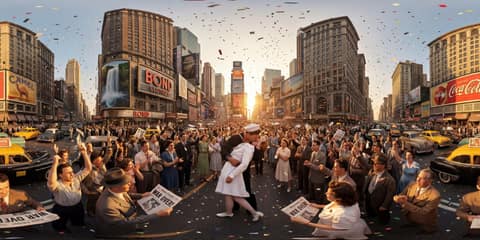
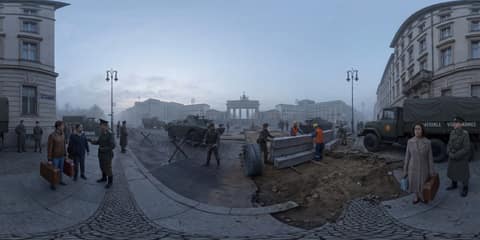
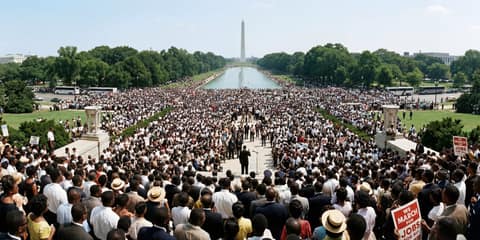
From 1945 the scenes change character. V-J Day in Times Square is a crowd photographing itself under electric advertising. The Berlin Wall in 1961 begins as barbed wire and cinder block laid by soldiers overnight, before the concrete slab version everyone pictures. The March on Washington in 1963 is a quarter of a million people, television cameras, and a speech whose most famous passage was improvised after Mahalia Jackson called out from behind the lectern. Dating these is a matter of reading the technology in the crowd: neon and news photographers, then broadcast trucks, then colour film.
What earns a place in this collection
The outcome outlived the people in it
Magna Carta was annulled within ten weeks and still ended up in constitutions eight centuries later. The test is the aftershock, not the day.
The scene is spatially specific
A named field, street, staircase or shoreline. Vague campaign maps make for bad panoramas; a mission compound with a chapel and low adobe walls makes for a good one.
It is visually honest about scale
Most of these events were smaller and quieter than their reputation. The storming of the Winter Palace involved walking through mostly unlocked doors, and the scene shows that.
There is a documented visual record
Contemporary sketches, newspaper engravings, photographs or film. Where the only record is a later painting, the painting's distortions are noted rather than copied.
It changed what people believed was allowed
Every entry moved a line — about kings, taxes, empires, borders or civil rights — and the line stayed moved.
8 scenes in this collection
Listed oldest first. Every entry is a real location with real coordinates, rebuilt as a 360° panorama — read the full story, or drop into the scene and try to date it with nothing but what you can see.
Pikes and matchlocks, smoothbore muskets in line, rifled arms behind cover, bolt-action and machine guns dug in — each belongs to a distinct span of decades.
Uniform or no uniform
Improvised civilian dress in a military scene usually means a revolution, a militia or a protest rather than a state army, which narrows both date and place.
Flags and insignia
Star counts, tricolours and party symbols change on known dates, and they are frequently the single most precise object in a crowd scene.
Recording equipment
Sketch artists mean before the 1860s, plate cameras on tripods the later 1800s, press cameras with flashbulbs the 1930s and 40s, TV cameras from the 1950s.
Why is Magna Carta in a collection about battles and revolutions?
Because it is the earliest scene here where power was formally taken from a ruler. There was no battle at Runnymede in 1215; there was a negotiated surrender of authority under the threat of one, which is what most revolutions eventually settle into.
Was the storming of the Winter Palace really a battle?
Barely. Bolshevik forces entered a lightly defended palace in October 1917 with few casualties. The dramatic assault most people picture comes from Sergei Eisenstein's 1927 reenactment, which was staged with far more people than the original.
What happened at the Alamo?
Mexican forces besieged the mission for thirteen days in 1836 and all 189 Texian defenders were killed. The delay helped Sam Houston reorganise, and his army won at San Jacinto six weeks later.
How quickly was the Berlin Wall built?
The first barrier went up overnight on 13 August 1961 as barbed wire and blocks laid by soldiers and police. The familiar concrete wall with the rounded pipe on top was a later generation, so the fencing type dates the scene precisely.