A shape borrowed from a flower
Architect Adrian Smith took the tower's Y-shaped footprint from the six-petalled Hymenocallis flower, but the geometry does structural work as much as symbolic: three wings buttress each other around a central hexagonal core, and the whole building sets back in a spiral as it rises, so no single face ever catches the full force of desert wind at once.
That matters more than height alone. Above a certain point a very tall building's biggest enemy is not gravity but sway, and engineers at Skidmore, Owings & Merrill tuned the setbacks specifically to disrupt the vortices that would otherwise build up and shake the structure.
Bill Baker, the SOM engineer behind the buttressed-core system, had already proven the idea on smaller Chicago towers before scaling it up for Dubai. Wind-tunnel models were tested at a laboratory in Ontario, where engineers confirmed the tower's tapering silhouette shed vortex shedding forces that would otherwise have required a far heavier, more expensive frame. Baker later said the design let the tower 'wind itself up' rather than fight the air, an idea that also freed the architects to place mechanical floors and refuges at each setback for occupants during long elevator waits.
828m
final height, still the world record
600m+
vertical distance concrete was pumped, a world record
26,000+
glass and aluminium cladding panels, fitted by hand
12,000
workers on site at the project's peak
Concrete as the real record
Steel framing runs out of usefulness at extreme heights in the Gulf's heat, so the Burj Khalifa is built almost entirely from reinforced concrete, self-compacting mixes designed not to need vibration in the cramped formwork. Getting it up was the harder problem: pumps forced concrete more than 600 metres vertically, a world record, through pipes chilled with ice to stop it curing before it arrived.
Crews worked through the night for the upper floors specifically because Dubai's daytime temperatures, often above 40°C, would set the mix too fast and weaken it. Roughly 12,000 workers, most from South Asia, were on site at the project's peak, housed in labour camps whose conditions later drew sustained criticism from rights groups.
The concrete mix itself, developed with local supplier Unimix, had to be reformulated repeatedly as the pumping height climbed, since additives that worked at 300 metres began segregating under the extra pressure at 500. Samsung C&T, the lead contractor, brought in engineers who had built Taipei 101 to help solve problems no supertall project had faced before. Curing the concrete evenly mattered as much as pumping it, so crews wrapped freshly poured sections in insulating blankets overnight to stop the outer layer cooling faster than the core and cracking.
This isn't simply meant to shatter height records. It is supposed to be a national icon.
Finishing a moving target
By the time the tower topped out in 2009, more than 26,000 hand-cut glass panels were still going up the outside, fitted to a curve that changes pitch at every setback. Rain and heat cycles meant the cladding crews could only work certain panels at certain hours, chasing shade around the building as the sun moved.
The 2008 financial crisis hit Dubai's property market hard mid-construction, and the emirate needed a bailout from Abu Dhabi to keep projects like this one solvent. When the tower opened in January 2010, its name changed overnight from Burj Dubai to Burj Khalifa, honouring the Abu Dhabi ruler whose money had kept the lights on.
Today the tower anchors Downtown Dubai, a 500-acre development that includes the Dubai Mall and the Dubai Fountain, both built in tandem with the tower to justify its address. Its observation decks on floors 124, 125 and 148 draw millions of paying visitors a year, turning what began as a debt-fuelled gamble into one of the emirate's steadiest sources of tourist revenue. Rival projects in Jeddah and elsewhere have since chased the height record, but as of the mid-2020s none had actually surpassed it, leaving the Burj Khalifa's 828 metres still the tallest occupied structure on Earth.
What everyone says
The Burj Khalifa is a steel-framed skyscraper like New York's towers.
What the evidence says
Its structure is almost entirely reinforced concrete up to the mechanical floors near the top, where a lighter steel spire takes over — concrete performs better than steel in the Gulf's heat and made the record-setting height achievable.
A number the developer would not confirm
Emaar, the Dubai developer, refused for years to state how tall the tower would actually be, fielding questions about the final figure with a stock line that it would be revealed only on completion. The secrecy was tactical: rival projects in Asia and the Gulf were racing to claim the title, and confirming a target early would have let a competitor simply build past it before Dubai finished pouring concrete.
The 828-metre figure was announced for the first time at the opening ceremony on 4 January 2010, alongside 10,000 fireworks launched from the tower itself and a redesigned choreography of the Dubai Fountain below. Sheikh Mohammed bin Rashid Al Maktoum, Dubai's ruler, used the same ceremony to rename the tower Burj Khalifa, a public thank-you to Sheikh Khalifa bin Zayed Al Nahyan of Abu Dhabi, whose government had extended roughly $10 billion in emergency loans through Dubai World months earlier when the emirate's property market seized up.
That debt crisis had briefly threatened the project's completion: contractors reported payment delays through late 2009 as Dubai's stock market fell and credit dried up, and only the Abu Dhabi bailout kept cranes moving on schedule. The secrecy around the final height became something of a template afterward, with later supertall projects in Jeddah and China adopting the same hold-the-number-until-opening strategy Emaar had used.
How it unfolded
2004
Excavation and piling begin on the Downtown Dubai site.
2007
The tower passes Taipei 101 to become the tallest building on Earth.
2008· the scene
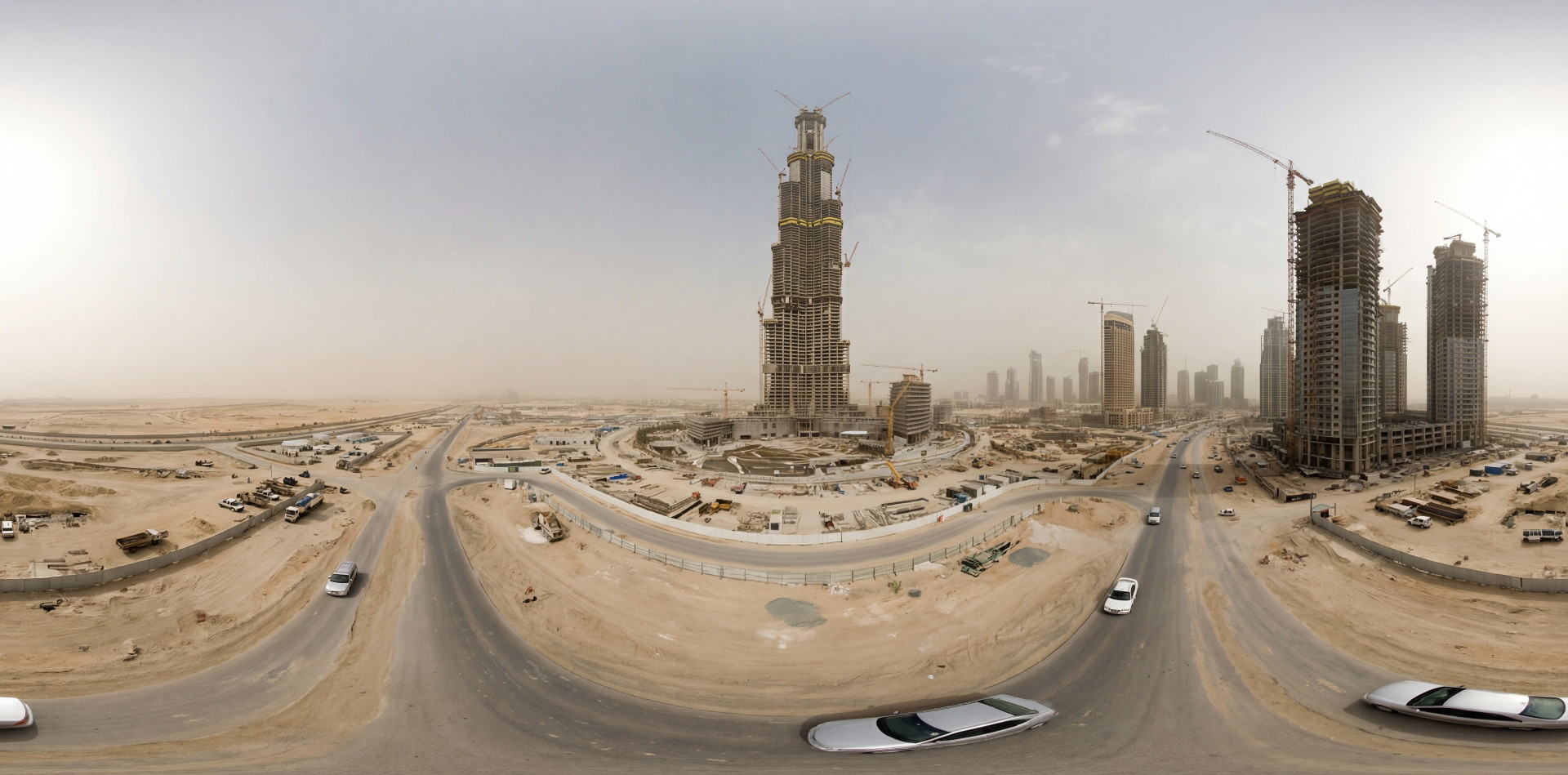
The scene shown here: topping-out work and cladding underway amid the financial crisis.
1 Jan 2009
Structural topping-out at 828 metres.
4 Jan 2010
Official opening; the tower is renamed Burj Khalifa.
2011
The Dubai Mall and Dubai Fountain complex, built alongside the tower, reach full operation.