Built on a grudge
Nero had answered the fire of AD 64 by seizing a swathe of central Rome for the Golden House: colonnades, a landscaped park and an artificial lake, all for one man. After his fall and the civil war of AD 69, Vespasian needed to prove he was a different kind of emperor.
So he drained the lake and put an amphitheatre in the hole. The land Nero took for himself came back as fifty thousand seats. Every Roman who walked through those arches understood the argument being made.
Vespasian had come to power as a jobbing general from Reate with no dynastic claim, and the amphitheatre doubled as propaganda for a new family, the Flavians. He kept Nero's giant bronze statue standing nearby but had its face reworked to resemble the sun god — a recycling of imperial vanity into public spectacle. That statue, the Colossus, later gave the amphitheatre its familiar nickname; contemporaries called the building itself simply the Flavian Amphitheatre for centuries afterward. Nero's artificial lake, the centrepiece of the Golden House grounds, had to be drained before a single foundation stone went in; engineers used its old bed as the footprint, sinking concrete piles deep enough to support four storeys above marshy ground, and excavators later found the lake's old drainage channels still running beneath the arena floor, repurposed to carry off rainwater and the blood and waste of the games above.
100,000 m³
of travertine, hauled 32km from Tivoli
~50,000
spectators, seated by rank
80
entrance arches, numbered for ticketed seating
100 days
of inaugural games staged by Titus in AD 80
Paid for by Jerusalem
The money came from the Jewish War. A reconstructed inscription from the site records that the amphitheatre was built ex manubiis — from the spoils — and the sack of Jerusalem in AD 70 supplied both the treasure and, in all likelihood, a large part of the labour.
That is the uncomfortable other half of the gift. The building that reads as generosity toward the Roman people was financed by the destruction of a city eighteen hundred miles away, and Rome made no secret of the connection. Titus paraded the Temple treasure — the menorah, the golden table, the trumpets — through the streets in his triumph of AD 71, and the relief carved inside his arch on the Sacred Way still shows soldiers shouldering the loot. The amphitheatre rose a few hundred metres from that arch, so a visitor could see the plunder in stone and the building it bought within the same walk.
Josephus, a Jewish general turned Roman chronicler, recorded that tens of thousands of prisoners were taken from the siege; some were shipped to Egyptian mines, others very likely ended up quarrying and hauling stone in Rome. No ledger names them, but the timing and scale of the workforce needed line up with the numbers he gives. Josephus himself, once a rebel commander, ended his life as a Flavian client in Rome, writing his history a short walk from the amphitheatre his former captors' spoils had funded. The travertine came from quarries at Tivoli, thirty kilometres east, hauled in on roads strong enough to bear blocks of several tonnes, some reaching eight; masons left projecting lifting bosses on the stone, meant to be chiselled flush later, and on the unfinished upper levels those bosses are still visible today, a fossil of the construction process frozen mid-task.
Rome is restored to herself, and under your rule, Caesar, what was the delight of a master is now the delight of the people.
A crowd-flow machine
Eighty ground-level arches, seventy-six of them numbered, fed a system of stairs and vaulted passages that funnelled ticket-holders to their tier. Bone or pottery tokens matched arch, stair and seat. Estimates for full evacuation run to a few minutes, which is why stadium architects still cite the plan.
Where you sat announced who you were. Senators on marble at the front, then knights, then citizens, then, at the very top under the awning masts, women and the poor — a social diagram rendered in stone.
Sailors from the imperial fleet at Misenum were stationed nearby to work the velarium, a canvas awning rigged on ropes and masts that could be angled to shade tens of thousands of spectators from the Roman sun — naval rigging skills repurposed for crowd comfort. Stone corbels for the mast poles still ring the top of the outer wall, spaced with the same regularity as the rigging points on a warship's deck. Each spectator's pottery or bone token was stamped with a section, row and seat number, matched to the numeral painted above the correct arch, so tens of thousands of people could find their place without an usher at every doorway; surviving tokens, small enough to fit in a palm, turn up in museum collections across Europe, evidence of a ticketing system that would not look out of place at a modern stadium.
What everyone says
Christians were routinely martyred in the Colosseum.
What the evidence says
There is no reliable ancient evidence for it. The association grew in the eighteenth century, when the ruin was consecrated as a site of martyrdom — which, ironically, is what saved it from being quarried away entirely.
Two thousand years of second lives
The Colosseum hosted games for roughly four centuries before the last recorded venatio, an animal hunt, in the sixth century AD. Earthquakes in 847 and 1349 brought down much of the southern outer wall, and its fallen travertine was hauled off to build Renaissance palaces, including parts of St Peter's Basilica.
What saved the rest was faith rather than law: eighteenth-century popes consecrated the ruin to Christian martyrs, real or not, which halted the quarrying almost overnight. Restoration since the 1990s has stabilised the arcades and reopened sections of the underground hypogeum to visitors.
Today the amphitheatre that Vespasian built from a burned emperor's private lake and a foreign war's plunder draws millions of visitors a year, most of them unaware that the ground beneath their feet was, within living memory of its builders, still a swamp choked with the debris of somebody else's palace.
How it unfolded
AD 64
The Great Fire; Nero takes the burnt ground for his Golden House.
AD 70
Titus sacks Jerusalem; the spoils fund the new amphitheatre.
AD 72
Vespasian drains the lake and construction begins.
AD 78· the scene
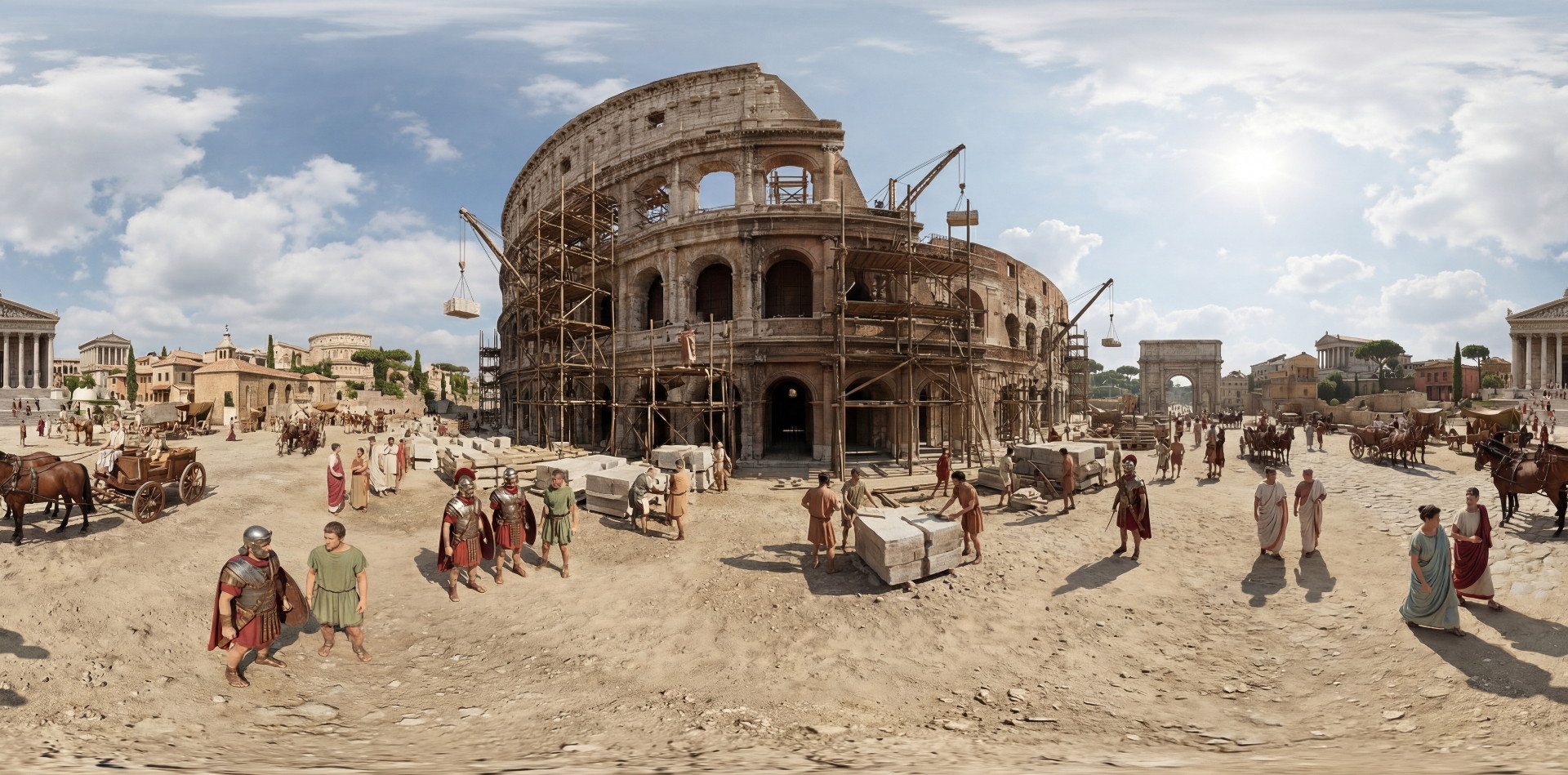
The scene here: shell complete, upper tiers being finished.
AD 80
Titus inaugurates the building with a hundred days of games.
AD 1349
An earthquake collapses the outer wall's southern face.