Three landmarks caught before they became postcards
Modern Monuments Under Construction: Three Landmarks Before the Postcard
A finished landmark is designed to look inevitable, which makes it almost undatable. Under construction it is the opposite: creeper cranes, unglazed frames, a mirror-bright surface that has not weathered yet and a skyline behind it that is still missing its later towers. These three scenes sit in the second half of the twentieth century and the first decade of the twenty-first, when the engineering was modern enough to attempt shapes nobody could previously calculate — and the photographic record is good enough to rebuild the site honestly.
The Gateway Arch is a weighted catenary in stainless steel; the Sydney Opera House shells were only made possible when Utzon cut every rib from the surface of one imagined sphere; the Burj Khalifa spirals through a series of setbacks that shed wind vortices rather than fighting them. None of these forms could be drawn, costed or erected without computation. When you see a monument whose geometry looks like it needed a machine to solve, you are after 1955 and probably after 1960.
Cranes date a scene better than the structure does
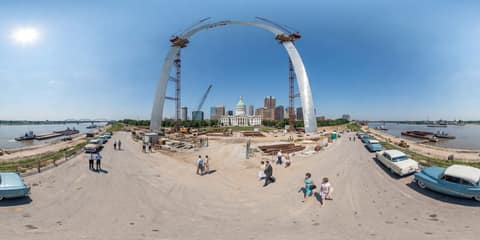
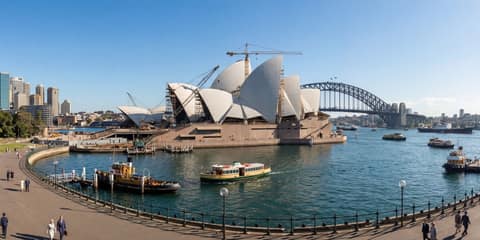
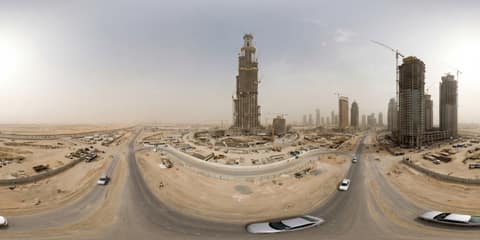
Creeper cranes climbing the legs of an arch, with a stabilising strut between them near the top, is a specific 1960s solution to a specific problem. Tower cranes everywhere across a half-built downtown, as in Dubai in 2008, is a boom rather than a project. Prefabricated tile panels being lifted into place on a shell roof is 1960s Sydney. The lifting equipment is usually the newest technology in shot, so it dates the scene more tightly than the monument it is building.
The skyline behind is a second clock
A landmark stands still once it is built, but the city around it keeps moving. The empty harbour edge beside the Opera House shells, the cleared riverfront under the Arch and the half-finished downtown around the Burj each belong to a single moment in their city's growth, and reading that backdrop usually narrows the year further than the monument in front of it.
The 3 scenes, oldest first
Each one is a real place with real coordinates, rebuilt as a 360° panorama. Read the story, or drop into the scene with no caption and try to date it from what you can see.
The clearest crane scene in the library: two legs rising independently toward a joint that had to meet within a fraction of an inch, with a strut holding them true.
What dates it: Triangular stainless steel sections narrowing with height, mirror-bright and unpainted.
Unpainted stainless steel is mirror-bright for its first years and dulls afterwards; new copper is salmon-pink and takes about twenty-five years to go green. A surface that looks wrong for the material's age is the strongest sign you are seeing a monument early in its life.
Identify the lifting gear
Creeper cranes that climb the structure they are building, luffing jibs on a tight urban plot and forests of tower cranes across a whole district each belong to different decades and different economies. Count them: one crane is a project, twenty is a construction boom.
Check whether the cladding is on
A structure that is topped out but not clad shows its frame — trusses, ribs, floor plates — and the frame is usually more datable than the façade that will cover it. Panels going on by hand from suspended platforms, rather than unitised curtain wall craned in, indicates a bespoke rather than a repetitive envelope.
Read the skyline behind, not the monument in front
Landmarks are built into cities that keep growing. A harbour with no towers behind Circular Quay, a riverfront cleared of forty blocks of warehouses, a downtown that is half foundation — the surroundings move fast and give a tighter year than the subject does.
Modern monuments questions and answers
How do you tell a monument's construction year from a photograph?
Work outward. The surface finish gives you the material's age, the lifting equipment gives you the decade of the method, and the skyline behind gives you the city's own timeline. The three together usually land within five years.
Why show landmarks unfinished?
Because the finished version is deliberately timeless. Scaffolding, cranes and bare frames are the only part of a monument that belongs unambiguously to one year, which makes the build the honest thing to reconstruct — and the more interesting thing to stand inside.
How long does copper take to turn green?
About twenty to thirty years in a coastal urban atmosphere. The Statue of Liberty was still brown when it was dedicated in 1886 and had gone fully green by the mid-1910s, which makes patina a usable clock on any copper-clad structure.
Are there older monuments in the library?
Yes — the full monuments collection runs from the Giza pyramids to the Burj Khalifa. This guide is the modern end of it; the ancient and industrial ends are covered on the collection page and the timeline.