Rails, bridges, canals and assembly lines that rewired daily life
Engineering Marvels That Rewired Everyday Life
Monuments announce; infrastructure rearranges. The eight scenes in this collection are the ones that quietly changed what an ordinary day felt like — the first intercity railway, the first underground line, an ocean-to-ocean rail link, a canal that deleted a continent from the sea route to Asia, a bridge that made a suspension span respectable, and a factory floor that turned a car into something a factory worker could buy. None of them were built to be admired. All of them were, immediately, because they made the impossible look routine within a single lifetime.
The railway invented the timetable, and the timetable invented modern time
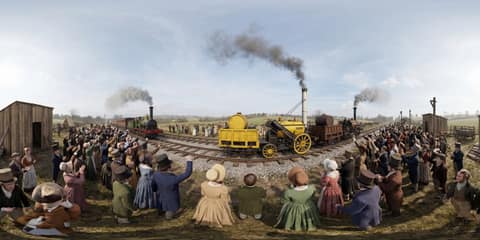
Before intercity rail, every town kept its own solar noon; Bristol ran about ten minutes behind London and nobody minded. A railway cannot run on local time without killing people, so from 1840 the companies imposed a single clock along the line and the country followed. The Liverpool and Manchester scene of 1830 is the first day of that world: double track, locomotive haulage end to end, a published timetable, and passengers who could plan a day around a machine. Look at the permanent way rather than the locomotive — stone sleeper blocks with no ballast shoulder is early railway, replaced within two decades by transverse timber sleepers and packed ballast.
Iron, then steel, and what each one lets you build
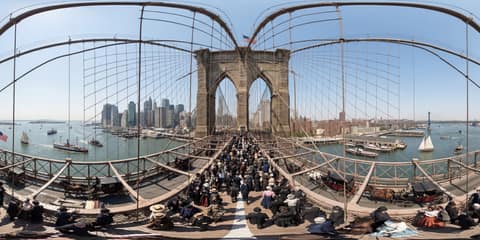
Cast iron takes compression and fails in tension, so early industrial structures are arched and thick. Wrought iron, riveted into trusses and plates, dominates the middle of the nineteenth century — Crystal Palace, the great train sheds, the Brooklyn Bridge's towers and stays. Bessemer and open-hearth steel arrive from the 1860s and change proportions again: thinner members, longer spans, and eventually a frame that carries the building so the wall can be glass. In these scenes the material is usually visible at the joint. Rivets in rows mean iron or early steel; a smooth welded seam means the twentieth century.
Canals, caissons and the parts that killed people
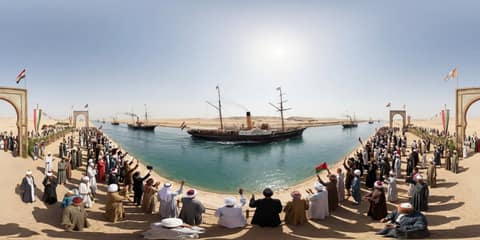
The Suez Canal cut a hundred nautical miles of desert to remove five thousand from the voyage to Bombay, and it was dug largely by hand before mechanical dredgers took over. The Brooklyn Bridge's towers stand on caissons — upturned boxes of compressed air sunk into the riverbed — and decompression sickness crippled the chief engineer, Washington Roebling, who then directed the work by telescope from his window while his wife Emily ran the site. Great engineering scenes carry that cost in plain sight: the pressurised airlock, the spoil heaps, the labour camps. It is worth looking for.
The assembly line is the last marvel, and the least photogenic
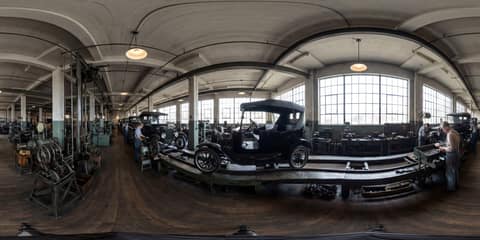
Nothing in the Dearborn scene of 1920 is tall or spectacular. A chassis moves past workers who each perform one task; the line sets the pace instead of the worker. It cut the build time of a Model T from over twelve hours to about ninety minutes and dropped the price to something a line worker could afford, which changed cities, roads and weekends more thoroughly than any bridge. Date it by the cars themselves: brass-era fittings and hand-cranked starters read pre-1915, black lacquer bodies and electric starters read the late teens and twenties.
What counts as an engineering marvel here
It compressed distance or time
Every entry either shortened a journey dramatically or made an old one repeatable to a timetable. That is the difference between a big structure and an infrastructure.
It was a first of its type at scale
Not the first experiment — the first working version that other people copied. The Metropolitan Railway was not the first tunnel; it was the first urban railway a city could actually commute on.
It forced a new standard
Railways standardised the clock, the gauge and the ticket. The Model T line standardised the task. Standardisation is the quiet legacy that outlives the hardware.
The build is visually legible
Caissons, cast-iron ribs, cut-and-cover trenches and moving lines all look like what they are, which makes the scene readable without a caption.
It has a datable opening day
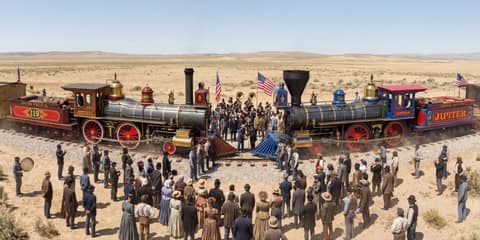
These projects end with a ceremony — a golden spike, a first train, a fleet sailing through a new cut — which gives the scene a fixed point rather than a fuzzy decade.
8 scenes in this collection
Listed oldest first. Every entry is a real location with real coordinates, rebuilt as a 360° panorama — read the full story, or drop into the scene and try to date it with nothing but what you can see.
Between Liverpool and Manchester, Lancashire, England
Early steam locomotives, including George Stephenson's famous Rocket, stand on display before massive crowds celebrating the opening of the world's first intercity passenger railway.
What dates it: Twin tracks on stone sleeper blocks, with no ballast shoulder — early permanent way.
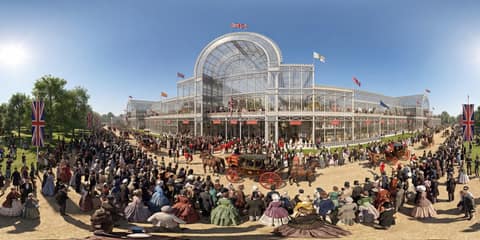
Massive crowds gather at Joseph Paxton's revolutionary Crystal Palace in Hyde Park for the Great Exhibition of 1851, the first international world's fair.
What dates it: Standardised cast-iron frames and 300,000 panes of sheet glass, assembled like a kit.
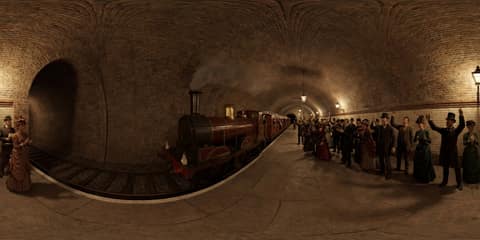
The Metropolitan Railway, Paddington to Farringdon, London
Victorian passengers wave excitedly as a steam locomotive pulls carriages through the brick-arched tunnel of London's revolutionary Metropolitan Railway, the world's first underground passenger railway.
What dates it: Brick-vaulted shallow tunnels with open sections for smoke to escape — dug from the surface, then roofed over.
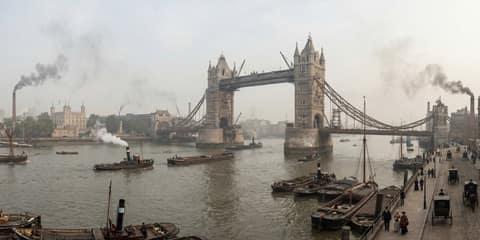
Steam-powered barges churn through the Thames beneath Tower Bridge in the heart of London during the Edwardian era, with industrial smokestacks dotting the misty skyline.
What dates it: Bascule leaves and high-level walkways: a bridge built to open, unlike any other Thames crossing.
Stone block sleepers put you before about 1840; transverse timber with ballast, chaired rail and later flat-bottom rail walk you forwards decade by decade.
Rivets versus welds
Rows of domed rivet heads mean iron or early steel fabrication. Smooth welded joints and bolted high-tensile connections mean the twentieth century.
Lighting on site
Gas lamps, then arc lamps from the 1880s, then filament bulbs indoors. The newest light source in frame gives you the earliest possible year for the whole scene.
How the load is being moved
Horse and hand-barrow, steam crane, steam shovel, electric hoist and diesel plant each occupy a distinct band of years and are usually the largest object in the picture.
London's Metropolitan Railway, opened in 1863 between Paddington and Farringdon. It was built by cut-and-cover — dig a trench, roof it, put the street back — and ran steam locomotives under a city, which is exactly as unpleasant as it sounds.
Why is the Brooklyn Bridge considered a milestone?
It combined a suspension span with diagonal stays and used steel wire at a scale nobody had risked before, giving a 486-metre main span in 1883. It proved long suspension bridges could carry heavy urban traffic safely for a century.
Which engineering feat here had the biggest economic effect?
The Suez Canal, arguably. Opening in 1869 it removed the Cape route to Asia for steamships, reshaped world trade patterns and turned Egypt into a strategic prize for the next century.
How do I date an industrial scene quickly in the game?
Find the lighting and the structural metal. Both changed in discrete, well-documented steps that were adopted quickly and never reversed, so the newest example in frame brackets the scene to about twenty years.