Famous Disasters in History, From Pompeii to Wall Street
Disasters are the most useful events in history for a very unsentimental reason: they freeze a moment. An ordinary Tuesday leaves no record, but an ordinary Tuesday interrupted by an eruption, a fire, a shockwave or a market collapse produces inventories, inquiries, insurance claims and photographs. Pompeii preserved a Roman town because it was buried in hours. The Great Fire produced the first serious building code in London. San Francisco produced the modern understanding of what shaking does to a city. Each of these five scenes is a normal day about to stop being one.
Why Pompeii is the best-documented town in the ancient world
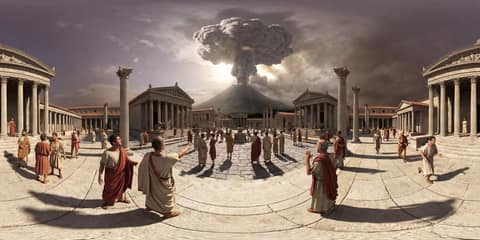
Vesuvius buried Pompeii and Herculaneum under metres of ash and pyroclastic material in less than a day in 79 AD, sealing shopfronts, graffiti, bread ovens, election notices and street fountains under a lid that kept air and looters out for seventeen centuries. The result is that we know more about ordinary Roman life in one mid-sized town than about most European cities a thousand years later. The scene is set before the collapse of the eruption column, with the plume already up and the street still functioning — which is roughly what the surviving accounts describe.
The Great Fire and the invention of the building code
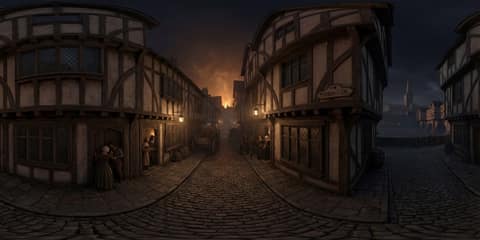
London in 1666 was timber-framed, jettied so the upper storeys leaned towards each other across lanes barely wide enough for a cart, and heavily stocked with pitch, oil and hay near the river. The fire started in a bakery on Pudding Lane, ran for four days and destroyed some 13,200 houses and 87 churches. The rebuilding acts that followed mandated brick and stone, widened streets and standardised frontages — which is why the medieval city vanishes in the visual record after 1666 and every scene from later London is legibly different in material.
San Francisco: the earthquake, then the fire that did most of it
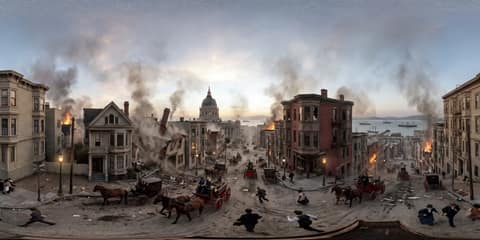
The 1906 shock lasted under a minute and was severe, but roughly four-fifths of the destruction came from the fires that followed as ruptured gas lines ignited and broken mains left hydrants dry. Dynamiting firebreaks made it worse in places. The scene is unusually rich for dating: electric trolley wires, cable car slots, brick cornices shaken into the street, wooden Victorians standing next to collapsed masonry, and press photographers with plate cameras already at work.
Ships and markets fail the same way
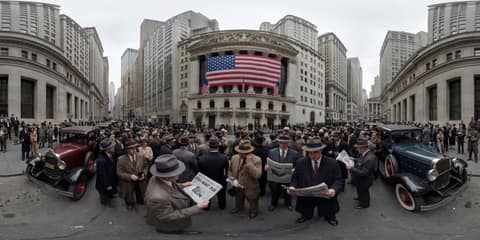
The Titanic carried lifeboats for about half the people aboard because regulations were written by tonnage rather than passenger count, and the ship's compartments were open at the top. The 1929 crash ran on margin buying and interlocking loans that were fine until they were not. Both were systems in which the safety assumption was that everything would not fail at once. Standing on the boat deck at a slight list, or on a trading floor as the ticker runs hours behind, the shape of the failure is the same: capacity that only existed on paper.
What makes a disaster scene worth building
It changed the rules afterwards
Fire codes, lifeboat regulations, building standards, banking reform. Every entry here produced a rulebook that still exists in some form.
The before-state is knowable
A disaster scene is only interesting if the normality it interrupts is documented — street layouts, ship fittings, trading floors, bakery lanes.
It is legible from inside
Smoke direction, list angle, collapsed frontages, crowd movement. Standing in the scene should tell you what is happening without a caption.
The human scale is preserved
Not spectacle for its own sake. These are shown as ordinary streets, decks and floors with people making decisions in real time.
The date is fixed to a day
24 August 79, 2 September 1666, 18 April 1906, 15 April 1912, 29 October 1929. Few events in history are pinned this precisely.
5 scenes in this collection
Listed oldest first. Every entry is a real location with real coordinates, rebuilt as a 360° panorama — read the full story, or drop into the scene and try to date it with nothing but what you can see.
A vertical column means an early eruption phase; a spreading grey ceiling means collapse. Low horizontal smoke in a street scene means wind-driven urban fire.
Building materials in the rubble
Timber frame and thatch, unreinforced brick, or steel frame with masonry cladding — each tells you the century, and each fails in a recognisably different way.
Emergency technology
Bucket chains, hand pumps, horse-drawn steam pumpers, motor fire engines and telephone alarm boxes each occupy a distinct band of decades.
Who is recording it
Engravers for 1666, plate cameras on tripods for 1906, press cameras and newsreels for 1929. The recording gear in frame is often the most precise clue available.
What was the deadliest disaster in this collection?
The eruption of Vesuvius in 79 AD, which killed thousands across Pompeii, Herculaneum and the surrounding towns. Exact figures are unknown; over a thousand bodies have been recovered at Pompeii alone.
Did the earthquake or the fire destroy San Francisco?
Mostly the fire. The 18 April 1906 shock caused severe damage, but ruptured gas lines and broken water mains turned it into a three-day conflagration that accounted for the large majority of the losses.
Why did the Titanic carry too few lifeboats?
Because British regulations set lifeboat capacity by a ship's tonnage, not by how many people it carried, and the rules had not been updated for ships of that size. The ship actually exceeded the legal minimum.
Is the Wall Street Crash really a disaster?
In the sense used here, yes — a system failing suddenly and changing the rules that followed. 29 October 1929 saw a record 16.4 million shares traded and led directly to a decade of banking and securities reform.