A film that needed an ending
The rooftop set was never meant to stand alone. It was filmed as the unresolved climax of a documentary, later released as Let It Be, about a band trying and largely failing to agree on a live show — ideas floated and dropped included a Roman amphitheatre in Tunisia, an ocean liner and a return to the Cavern Club in Liverpool. Michael Lindsay-Hogg, directing, needed footage of the group actually performing together, and the roof of their own Apple Corps building was the compromise nobody vetoed, chosen largely because it required no travel and no audience to organise.
It was decided on the morning itself, after weeks of indecision about where a live show might even happen. Engineers ran cables up from the basement studio to the roof, road manager Mal Evans hauled amplifiers up a narrow stairwell, and the band did not warn staff on other floors, neighbouring offices, or the police about what was about to start above their heads.
Weeks of filmed rehearsal at Twickenham Studios in early January, starting in the cold of a cavernous soundstage at 8am each day, had produced arguments rather than songs, and George Harrison briefly quit the band on 10 January, walking out mid-session after a row with Lennon, before returning eleven days later on condition the live-show idea be dropped entirely in favour of something simpler and closer to home, namely the basement studio at their own Apple offices on Savile Row.
42 min
total length of the rooftop performance
5
songs played, across nine takes
3
London police officers who reached the roof before the set ended
1
guest musician — Billy Preston on electric piano
Forty-two minutes, five songs, nine takes
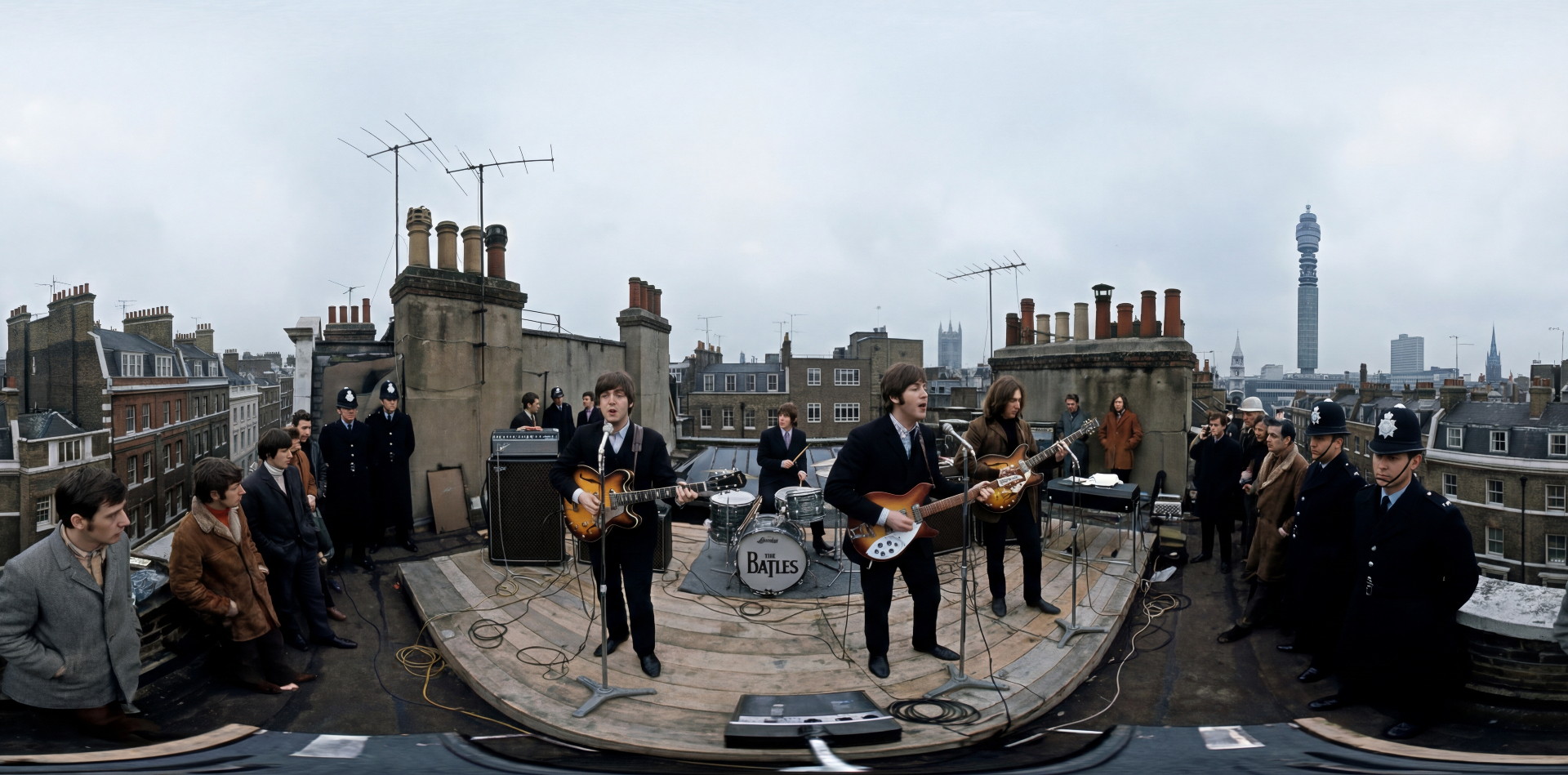
Billy Preston, an American keyboardist the band had met on tour years earlier, happened to be visiting London and was pulled in on electric piano — the closest thing to a fifth Beatle any studio recording ever credited, and his name appears alongside theirs on the 'Get Back' single label. Ringo wore his wife Maureen's red raincoat against the January cold; George and John borrowed fur-lined jackets from Yoko Ono's wardrobe truck rather than go back downstairs for their own coats.
They played 'Get Back' twice, along with 'Don't Let Me Down', 'I've Got a Feeling', 'One After 909' and 'Dig a Pony', working through nine takes in all across the roughly forty-two minutes, as engineers below — including Glyn Johns at the mixing desk — adjusted levels blind, unable to see the roof and relying on a hastily rigged intercom to know when a song had actually started.
Five cameras were positioned around Savile Row and inside neighbouring buildings, some disguised behind net curtains or hidden inside a chimney stack, to capture reactions from the street as well as the performance itself, giving Lindsay-Hogg's crew footage of bewildered pedestrians, delivery drivers and office workers leaning out of windows in overcoats against the cold that they could never have staged deliberately. The temperature that lunchtime was close to freezing, cold enough that Lennon can be heard complaining about his fingers between songs.
I'd like to say thank you on behalf of the group and ourselves, and I hope we passed the audition.
The police who couldn't quite stop it
Noise complaints from nearby offices brought uniformed police to the building within twenty minutes, and film crews were sent down to stall officers at the reception desk and on the stairs while the band kept playing above. Paul McCartney can be heard on the recording needling the situation into the closing verses of 'Get Back', singing about getting arrested.
The set ended when Ringo, watching the police reach the roof, simply stopped. It was the last time all four Beatles performed together in public, five months before Abbey Road was recorded a few streets away.
No arrests were made and no charges followed; the worst outcome was a request that the volume be turned down, delivered by a constable who by his own later account rather enjoyed the free show before doing his job and asking them to stop.
What everyone says
The rooftop concert was a spontaneous, unplanned stunt.
What the evidence says
It was filmed as the deliberate resolution of weeks of documentary shooting about a live show the band could not agree on; the location and timing were decided the same morning, but the cameras, extra microphones and film crew stationed to delay police were all arranged in advance.
From rooftop tape to restored film
The rooftop recordings became the backbone of the Get Back / Let It Be sessions, though producer Phil Spector's later overdubs on the wider album, added without the full band's agreement, caused a lasting rift; McCartney spent decades trying to have Spector's orchestral additions to 'The Long and Winding Road' stripped back, eventually releasing a stripped-down version, Let It Be... Naked, in 2003.
Michael Lindsay-Hogg's original film went largely unseen for years after its 1970 release, tied up in rights disputes and its own reputation as a document of the band's breakup rather than a celebration of their music. Peter Jackson's 2021 documentary series Get Back drew on the same footage, restored frame by frame, and gave the rooftop set a far longer, more detailed hearing than the original film had allowed.
Savile Row itself still carries a small plaque marking the Apple Corps building, and the rooftop, now largely inaccessible to the public, remains the last stage the four Beatles ever shared, a detail that gives the recording a finality nobody involved could have known about as they played that January lunchtime.
How it unfolded
Jan 1969· the scene
Sessions for what becomes Let It Be stall over where, or whether, to play live.
30 Jan 1969, morning
The band decides, same-day, to play from the Apple roof.
30 Jan 1969, lunchtime
The scene here: the set begins, traffic stops on Savile Row.
30 Jan 1969
Police arrive; film crews delay them while the songs continue.
May 1970
Let It Be is released, built around the rooftop footage as its climax.