A shoot that almost didn't happen this way
Paul McCartney sketched the idea himself: the band walking across the zebra crossing outside their own recording studio, nothing more elaborate than that, and handed the sketch to Iain Macmillan almost as an afterthought. Earlier proposals for the album's cover had been far grander, including a mountain-climbing expedition abroad, before the band settled on photographing something a hundred yards from where they were already working, saving both time and money on a tight schedule.
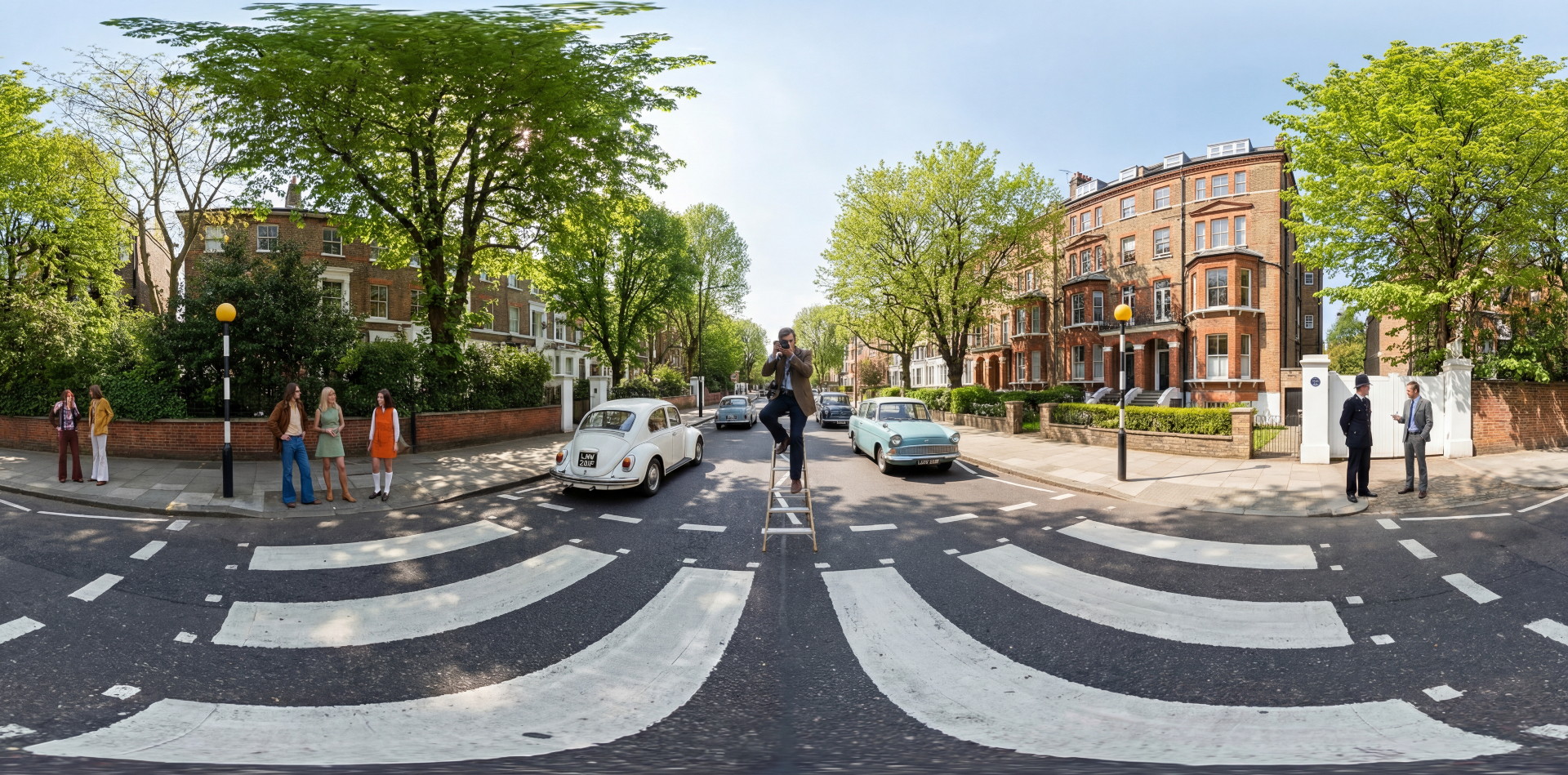
Iain Macmillan had known John Lennon and Yoko Ono and was given the job on short notice, with only a day or two to plan a shoot he had never rehearsed. He had roughly ten minutes, balanced on an aluminium stepladder set up in the middle of Abbey Road on the morning of 8 August 1969, with a single policeman holding back traffic in both directions while he took just six frames as the four men walked back and forth across the crossing.
Macmillan later described the arrangement as almost casual by the standards of a major album cover: no art director on site, no reshoot budgeted, and a policeman recruited from ordinary traffic duty rather than hired security, simply because the studio happened to be on a public road. A friend of Linda McCartney's held back the far end of traffic on foot while Macmillan worked, and the whole operation, from setting up the ladder to the band walking back inside, was over within about twenty minutes.
10 min
approximate length of the entire photo shoot
6
frames Iain Macmillan took from his stepladder
11:35 am
the time recorded for the shoot, 8 August 1969
2010
year the crossing received Grade II listed status
Bare feet and a parked Beetle
McCartney is barefoot in the chosen frame because it was a warm day in August and he had taken his sandals off between takes, not for any of the reasons fans later invented; in other frames from the same sequence he is wearing sandals again. The white Volkswagen Beetle parked to the left belonged to a resident of a nearby flat, not the band, and was left in shot by accident; its number plate was stolen so often by souvenir hunters afterward that it was eventually removed and later sold at auction.
Macmillan chose the fifth of his six frames — the one where the band's stride was most evenly matched, Lennon leading in a white suit, Ringo Starr in black, George Harrison in denim a step behind and McCartney barefoot at the rear — and the album went out with no text at all on the front, no band name, no title, on the theory that the Beatles no longer needed either. EMI's marketing department reportedly objected before relenting, since no other major release that year had dared a wordless sleeve.
The shoot was logged in the studio's own diary at 11:35 in the morning on 8 August 1969, a detail that survived only because engineers kept precise session notes; the band walked back inside afterward and returned to mixing the record within the hour.
It was the easiest thing in the world. I had about ten minutes to do it in.
A rumour that outlived the record
Within weeks of release, an American college newspaper column and then radio DJs seized on the cover as evidence supporting rumours that Paul McCartney had secretly died: his bare feet read as a corpse detail, the cigarette in his hand a mourner's marker, the number plate — LMW 28IF — decoded as 'Linda McCartney Weeps, 28 if he had lived.' None of it held up to the plain explanation the band gave at the time.
The crossing was granted Grade II listed status by English Heritage in 2010, the first stretch of road marking in Britain protected in this way, precisely because tourists kept recreating the photograph and needed somewhere durable to do it.
Apple Corps, which still holds the rights to the image, later authorised a live webcam trained permanently on the crossing so fans anywhere in the world could watch strangers dodge real traffic to restage a photograph that had taken Macmillan barely ten minutes to make.
What everyone says
The cover was designed as a coded clue that Paul McCartney had died.
What the evidence says
The 'Paul is dead' reading was retrofitted onto an unposed, largely accidental photograph months after release. McCartney was barefoot because of warm weather, and the parked Beetle belonged to a local resident, not the band.
A crossing that never stopped working
Westminster Council has had to repaint the crossing's black-and-white stripes more often than any equivalent zebra crossing in London, largely because fans posing for photographs wear the paint down and occasionally deface it during anniversaries; the council has resisted proposals to relocate the crossing altogether despite the disruption to traffic on what remains a working road.
Macmillan's contact sheet of the six frames survived and later sold at auction, along with a print personally inscribed by John Lennon; the sheet shows how narrow the difference was between the chosen fifth frame and the others, with only small shifts in the band's spacing and stride separating an iconic image from an ordinary one.
Abbey Road Studios itself continued operating as a working studio throughout the crossing's rise to fame, and musicians recording there still walk past tourists posing outside most days of the week, an arrangement that has made one of the world's most photographed pieces of tarmac also one of its most mundane, functioning streets.
How it unfolded
Early 1969· the scene
Earlier, more elaborate cover concepts for the album are dropped.
8 Aug 1969, 11:35 am
The scene here: Macmillan shoots six frames of the band crossing.
8 Aug 1969
The band returns to Abbey Road Studios to keep mixing the album.
26 Sep 1969
Abbey Road is released with the crossing photograph and no cover text.
2010
English Heritage lists the crossing as a protected historic site.