The mould, not the press
Screw presses already existed, for wine and paper alike, and moveable type had been used in China and Korea for centuries before Gutenberg attempted anything similar in Mainz. His contribution was an adjustable brass matrix mould that could cast identical pieces of type quickly and cheaply, letter after letter, in a metal alloy soft enough to cast and hard enough to survive thousands of impressions without wearing down.
That alloy — mostly lead, with tin and antimony — mattered as much as the mould itself. Antimony made the type expand slightly as it cooled, filling the matrix sharply instead of shrinking away from it, a metallurgical detail Gutenberg likely arrived at through years of trial and error as a goldsmith by training, working in near-total secrecy to protect the process from rival craftsmen.
He also had to reinvent the ink: water-based inks used for woodblock printing beaded off metal type and produced patchy, uneven letters, so his shop developed an oil-based ink thickened with copper, lead and sulphur compounds, closer in body to the varnishes contemporary panel painters were using than to anything a scribe copying manuscripts by hand would ever have needed.
~180
copies of the 42-line Bible originally printed
49
copies or substantial fragments surviving today
1455
year Fust's lawsuit cost Gutenberg his workshop
250+
European cities with printing presses by 1500
A lawsuit finishes what the Bible started
Gutenberg financed the enterprise with loans from Johann Fust, a Mainz financier, secured against the press equipment itself as collateral. By 1455, with the 42-line Bible nearly complete after roughly three years of setting and printing, Fust sued for repayment and won; Gutenberg lost his workshop, his type and most of the credit for what he had built.
Fust took over the business with Gutenberg's former assistant Peter Schöffer, who had cut much of the type and married Fust's daughter soon after, and their partnership went on to print some of the earliest commercially successful books in Europe, while Gutenberg himself died in relative obscurity around 1468, granted a small court pension in his final years.
A Paris scholar named Guillaume Fichet, writing a few years later, marvelled that a man in Mainz could produce more books in a day than a scribe's workshop could in a year — one of the earliest surviving outside reactions to what the new workshop had actually achieved, written before most of Europe had even seen a printed page.
To the praise and glory of God... this book was completed with the help of the Most High.
Around 180 Bibles, then everything
Roughly 180 copies of the 42-line Bible were printed, on paper and a smaller number on vellum, each one still hand-finished afterward with rubricated initials and painted decoration to make it resemble the manuscripts readers already trusted and were willing to pay for. Printing did not yet look like a break from tradition; it looked, to its first buyers, like faster tradition.
Within fifty years presses using variants of Gutenberg's system operated in more than 250 European cities, and millions of books existed where a few decades earlier there had been thousands copied by hand. The cost of a text fell so far that literacy, and later the Reformation's pamphlet wars, became possible on a scale no manuscript economy could ever have supported or sustained.
Forty-nine copies or substantial fragments of the 42-line Bible are known to survive, scattered from Mainz to Tokyo, and a complete vellum copy has not changed hands publicly in decades — the last comparable sales, of individual leaves and partial sets, still commanded seven-figure sums at auction.
What everyone says
Gutenberg invented printing itself.
What the evidence says
Woodblock printing was already established in Europe and Asia, and moveable type had been used with ceramic and metal characters in China and Korea generations earlier. Gutenberg's system was the first to combine casting, ink and press into something Europe could scale industrially and cheaply.
A notary's record of the quarrel
The clearest surviving account of the Fust dispute comes from a notarial instrument drawn up by Ulrich Helmasperger in November 1455, recording sworn testimony from the lawsuit itself. It describes Fust's original loan of 800 guilders, a second sum advanced later toward paper and wages, and witnesses testifying that Gutenberg had spent the money on 'tools' for the work rather than diverting it elsewhere, as Fust had alleged in court before the arbitrators.
The 42-line page took its name from the number of lines set in the two columns of most pages, though the earliest gatherings used forty lines before the compositors tightened the setting to save paper, a detail visible only by comparing surviving copies closely, page by page, against one another for the shift.
Enea Silvio Piccolomini, later Pope Pius II, wrote from Frankfurt in March 1455 describing quires of a strikingly legible Bible he had been shown there by an agent selling advance copies, so cleanly printed and uniform, letter for letter, that he claimed a man could read it easily without spectacles, one of the earliest outside witnesses to the new Bibles circulating in the trade before a single one had even been bound.
How it unfolded
c. 1440
Gutenberg begins developing type-casting in secrecy while living in Strasbourg.
1450
Fust lends Gutenberg capital to set up and equip the Mainz workshop.
1455· the scene
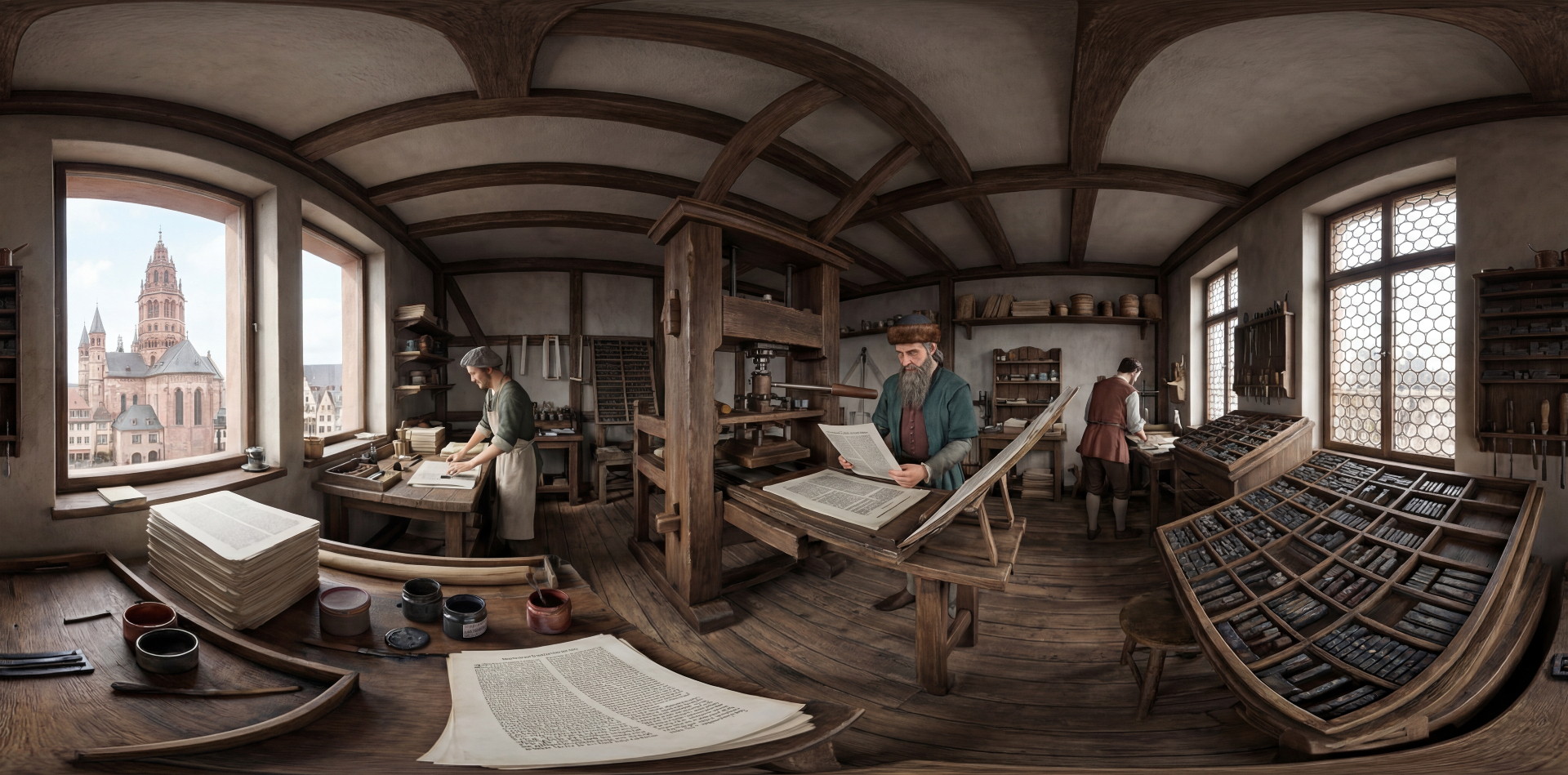
The scene here: the 42-line Bible nears completion on the press.
1455
Fust sues and wins; Gutenberg loses his equipment and much of his credit.
1457
Fust and Schöffer print the Mainz Psalter, the first book to carry a printed date.
1500
An estimated 20 million books have been printed across Europe.