A festival that outgrew its own permit
Four young promoters — Michael Lang, Artie Kornfeld, John Roberts and Joel Rosenman — lost their original venue in Wallkill, New York, weeks before the date after local opposition, and only secured Max Yasgur's 600-acre dairy farm in Bethel in late July, giving construction crews barely a month to build a stage, sound towers and campgrounds. Fencing and ticket booths were still incomplete when traffic backed up for miles on the New York State Thruway, prompting radio stations to broadcast warnings telling listeners to turn back.
Faced with tens of thousands of people who had already arrived and no way to check tickets, the organisers made it a free concert rather than risk a crush at the gates. That single decision, forced by circumstance rather than idealism, is what let the crowd swell past 400,000, since anyone who could reach Bethel could now simply walk in across open fields once the perimeter fencing was abandoned unfinished. Traffic backed up along Route 17B for an estimated seventeen miles at the worst of it, and some ticket-holders abandoned their cars on the roadside and walked the last several miles on foot carrying tents and sleeping bags.
Yasgur, a Republican dairy farmer with no particular sympathy for the counterculture, leased his land for $75,000 after two other landowners backed out under pressure from neighbours; he later told the crowd from the stage on Sunday afternoon that he was pleased so many young people had come to Sullivan County, and that half a million people camped together for three days had proved something to the world. His herd of dairy cows had to be moved off the property entirely for the duration of the festival.
~400,000
attendees against an expected 50,000
600 acres
of Max Yasgur's farmland used for the site
4 days
15–18 August 1969, extended by the Monday overrun
32
acts that performed across the weekend
The logistics nobody planned for
Governor Nelson Rockefeller considered sending National Guard troops before deciding the roads were too jammed for anyone to move safely, guard or otherwise, and instead declared the surrounding area a disaster zone so state resources could be mobilised without a military presence on site. Army helicopters, borrowed from a nearby base, ended up flying in doctors, food, flowers and even performers such as John Sebastian because the local roads were impassable for two days straight.
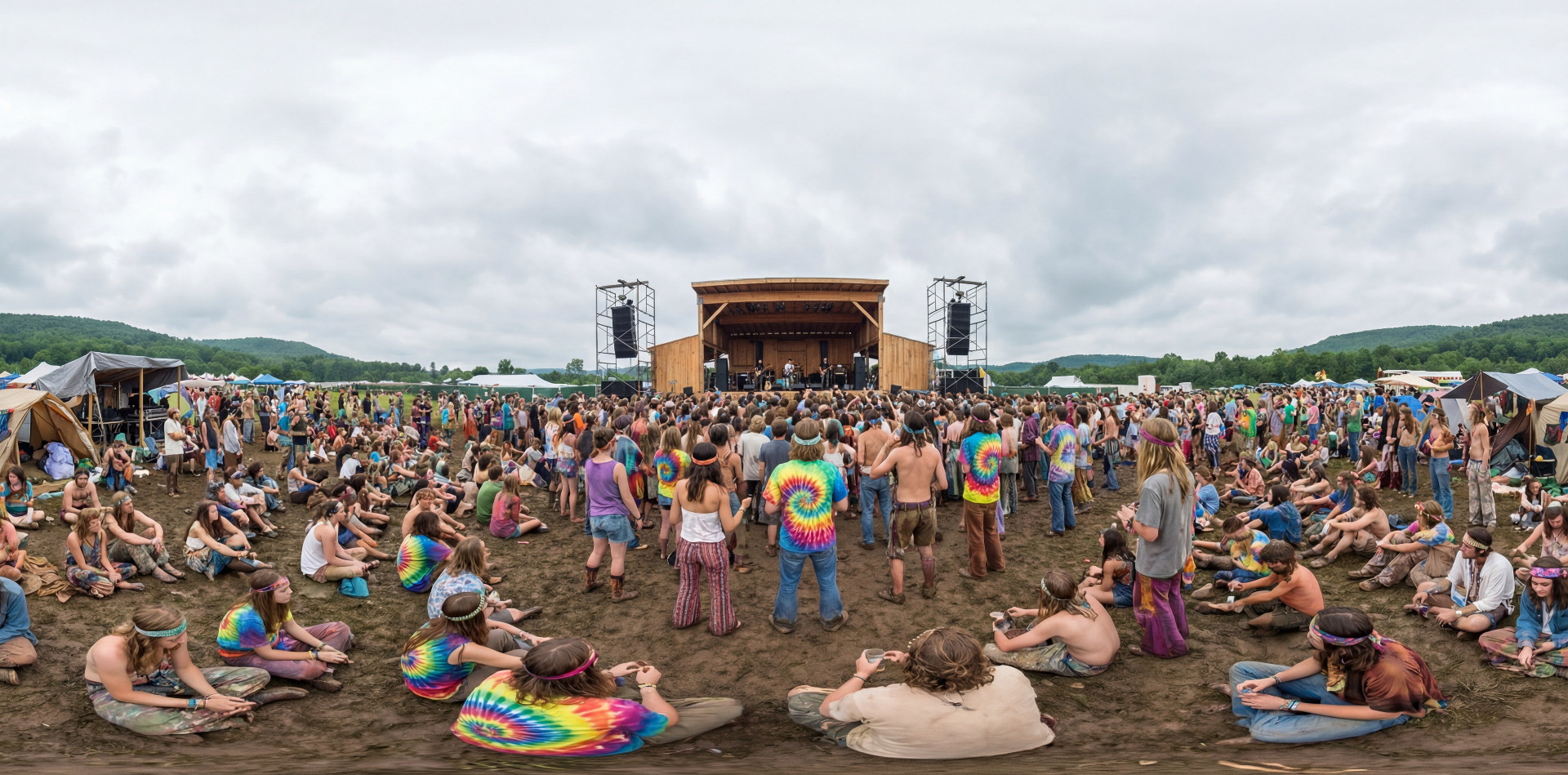
Rain on the Saturday turned the natural bowl of the field into deep mud thick enough to swallow shoes, and organisers broadcast warnings over the PA about bad batches of drugs circulating in the crowd — one of the more sobering, least mythologised moments of the weekend, delivered calmly between sets by a stage announcer asking people to look out for one another.
A local Jewish community centre and a hastily deputised group of doctors and nurses, backed by members of the Hog Farm commune who had been flown in specifically to help run the campground and food lines, staffed a free medical tent that treated thousands of cases of cut feet, bad trips and exhaustion over the four days, with almost no serious injuries reported despite the crowd's size. Free food, including thousands of sandwiches, was flown in by helicopter after word spread that supplies on site had run out by the second day.
We must be in heaven, man.
Monday morning, half the crowd gone
By the time Jimi Hendrix took the stage on Monday morning, the festival was eighteen hours behind schedule and most of the crowd had already left for work or school; estimates put his audience at around 30,000, a tenth of the peak. His extended, distorted rendition of 'The Star-Spangled Banner' during that set became one of the era's most replayed pieces of film.
Three deaths were recorded — one from a drug overdose, one from a tractor accident involving someone asleep in a sleeping bag — against two births reported by attendees. The clean-up took weeks; the myth took no time at all to set in.
The promoters lost roughly $1.3 million on the weekend itself, a debt only recovered years later through the 1970 documentary film and its soundtrack album, which turned a financial disaster into the most profitable failure in concert history.
What everyone says
Woodstock happened in the town of Woodstock.
What the evidence says
The festival was named for the town where Bob Dylan and other musicians had settled, but after two venues fell through it was actually staged on Max Yasgur's farm in Bethel, roughly sixty miles away.
The farm afterward
Max Yasgur faced a lawsuit from neighbouring farmers over the mess left on his land, and some local businesses boycotted his dairy in the aftermath, but he remained unapologetic in interviews, saying the young people who came had behaved decently under difficult conditions. He sold the farm in 1971 and died of a heart attack in 1973, before the site became the pilgrimage destination it is today.
The field itself was largely left undeveloped for decades until Alan Gerry, a local cable-television entrepreneur, bought the land and funded the Bethel Woods Center for the Arts, which opened a museum and performance venue on the original site in 2008, using recorded testimony and artefacts to reconstruct the weekend for visitors who were not born when it happened.
A simple monument, a stone marker placed by a former concertgoer in 1984, still stands on the original hillside marking roughly where the stage once faced the crowd, and it remains a low-key counterpoint to the museum's more elaborate exhibits a short walk away.
How it unfolded
Spring 1969· the scene
Wallkill, New York, rejects the festival after local opposition.
Late July 1969
Max Yasgur agrees to lease his Bethel farm with only weeks to prepare.
15 Aug 1969
Richie Havens opens; the crowd already dwarfs the ticketed capacity.
16–17 Aug 1969
The scene here: rain, mud and a crowd past 400,000 on the hillside.
18 Aug, morning
Jimi Hendrix closes the festival to a much-thinned crowd.