Four scenes where culture happened in an ordinary place
Pop Culture Landmarks: Four Ordinary Places Where Culture Happened
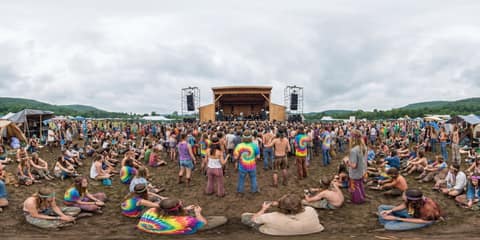
Three of these four scenes happened in 1969, within seven months of each other, and none of them took place anywhere designed for the purpose: a dairy farm in Bethel, the roof of an office at 3 Savile Row, and a zebra crossing outside a recording studio in St John's Wood. The fourth reused a stadium built for the 1932 Olympics rather than constructing a new one. That is the argument of this guide — postwar culture kept happening in borrowed venues, and the borrowed venue is usually the thing that dates the scene.
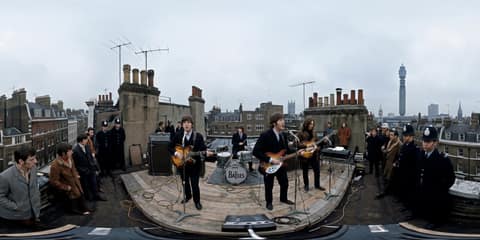
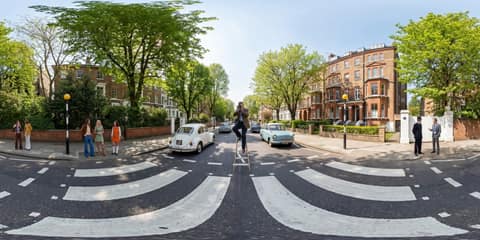
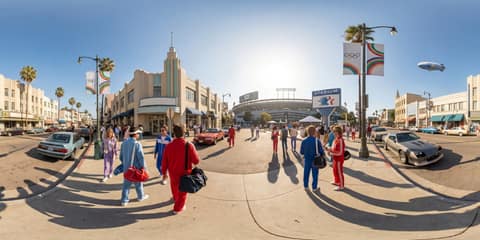
Woodstock was held on Max Yasgur's farmland after the town of Wallkill refused a permit, sixty miles from the town it is named after. The Beatles played on their own office roof because they had run out of appetite for a concert hall. The Abbey Road cover was shot on a public crossing in ten minutes with a policeman holding traffic. Los Angeles in 1984 turned an existing 1932 coliseum into an Olympic stadium with temporary structures and paint. When the setting looks improvised, you are looking at postwar culture rather than institutional culture.
1969 is the densest year in the library
Within seven months: the rooftop concert in January, the Abbey Road shoot in August, Woodstock the same month. All three are British or American, all three are unticketed or semi-accidental as spectacles, and all three were photographed heavily enough to rebuild. If a scene in this guide shows winter coats on a London roof, or a natural amphitheatre of farmland packed to the treeline, you can go straight to the year and spend your remaining attention on the map.
By 1984 the crowd is the product
The Los Angeles Games are the hinge. They were funded almost entirely by broadcast rights and corporate sponsorship, the first to be run that way, and it shows in the scene: sponsor branding on display, bright 'festive federalism' colour panels dressing a fifty-year-old stadium, and a parade of nations missing the Eastern bloc flags entirely because of the boycott. Fifteen years after Woodstock, the same kind of gathering has become a television product with an absence you can count.
The 4 scenes, oldest first
Each one is a real place with real coordinates, rebuilt as a 360° panorama. Read the story, or drop into the scene with no caption and try to date it from what you can see.
A Georgian townhouse roof in Mayfair with a small stage against a chimney stack, office workers watching from neighbouring roofs and a crowd blocking the pavement below.
What dates it: A Georgian townhouse roof in Mayfair, with the band on a small stage against a chimney stack.
The moment the spectacle becomes a broadcast: a 1932 stadium dressed in temporary colour, sponsor branding on show and a parade with the Eastern bloc missing.
What dates it: The 1932 Coliseum reused rather than replaced, with temporary structures and bright 'festive federalism' colour panels.
A striped zebra crossing with belisha beacons is British, not American, and the pattern of the stripes and the beacon globes narrow the decade. Road markings are municipal and change on a documented schedule, which makes them one of the most reliable dating clues in any urban scene.
Read the parked cars, especially the accidental ones
The white Volkswagen Beetle on Abbey Road belonged to a resident and dates the shot as precisely as anything the photographer intended. Abandoned cars lining a rural road for miles, as at Bethel, tell you the crowd overwhelmed the infrastructure — an event that outgrew its own planning.
Look at the sound equipment
Scaffolded stage towers with primitive PA stacks, dwarfed by the crowd, is late-1960s festival practice. By the 1980s the rig is flown rather than stacked, and by the 2000s the screens are larger than the stage. Amplification scales faster than almost anything else in a crowd scene.
Count the flags and note which ones are missing
At an Olympic scene the parade of nations is a political document. Missing Eastern bloc flags means 1984; a missing American flag means 1980. Absence is evidence, and it is usually more specific than the architecture.
Watch what people are wearing for the weather
The rooftop concert was cold enough that Ringo borrowed a red raincoat, which is why winter clothing on a Mayfair roof is a January clue rather than a fashion one. Match the clothing to the season before you match it to the decade.
Pop culture landmarks questions and answers
Why are three of these scenes from the same year?
Because 1969 is when the postwar cultural record gets dense and the venues get informal at the same time. The rooftop concert, the Abbey Road shoot and Woodstock all happened within seven months, all three were heavily photographed, and all three took place somewhere never designed to host them.
How do you date a crowd scene?
Sound equipment, vehicles and clothing, in that order. Stage rigs and cars change fast and are dated precisely in the record; clothing changes fast but is worn unevenly, so it confirms a decade rather than establishing one.
Is Woodstock actually in Woodstock?
No. It was held on Max Yasgur's dairy farm near Bethel, about sixty miles from the town of Woodstock, after a permit was refused elsewhere. Scenes that carry the wrong place name in their title are exactly the kind the game rewards you for knowing.
What else is in the culture collection?
The full collection runs from the printing press through the first electric light to the stage and the stadium. This guide covers its postwar end; the earlier scenes sit on the collection page and across the timeline.