A bid nobody else wanted
Montreal's 1976 Games had left the city with debt it would spend three decades repaying, and after Denver voters rejected the 1976 Winter Games outright, the IOC found itself with exactly one credible bidder for 1984. Los Angeles used the leverage. Peter Ueberroth, the businessman running the organising committee, refused to let the city underwrite the risk.
The deal that resulted broke with fifty years of Olympic practice: existing venues only, a single new structure built with private money, and a budget run like a corporation's rather than a government's. Ueberroth negotiated broadcast rights and sponsorship deals directly, limiting official sponsors to one per product category so companies would bid against each other for the privilege.
City voters had passed a charter amendment in 1978 explicitly barring the use of public tax money to finance the Games, a clause inserted after residents watched Montreal's overruns on the evening news. Ueberroth's committee had to raise every dollar of the roughly $500 million budget itself, anchored by ABC's $225 million contract for the American television rights, the single largest deal in the entire budget, plus thirty exclusive corporate sponsors bidding against each other by category.
$232.5m
operating surplus, the first profitable Games on record
140
nations competing, despite the Soviet-led boycott
4
golds won by Carl Lewis, equalling Jesse Owens's 1936 total
1
new permanent venue built — the swim stadium at USC
Nine hundred volunteers and a coat of paint
With almost no new construction to show off, the organisers hired designer Deborah Sussman to unify dozens of ageing venues under a single look, a palette of magenta, vermilion, chrome yellow and aqua that came to be called 'festive federalism.' Scaffolding towers, banners and even rented fencing were repainted in the scheme so that USC's football stadium and the UCLA gymnastics hall read as one Games.
Roughly 30,000 volunteers staffed venues, and the organising committee leaned on existing college dorms at USC and UCLA to house athletes instead of building an Olympic Village from scratch. The approach cut costs sharply but also meant improvisation: press facilities, media buses and security checkpoints were bolted onto buildings never designed for an Olympics. Sussman's studio, working out of a converted warehouse in Venice, produced more than a hundred distinct graphic elements from that single rented palette, all of it struck and trucked away within days of the closing ceremony.
The gamble on volunteers and borrowed infrastructure paid off in a way that surprised even Ueberroth's own staff. Traffic engineers had predicted Los Angeles freeways would seize up under Olympic crowds, so businesses staggered work hours and commuters were urged to carpool; congestion during the Games ended up lighter than an ordinary summer weekday, a result city planners had not dared to forecast out loud beforehand.
We are not going to mortgage the future of this city for the sake of two and a half weeks of sport.
Cold War arithmetic
The Soviet-led boycott, announced on 8 May 1984, kept East Germany, Cuba and thirteen other countries away in retaliation for the American-led boycott of Moscow four years earlier. Officials cited 'chauvinistic sentiments' in the United States; few observers doubted the tit-for-tat logic. Romania broke ranks and came anyway, to a standing ovation at the opening ceremony that reportedly lasted several minutes longer than any other national delegation received.
The absences thinned some fields badly — Soviet gymnasts and wrestlers were sorely missed — but ticket sales barely dipped. Carl Lewis matched Jesse Owens's 1936 haul of four golds, and swimmer Rowdy Gaines and gymnast Mary Lou Retton became instant household names on the strength of NBC's blanket coverage.
Attendance across the sixteen days topped 5.7 million ticketed spectators, a figure the organisers had not dared promise publicly given the boycott. Sponsors who had paid a premium for exclusive category rights, from Coca-Cola to Fuji Film's rival Kodak, found the crowds and ratings held up regardless of which flags were missing from the parade of nations. ABC's ratings held too, helped by the time-zone quirk executives had worried over: West Coast events aired live in prime time back east, and the broadcast became the template American networks would use for every Summer Games that followed.
What everyone says
The 1984 boycott gutted the Games as badly as 1980's had.
What the evidence says
Fourteen Eastern bloc countries stayed away, but 140 nations still competed — more than any prior Olympics — and ticket revenue held up. The absences hurt specific sports, not the Games as a spectacle.
The surplus that changed the argument
Ueberroth's committee closed the books with roughly $232.5 million left over, an outcome so unusual for an Olympics that it was treated as a scandal in reverse — reporters kept asking where the catch was. Some of the surplus endowed the LA84 Foundation, which still funds youth sport in Southern California decades later.
The template stuck. Every subsequent bid city has had to answer for its finances against the 1984 comparison, for better or worse, and Los Angeles itself was awarded the 2028 Games partly on the promise of doing it again with existing stadiums.
Ueberroth himself was named Time's Man of the Year for 1984, an honour rarely given to a sports administrator, and he went on to run Major League Baseball as commissioner. The Coliseum he leaned on, already fifty-nine years old in 1984, is now the only stadium on Earth scheduled to host Olympic opening ceremonies in three different centuries once 2028 arrives. Economists still cite the 1984 model when a city council debates whether to bid at all, since it remains the clearest proof that a Games can turn a profit without new debt.
How it unfolded
1976
Montreal's Games leave the city with debt that takes 30 years to clear.
1978
Los Angeles becomes the sole bidder; voters bar public money and the IOC accepts private-financing terms.
May 1984· the scene
The Soviet Union announces its boycott, citing security concerns.
28 July 1984
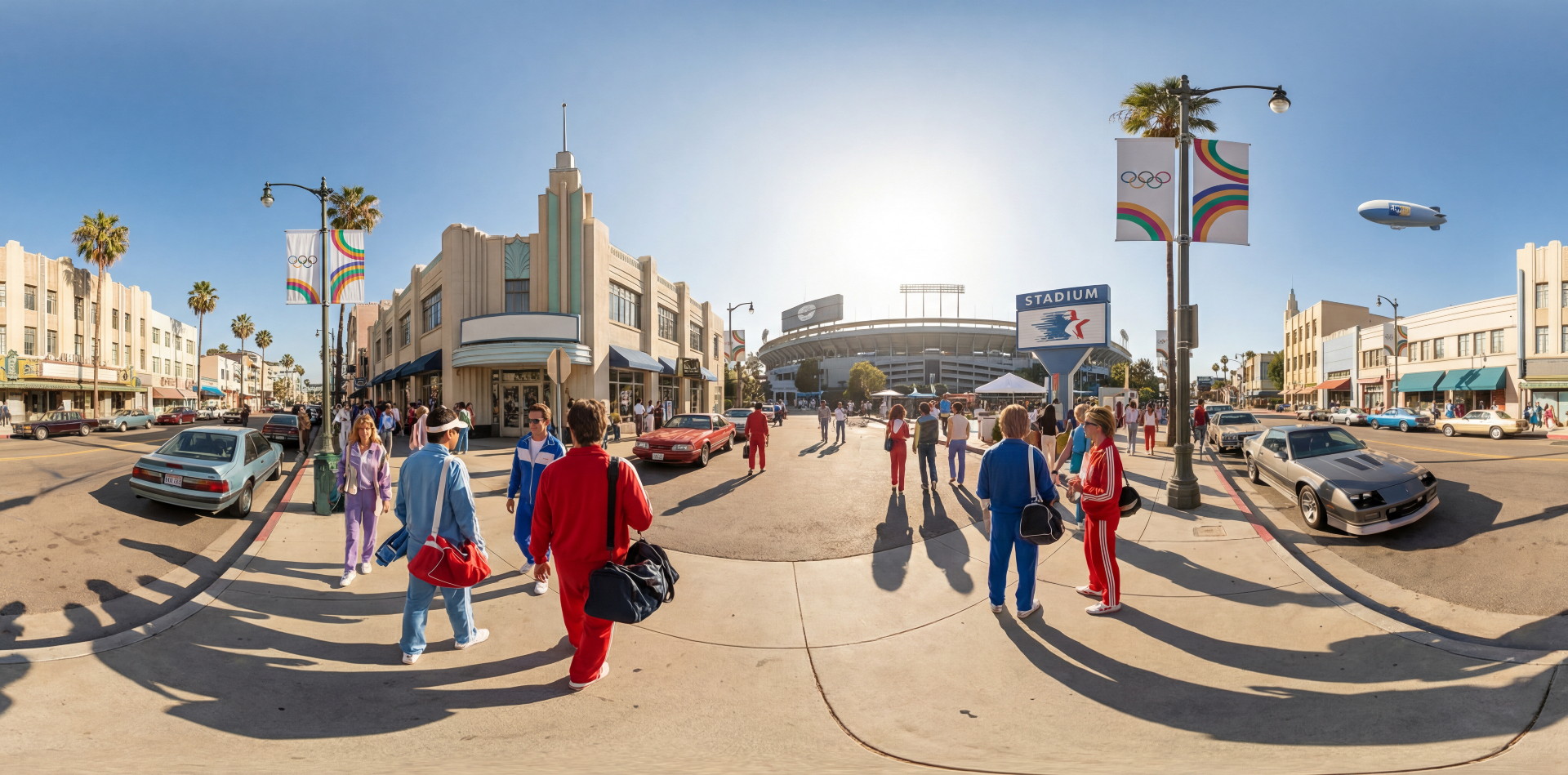
Opening ceremony at the Coliseum — the scene shown here.
12 August 1984
Closing ceremony; the Games post their unprecedented surplus.
1985
The LA84 Foundation is endowed with a share of the surplus for Southern California youth sport.