A sculptor's revenge
Michelangelo had spent years fighting with Julius II over an unfinished marble tomb before the pope redirected him to the ceiling instead, a job Michelangelo suspected rivals, especially the architect Bramante, had pushed onto him hoping he would fail publicly at a medium he had barely practised. The contract, signed in May 1508, fixed his fee at 3,000 ducats, a sum he complained barely covered his assistants, pigments and the cost of the scaffold itself. He wrote bitterly about the assignment even as he redesigned its scope, discarding an initial, simpler plan for the twelve apostles in favour of something far larger, a change Bramante is said to have mocked as beyond a sculptor's competence.
What he produced instead ran to some 343 figures across roughly five hundred square metres: the Genesis narrative down the spine, prophets and sibyls along the sides, and the ignudi — nude youths of his own invention with no scriptural basis at all — filling the corners between scenes, a purely decorative device he nonetheless treated with the same anatomical seriousness as the biblical figures, and later counted individually by cataloguers working from photographs during the twentieth-century restoration.
He had almost no experience of large-scale fresco before this commission, having trained chiefly as a sculptor in the workshop of Domenico Ghirlandaio years earlier; contemporaries later noted the irony that the man who insisted he was 'no painter' would go on to reshape what painting in Rome looked like for the following century.
~300
figures painted across the ceiling
500 m²
total painted area
4 yrs
from 1508 to completion in 1512
20 yrs
gap before Michelangelo returned to paint the Last Judgement
A day's work has to survive the night
True fresco requires pigment applied to wet plaster so it binds chemically as it dries, which meant Michelangelo and his assistants could only plaster as much wall as could be painted in a single session, a giornata, before the surface set beyond use. Mistakes could not be corrected once the plaster hardened, only chiselled out entirely and redone from scratch at real cost in time and materials.
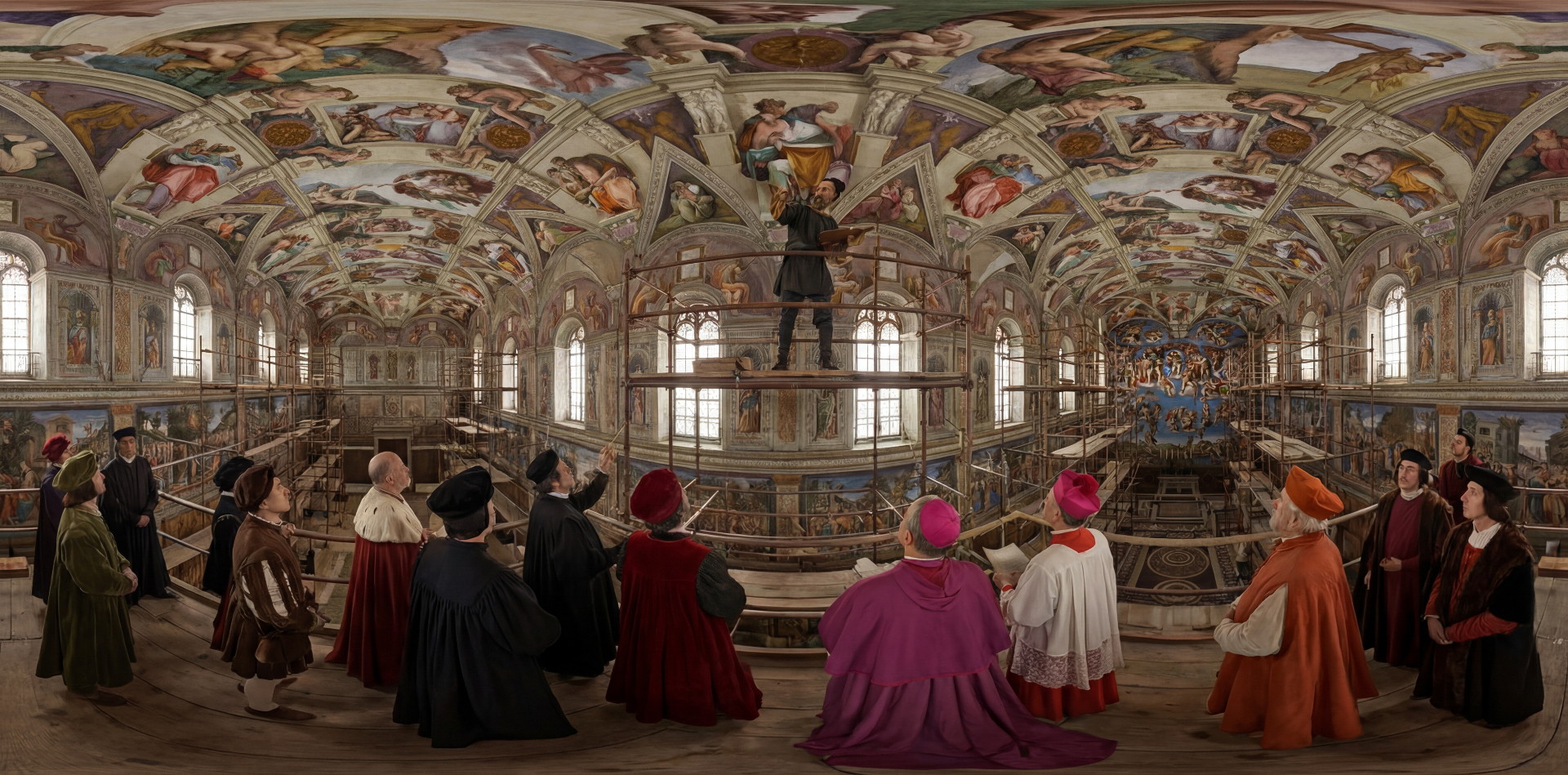
He designed his own scaffold, a flat platform on wooden brackets slotted into holes drilled near the tops of the walls rather than built up from the floor on freestanding towers, as the architect Bramante had first proposed and Michelangelo rejected as impractical and full of holes that would have marred the finished vault. The bracketed design let services continue on the chapel floor below throughout the four years of work, with a curtain screening the altar area from falling plaster and dust, and it left no permanent scars once the brackets were removed and the holes plastered over.
Analysis of the plaster seams by later conservators identified some 480 individual giornate across the whole ceiling, evidence of exactly how the work was paced day by day, with the more confident, faster patches concentrated toward the end as Michelangelo's technique with the brush, rather than the chisel, visibly improved over the four years.
I am no painter.
Centuries of candle soot
Michelangelo finished in October 1512, having worked largely without the team of assistants he had originally hired, dismissing most of them early in frustration at what he considered their inadequate quality. Julius II reportedly pressured him constantly to finish faster, at one point threatening to have him thrown from the scaffold if the work did not progress.
The ceiling's modern reputation for muted, sombre colour was mostly candle soot and old varnish accumulated over four and a half centuries. The 1980–1994 cleaning campaign, funded by a Japanese television network and controversial at the time among art historians who feared solvents would strip away Michelangelo's own final shadow-glazes, removed layers of animal-glue varnish applied by earlier restorers and revealed brighter blues, oranges, acid greens and pinks beneath centuries of grime, a palette far closer to Florentine Mannerist painting than the sombre, brownish ceiling generations of visitors had assumed was original.
The chapel remains in active liturgical use today, hosting the conclave that elects each new pope, so the ceiling Michelangelo painted under commercial and political pressure now presides, largely unaltered in its essentials, over one of the Catholic Church's most consequential and secretive rituals.
What everyone says
Michelangelo painted the ceiling lying on his back.
What the evidence says
He stood on his scaffold, leaning backward with his head tilted up for hours at a stretch, a posture he complained gave him lasting neck and eye strain in a wry poem, complete with a sketch of himself, that he wrote about the ordeal.
Mould, verse, and a change of scale
Early in 1509, damp seeping through the old roof caused a bloom of mould to spread across an already finished section near the entrance wall, forcing Michelangelo to strip the plaster back and start again from bare stone; he blamed the wet Roman winter and his own plaster mixture, and only after adjusting the lime ratio, on the advice of local craftsmen, did the intonaco hold cleanly for the giornate that followed. He wrote to his father that the outbreak had nearly ruined months of work and cost him further ducats he had not budgeted to lose.
In a sonnet sent to his friend Giovanni da Pistoia, accompanied by a sketch of himself bent backward at the easel, Michelangelo complained his beard pointed at the sky, his brush dripped paint onto his face, and his skin had stretched so taut from the posture that his spine had folded like a Syrian bow.
After finishing the Deluge, one of the first scenes he attempted, Michelangelo judged its many small figures illegible from the chapel floor sixty feet below and enlarged his scale sharply for everything that followed, a visible shift historians can trace scene by scene as the ceiling progresses from the entrance wall toward the altar, the figures growing bolder and simpler with each successive panel.
How it unfolded
1505
Julius II commissions Michelangelo for his tomb, a project later shelved for decades.
1508
Work on the ceiling begins after Michelangelo's initial reluctance and resistance.
1510· the scene
The scene here: scaffold up, the Genesis scenes underway across the vault.
1512
The ceiling is unveiled on All Saints' Eve to immediate acclaim.
1980–1994
A cleaning campaign removes centuries of soot and old varnish from the vault.