A fort wall, not a temple
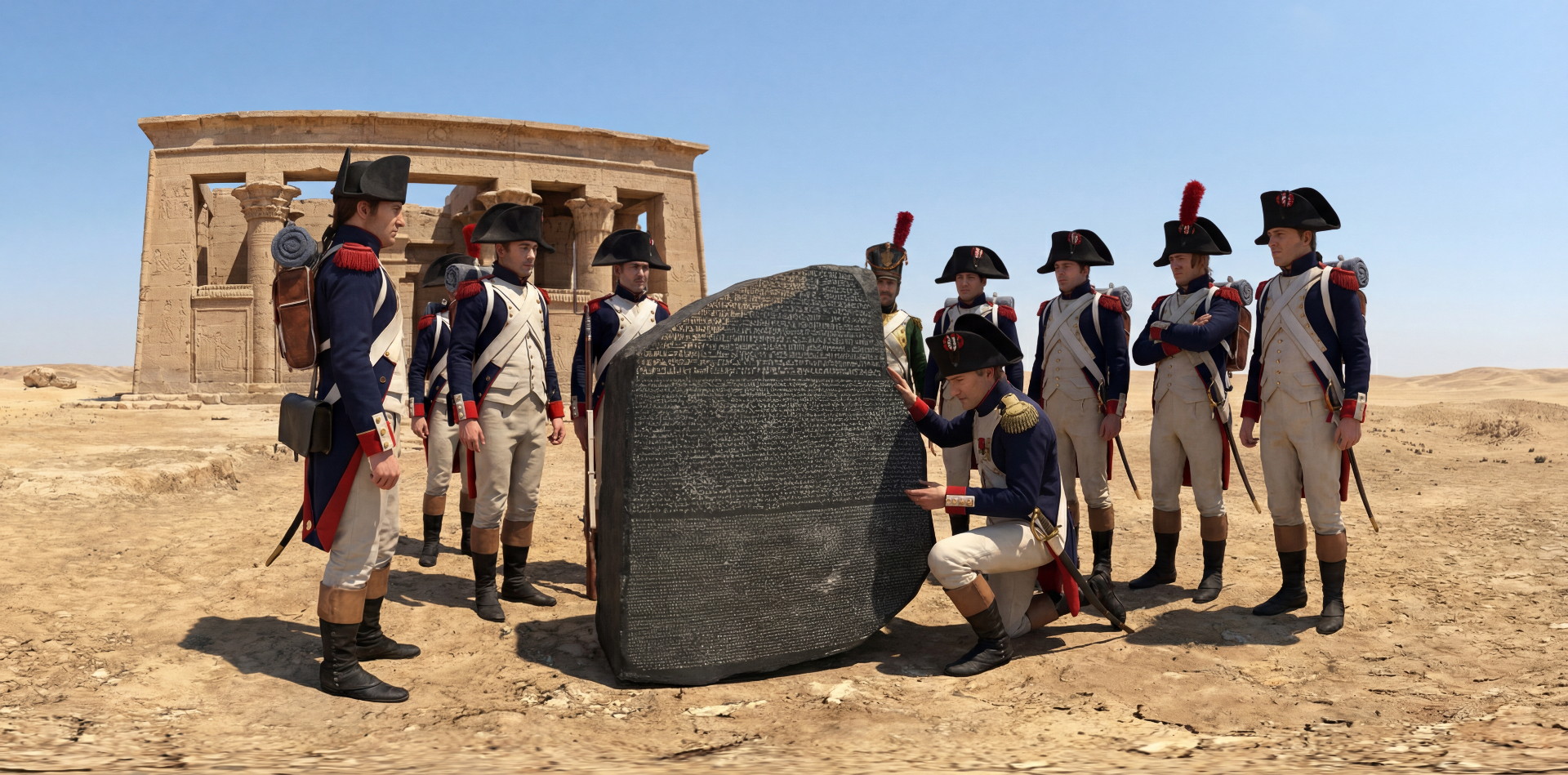
Napoleon's 1798 invasion of Egypt brought with it not just soldiers but 167 scholars, engineers and scientists of the Commission des Sciences et des Arts, tasked with documenting the country scientifically — the expedition that founded modern Egyptology as a discipline. The stone itself was found by accident in mid-July 1799, reused centuries earlier as ordinary building material in a wall of Fort Julien, an old Mamluk-era fortification near the town of Rashid (Rosetta) that French engineers were now demolishing and rebuilding to strengthen Nile Delta defenses against the British fleet.
Officer Pierre-François Bouchard, a lieutenant of engineers supervising the demolition work, spotted that the slab carried three separate blocks of carved text and had the sense to report it up the chain to General Jacques-François Menou rather than let it be broken up for more building rubble, as was reportedly the fate of similar inscribed fragments uncovered nearby during the same fortification project.
The stone measures just under four feet tall, about two feet nine inches wide, some eleven inches thick, and weighs approximately 762 kilograms — a slab of dark grey-and-pink granodiorite, not the basalt long assumed. What survives is only the middle portion of a much larger stela; the missing upper section is thought to have carried a scene of Ptolemy V presenting offerings before the gods, standard iconography for temple decrees of this type, while the lower-left corner is also broken away.
196 BC
date of the decree inscribed on the stone
3
scripts carved into the stone: hieroglyphic, demotic, Greek
1822
year Champollion announced his decipherment
1802
year the stone entered the British Museum
Three scripts, one guess
The stone preserves a single priestly decree issued by a council of Egyptian priests meeting at Memphis in 196 BC, honouring the boy pharaoh Ptolemy V Epiphanes on the first anniversary of his coronation, written out in hieroglyphic script for the gods, demotic for everyday administration, and Greek for the ruling Ptolemaic bureaucracy — the last readable without difficulty by any educated European scholar. The working assumption, correct as it turned out, was that all three versions said essentially the same thing.
British polymath Thomas Young, better known for work on the wave theory of light, made the first real breakthrough around 1814, correctly identifying that hieroglyphs inside oval cartouches — including the name of Ptolemy — spelled foreign royal names phonetically rather than functioning purely as pictorial symbols. Young published his findings anonymously in an 1819 Encyclopaedia Britannica article, but he could not extend the phonetic method convincingly to native Egyptian words themselves.
Scholars attached to the French expedition in Cairo made ink-rubbing copies and plaster casts of the stone within months of its discovery, and Napoleon reportedly ordered lithographic prints distributed to European institutions before the stone itself was surrendered. This meant that even after the object left Egypt, accurate printed facsimiles of all three texts were already circulating among academies in Paris, London and beyond, letting rival scholars race toward decipherment independently of who physically held the slab.
It is a complex system, writing figurative, symbolic, and phonetic all at once, in the same text, the same phrase.
Champollion's leap
Jean-François Champollion, who had taught himself Coptic as a teenager believing it descended directly from ancient Egyptian, built on Young's phonetic insight and, comparing the cartouche names ‘Ptolemy’ and ‘Ramesses’ found on the Rosetta Stone and on inscriptions from Abu Simbel, worked out in 1822 that hieroglyphic writing combined phonetic and symbolic signs together within the same text rather than being purely one system or the other. He set out the full system in a letter addressed to Bon-Joseph Dacier, permanent secretary of the Académie des Inscriptions, read before the Academy on 27 September 1822.
The stone itself never reached Paris. Under the 1801 Treaty of Alexandria ending the French campaign in Egypt, French antiquities including the stone were surrendered to British forces as war trophies rather than returned to France, over the objections of French scholars who tried to hide it among personal baggage. It has been in the British Museum since 1802, missing only a brief 1917 evacuation to an Underground station during air-raid fears in the First World War.
Champollion, reportedly overcome on realising the system he had cracked while comparing the cartouches on 14 September 1822, is said to have rushed to his brother Jacques-Joseph's office at the Institut de France exclaiming ‘Je tiens l'affaire!’ — ‘I've got it!’ — before collapsing from nervous exhaustion and remaining largely bedridden for several days afterward, unable to work until he had recovered enough to write up his findings formally.
What everyone says
The Rosetta Stone is made of black basalt.
What the evidence says
It is granodiorite, a grey igneous rock. The ‘black basalt’ description was repeated in early British Museum catalogues and stuck in popular use for well over a century.
A fragment that rewrote a field
Champollion's decipherment opened every hieroglyphic text in Egypt to translation for the first time in over a thousand years, since knowledge of the script had died out with Egypt's last priests in the fourth century AD. Tomb walls, temple inscriptions and papyri became readable history rather than decoration almost overnight, and scientific Egyptology, with Champollion himself appointed the Louvre's first curator of Egyptian antiquities in 1826, was founded as a discipline within a single generation.
The stone remains the single most-visited object in the British Museum, drawing crowds that outnumber those for any other item in the collection, and has been displayed there since 1802 with only occasional periods off view. Egypt's Supreme Council of Antiquities, through former minister Zahi Hawass among others, has formally requested its permanent return on several occasions since the early 2000s, citing its removal under wartime conditions; the museum has so far declined, citing its 1963 governing act restricting deaccessioning.
Modern multispectral and 3D-imaging studies carried out by the British Museum in recent decades have recovered faint traces of red and blue pigment and older graffiti scratched into the stone's surface, evidence that it was repeatedly repainted in antiquity and later scrawled on by early European visitors — including, reportedly, museum staff testing white paint-filled lettering — long before Bouchard's soldiers ever pulled it from a fort wall in 1799.
How it unfolded
196 BC
The original decree is issued at Memphis under Ptolemy V.
July 1799· the scene
The scene here: French troops uncover the stone at Fort Julien near Rashid.
1801
Treaty of Alexandria transfers the stone to British forces.
1802
The stone goes on display at the British Museum.
1814–1819
Thomas Young identifies phonetic use of hieroglyphs for foreign names.
1822
Champollion announces a working decipherment of the full script.