The end of the common pot
The original 1620 agreement with the Merchant Adventurers pooled all labour and produce for seven years, with profits split later between colonists and investors. Bradford recorded that the arrangement bred resentment: the industrious felt they fed the idle. In 1627 the colony bought out its London backers for £1,800, paid off over years, and divided land and cattle among the 156 residents by household.
The effect was immediate. Families that had grown grudging corn for the common store began planting far more once it was their own, a shift Bradford himself credited with ending years of chronic hunger among people who, only a few seasons before, had been burying half their number each winter.
The buyout was arranged through eight colonists, later called the Undertakers, who personally assumed the debt in exchange for a temporary monopoly on the fur trade — a private guarantee standing behind a public settlement that London's investors had otherwise given up as a bad venture. Edward Winslow and William Bradford himself were among the eight, meaning the colony's own governor carried a large personal share of a debt that took the better part of two decades to finally clear in full.
156
residents of Plymouth Colony in 1627
£1,800
debt owed to London investors, paid off in instalments
7 yrs
length of the original communal-labour agreement
1
street the entire settlement was built along
A street, not a frontier fort
By 1627 Plymouth was one street running from the shore up to a hilltop fort that doubled as a meeting house, its cannon facing the bay rather than the woods. The town's own defence rested less on the palisade than on the alliance struck in 1621 with Massasoit of the Wampanoag, still holding despite mounting friction over land and trade.
A Dutch visitor, Isaack de Rasieres, described the settlement that year: houses set along the single road, a fort with six cannon, and fields laid out on the slopes beyond — a portrait detailed enough that historians still use it to reconstruct the colony's layout, since no map or plan of the town from that period itself survives.
De Rasieres also noted the settlers kept watch in armed pairs and carried muskets even to church, a habit that struck him as excessive but which Plymouth's leaders regarded as ordinary prudence after six years of living, at best, on sufferance from their neighbours. His account also describes the colony's modest wampum trade with the Dutch at New Amsterdam, an exchange of shell beads for furs that Plymouth adopted that same year and that soon became a staple of trade across New England.
By this time harvest was come, and instead of famine now God gave them plenty... any general want or famine hath not been amongst them since to this day.
Outgrown almost immediately
Even as Plymouth stabilised, it was about to be eclipsed. Three years later the Massachusetts Bay Colony would land over a thousand settlers with far greater capital, founding Boston and drawing trade and migration away from the older, poorer colony to its south. Plymouth would remain independent until 1691, but always the smaller neighbour.
What Plymouth kept was precedent: its compact, its land division and its relatively cooperative dealings with the Wampanoag were studied and sometimes copied by the colonies that followed and eventually outgrew it, even as those newer settlements dwarfed it in population and capital within a decade.
By the time Plymouth was folded into the Province of Massachusetts Bay in 1691, its population had grown to roughly 7,000, still a fraction of Boston's, and its distinct legal identity survived afterward mainly in county names and in the memory later generations built around 1620. Plymouth Rock itself was not singled out as sacred ground until 1741, and the reconstructed 1627 village now open to visitors, Plimoth Patuxet, was built in the twentieth century from archaeological and documentary evidence rather than any surviving original structure, none of which lasted the intervening centuries.
What everyone says
Plymouth Colony was a thriving, well-fed settlement from early on.
What the evidence says
For its first seven years it ran on communal labour that produced chronic shortages. Bradford blamed the system itself, and productivity only recovered once land was privately assigned in the 1620s.
What Bradford wrote down
Almost everything known about the 1627 division comes from a single source: William Bradford's own manuscript, Of Plymouth Plantation, kept as a working record across roughly two decades of his governorship rather than composed afterward from memory. It lists the 1627 land and cattle division household by household, down to which family received which cow or goat share.
The manuscript itself vanished from Massachusetts during the American Revolution, apparently carried off by a British officer, and turned up decades later in a London bishop's library; it was not returned to the United States and published in full until 1856, meaning most of what nineteenth-century Americans believed about Plymouth came from other, secondhand accounts.
Bradford's spare, unsentimental style — recording deaths and debts in the same flat tone as good harvests — is part of why historians still trust the document: he had no later reputation to protect and no reason to flatter a colony that, by the time he was writing its early chapters, had already outlived the crisis years he was describing.
How it unfolded
1621
Peace agreement struck with Massasoit and the Wampanoag.
1623
Private household plots first tried for corn, easing food shortages.
1627· the scene
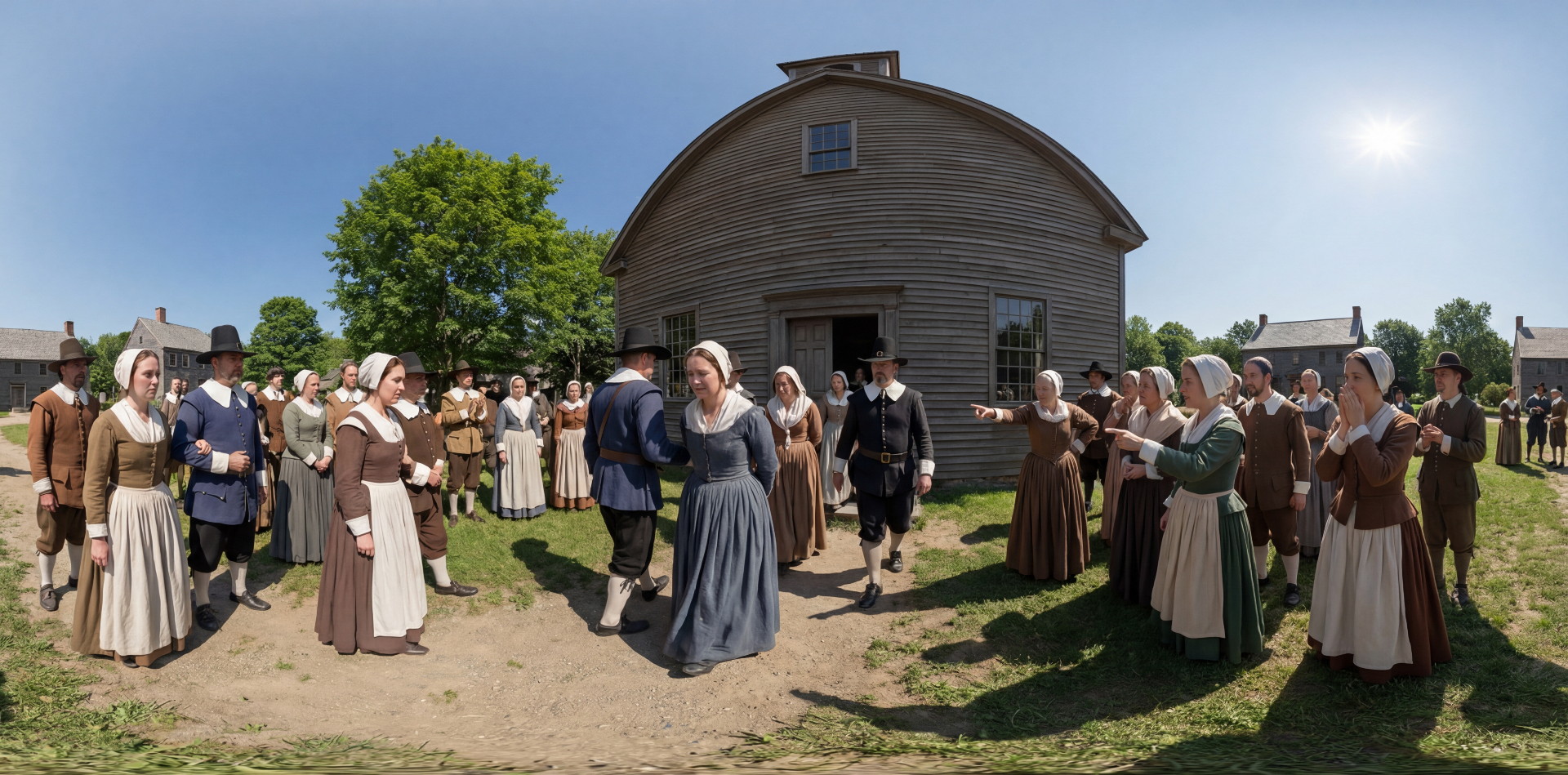
The scene here: full division of land and livestock among families.
1627
Colony agrees to buy out the Merchant Adventurers for £1,800.
1630
Massachusetts Bay Colony founded nearby, quickly overshadowing Plymouth.
1691
Plymouth Colony absorbed into the Province of Massachusetts Bay.