Papermakers with a theory
Joseph-Michel and Jacques-Étienne Montgolfier ran a paper manufacturing family business in Annonay and had experimented with small paper balloons over a fire since 1782, noticing that smoke seemed to carry things upward. They concluded, wrongly, that they had isolated a special lifting gas they called ‘Montgolfier gas’, rather than simply heated air, a belief that persisted among the brothers themselves even as other scientists began to suspect the true, simpler cause.
Their first public demonstration, in Annonay in June 1783, sent an unmanned balloon roughly two kilometres into the air in front of a crowd of local dignitaries, and news of it reached the French Academy of Sciences within days. The Annonay balloon, made of paper glued to a canvas lining and roughly 33 feet in diameter, took several hands nearly ten minutes just to fill before the ropes were released.
The brothers fed their fires with a mix of straw, wool and even old shoes, believing certain smoky materials produced more lifting gas than others; the true cause, plain heat, meant the choice of fuel made almost no difference at all to how well the balloon flew. Their earliest experiments, conducted quietly at home with paper bags held over a fire, reportedly convinced Joseph-Michel first, after he noticed a bag of smoke drift up his chimney rather than settle in the flames.
8 min
duration of the Versailles flight
~3 km
distance the balloon travelled with its animal crew
~60 ft
height of the decorated balloon envelope
120 yrs
gap between this flight and the Wright brothers' powered flight
A sheep as a stand-in for a man
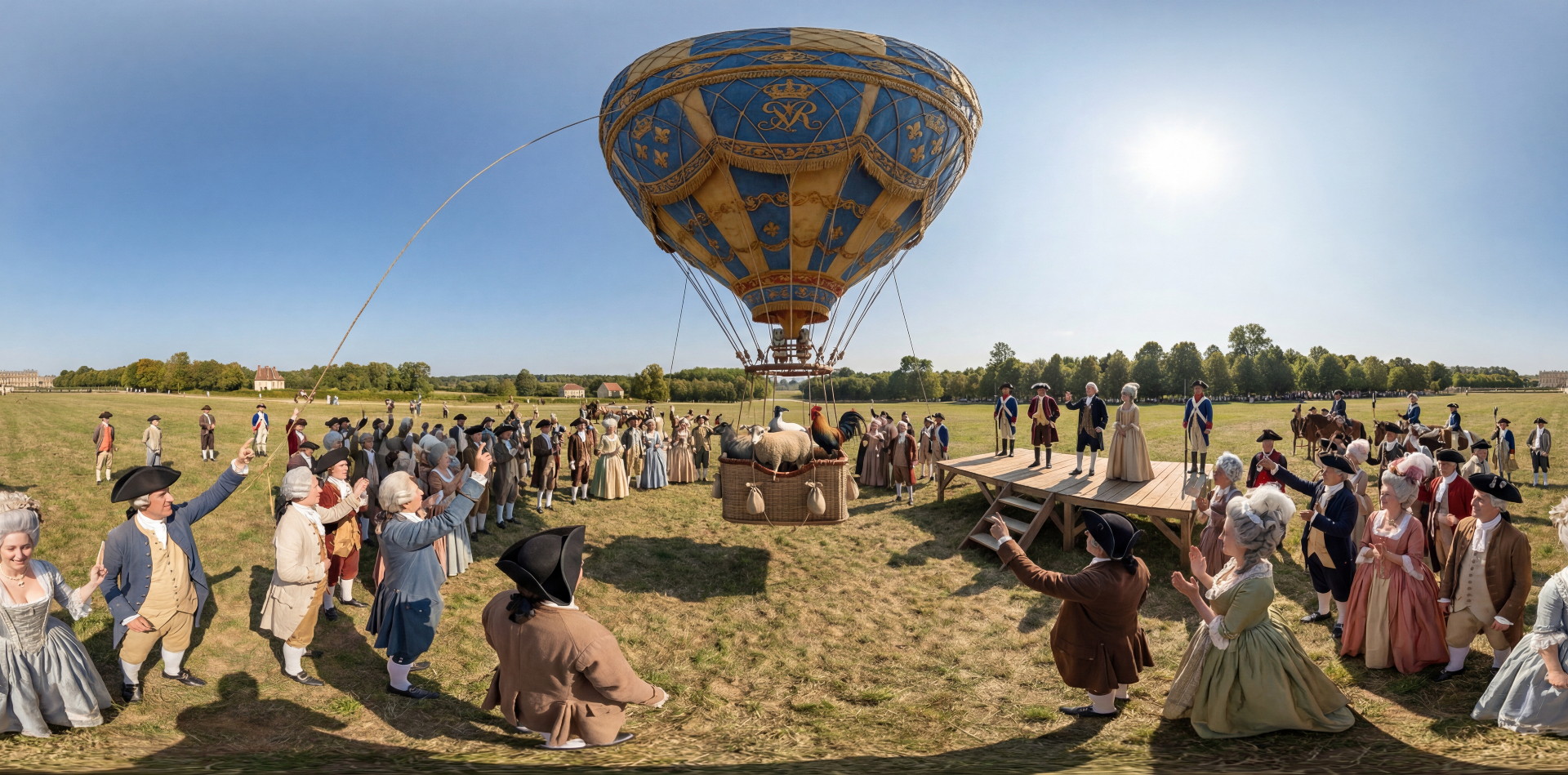
Summoned to Versailles, the brothers built a far larger balloon — nearly 60 feet tall, decorated in blue and gold with the king's monogram and painted with suns, fleurs-de-lis and zodiac signs — and on 19 September 1783 launched it from the Château de la Muette before Louis XVI, Marie Antoinette and a crowd estimated in the tens of thousands. The passengers, a sheep named Montauciel, a duck and a rooster, were a deliberate experiment: nobody knew whether altitude itself might kill a living creature, and the duck was included specifically as a control, since it was already known to tolerate high altitude in flight.
The flight lasted about eight minutes and covered roughly three kilometres before landing safely in a nearby wood; the animals emerged apparently unharmed, though the sheep reportedly had trodden on the rooster during the descent, bruising one of its wings without doing any lasting damage. Crowds who had followed the balloon's low arc across the park reached the landing site within minutes, eager to confirm for themselves that the animals had truly survived the ascent.
A report on the flight, drawn up for the Academy of Sciences and reportedly reviewed with Benjamin Franklin among the assembled observers, recorded the basket's construction and the animals' condition on landing in careful, almost clinical detail, treating the event as a genuine scientific trial rather than mere spectacle. The sheep, Montauciel — whose name meant ‘climb to the sky’ — was afterward retired to live out its days at the royal menagerie, a minor celebrity of the court.
I did not think to see, in my time, such a proof of the possibility of leaving the earth and travelling through the air.
Humans go up next
Confident the danger was manageable, Jean-François Pilâtre de Rozier and the Marquis d'Arlandes made the first free flight carrying humans on 21 November 1783, launching from the grounds of the Château de la Muette and rising over Paris for about 25 minutes, covering some 5.5 miles before landing beyond the city's southern edge, tending the fire aboard the balloon itself with wet sponges to control any stray flames that threatened the paper envelope.
Balloon mania swept France within months — fabrics, hairstyles, snuffboxes and porcelain were named ‘à la Montgolfier’, and shops sold engravings of the flight to a public that could not get enough of it — and ballooning became the first form of human flight, over a century before the Wright brothers' powered aircraft.
Benjamin Franklin, then serving as American minister in Paris, watched an early hydrogen balloon launch that December and wrote to a fellow member of the Royal Society describing the crowd's astonishment, adding that he did not know ‘what use it can be’ but that it was too remarkable to ignore.
What everyone says
The Montgolfiers understood that hot air itself provided the lift.
What the evidence says
They believed they had discovered a unique lifting gas released by burning specific materials like straw and wool. The correct explanation — heated air simply being less dense than cold air — was only widely accepted later.
A slow correction
The rival hydrogen balloon developed almost simultaneously by physicist Jacques Charles proved the more practical technology in the long run, since hydrogen needed no onboard fire, but the Montgolfiers' hot-air method survives today essentially unchanged in modern sport ballooning.
It was not until well into the nineteenth century that the physics of buoyancy in gases was generally accepted as the explanation, finally displacing the idea of a special ‘Montgolfier gas’ that the brothers themselves had never abandoned.
A full-scale replica of the Versailles balloon has been built and flown at Annonay for anniversary celebrations, and the original launch site there is marked with a monument to the brothers, who never fully understood the principle their invention proved, dying decades before physicists settled the question of buoyancy that their own balloons had first raised.
How it unfolded
1782
The Montgolfier brothers begin small-scale experiments with hot-air lift.
June 1783· the scene
First public unmanned demonstration flight at Annonay.
19 Sept 1783
The scene here: sheep, duck and rooster fly at Versailles before Louis XVI.
21 Nov 1783
Pilâtre de Rozier and d'Arlandes make the first crewed free flight over Paris.
Dec 1783
Benjamin Franklin watches an early hydrogen balloon ascent in Paris.