Choosing the problem nobody else was solving
By the 1890s, well-funded rivals including Samuel Langley, secretary of the Smithsonian Institution and backed by tens of thousands of dollars in government and private money, were chasing powered flight mainly by building bigger, more powerful engines and simply assuming stability and control would follow once enough thrust was available. Wilbur and Orville Wright, running a modest bicycle shop in Dayton, Ohio, on a fraction of that budget, decided control was the harder and more important problem, and spent hours watching buzzards and pigeons to study how birds shifted their wingtips to bank and turn.
Their breakthrough was wing-warping: twisting the wingtips in opposite directions using a system of cables and pulleys operated by the pilot's hips, giving an aviator genuine roll control for the first time in the history of flight. They tested the idea patiently on tethered kites and then full gliders at Kitty Hawk, North Carolina, from 1900 onward, chosen for its steady coastal winds, isolation from prying press, and soft sand landings, refining the design across three separate seasons before ever attempting powered flight.
Langley's own well-publicised attempt, the man-carrying Aerodrome, was launched by catapult from atop a specially built houseboat on the Potomac River just nine days before the Wrights' success at Kitty Hawk, and it plunged straight into the water both times it was tried, nearly drowning its pilot on the second attempt. The very public failure, covered by national newspapers, briefly made powered flight look like an expensive rich man's folly rather than an achievable engineering goal.
12 sec
duration of the first powered flight
852 ft
distance of the day's longest flight
27 mph
headwind the Flyer launched into
200+
wing shapes tested in the brothers' homemade wind tunnel
When the published tables lied
Their 1901 glider performed far worse than calculations based on the German pioneer Otto Lilienthal's widely trusted published lift tables had predicted, a discrepancy serious enough that Wilbur privately doubted whether powered flight was achievable within their lifetimes. In response the brothers built their own six-foot wind tunnel in the back room of their Dayton bicycle shop over the winter of 1901, testing more than two hundred different wing shapes on a homemade balance they designed themselves, generating new and far more accurate lift and drag data from scratch rather than continuing to trust the existing European literature.
That self-generated wind-tunnel data, combined with a light aluminium-block engine they designed and built because no commercial manufacturer made anything powerful enough for their needs at a weight the airframe could lift, let the brothers design the 1903 Flyer with real engineering confidence rather than the hopeful guesswork that had characterised most of their rivals' projects.
Their bicycle-shop mechanic Charlie Taylor, working from rough sketches the brothers provided, machined the entire four-cylinder engine block by hand in about six weeks using only basic shop tools, producing roughly twelve horsepower from a design light enough to fly, at a time when commercially available petrol engines of similar output weighed far too much for any aircraft of the Flyer's modest size and wingspan to lift off the ground.
Success four flights thursday morning all against twenty one mile wind started from level with engine power alone average speed through air thirty one miles longest 57 seconds inform press home christmas.
Four flights, five witnesses
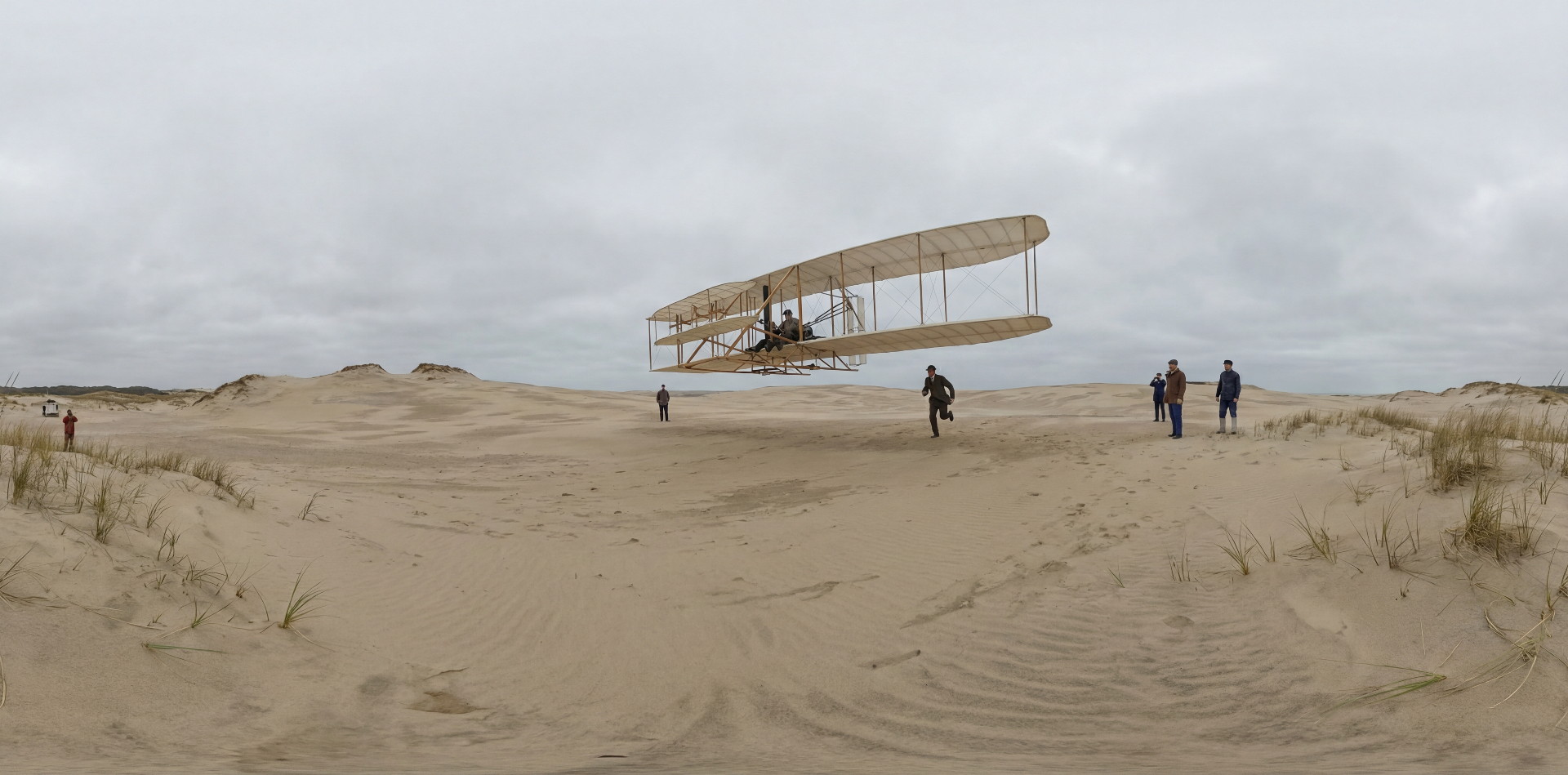
On the cold, windy morning of 17 December 1903, with a coin toss deciding pilot order after an earlier attempt by Wilbur had stalled the aircraft, Orville flew first: 120 feet in twelve seconds, into a stiff headwind of roughly 27 miles an hour, watched by five witnesses including three men from the local lifesaving station and a teenage boy from the nearby village. John T. Daniels, one of those lifesavers who had never operated a camera before, tripped the shutter on a pre-positioned camera to capture the moment of lift-off in the single most reproduced photograph in aviation history. The fourth and longest flight of the day, piloted by Wilbur, covered 852 feet in 59 seconds before a sudden gust damaged the aircraft on landing.
The brothers wired their father, Bishop Milton Wright, a brief telegram announcing success from the Kitty Hawk weather station that afternoon; a local Virginian newspaper ran a badly garbled version the next day, wildly exaggerating the distance and duration, and it took years of further demonstration flights in Ohio and France before the wider public, the press, and rival claimants to the achievement fully accepted what had actually happened on that remote dune.
A sudden gust caught the parked, unmanned Flyer shortly after the fourth flight and tumbled it repeatedly across the sand while several onlookers tried in vain to hold it down, damaging the frame and engine mounts badly enough that it never flew again in its original form; the brothers nonetheless packed the wreckage carefully for the return trip north, the same day they had quietly made history with it.
What everyone says
The Wright brothers' key invention was the engine.
What the evidence says
Their light engine was necessary but not novel in principle. The genuine breakthrough was three-axis control — wing-warping for roll, plus a rudder and elevator — derived from their own wind tunnel data after existing published tables proved unreliable.
From a dune to the Smithsonian ceiling
Public and scientific scepticism lingered for years, fed partly by the Smithsonian's own institutional embarrassment over Langley's very public failure and its reluctance to credit two untitled bicycle mechanics over its own salaried secretary; the brothers, wary of patent theft, did not fly publicly again until 1904 and 1905, quietly refining the design at Huffman Prairie, a cow pasture outside Dayton, largely away from press attention and public scrutiny.
A bitter, decades-long dispute between the Wrights and the Smithsonian over which aircraft truly deserved credit for the 'first flight' left the original Flyer on loan to the Science Museum in London for years in protest, and it was only resolved in 1948, after Orville's death, when the restored 1903 Flyer was finally donated to the Smithsonian under a binding contract insisting it always be displayed and described as the first powered, controlled, heavier-than-air flight.
It hangs today in the National Air and Space Museum in Washington, D.C., the original spruce spars and muslin fabric still largely intact beneath later repairs, a fragile survivor of the single windswept afternoon that turned a small bicycle shop's private wind-tunnel data into the foundation of modern aviation engineering.
How it unfolded
1899
The Wrights begin studying bird flight and wing-warping control.
1900–02
Glider tests at Kitty Hawk refine control surfaces without an engine.
1901
Poor glider performance leads them to build their own wind tunnel.
17 Dec 1903, morning· the scene
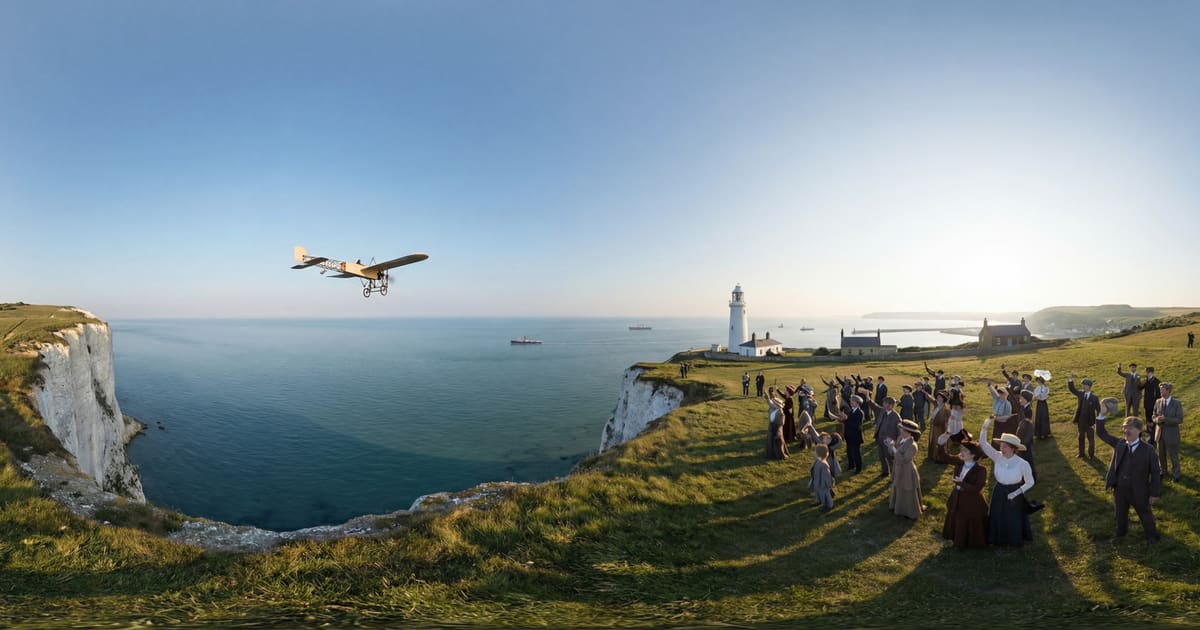
The scene here: Orville's first flight, 120 feet in twelve seconds.
17 Dec 1903, later
Wilbur's fourth flight covers 852 feet before a gust damages the Flyer.
1948
The Smithsonian formally recognises the Wrights and displays the restored Flyer.