A eunuch admiral and an emperor's ambition
Zheng He was captured as a boy during the Ming conquest of Yunnan, castrated, and raised in the household of the prince who became the Yongle Emperor. His rise to command the treasure fleet reflected the trust that emperor placed in eunuch officials over the traditional scholar-bureaucracy, a rivalry between the two factions at court that would later cost the voyages both their funding and much of their written record.
Yongle wanted tribute states acknowledging Ming supremacy, not colonies or trading posts of the kind Europeans would later carve out. The fleets carried silk, porcelain and silver to give away and returned with envoys, exotic animals, and pledges of allegiance — diplomacy conducted at a scale no other power on Earth could then attempt, projected across two oceans rather than one river system.
Yongle had also just moved the Ming capital from Nanjing toward Beijing and was rebuilding the Grand Canal at enormous cost, so the treasure fleet was one of several colossal state projects competing for the same pool of timber, grain and conscripted labour in the 1410s and 1420s, a strain later officials would cite when arguing to shut the whole program down.
7
treasure voyages between 1405 and 1433
27,000
men reportedly carried on the largest voyages
300+
ships in the biggest fleets, by Ming court records
120m+
claimed length of the largest treasure ships
Ships built to overawe, not to fight
Chinese shipbuilders had watertight bulkheads and stern-mounted rudders centuries before Europe adopted either innovation. The largest treasure ships, according to Ming records, exceeded 120 metres — figures modern naval architects have questioned as exaggerated, though even conservative estimates put them well beyond anything Portugal or Spain would launch for another century of shipbuilding.
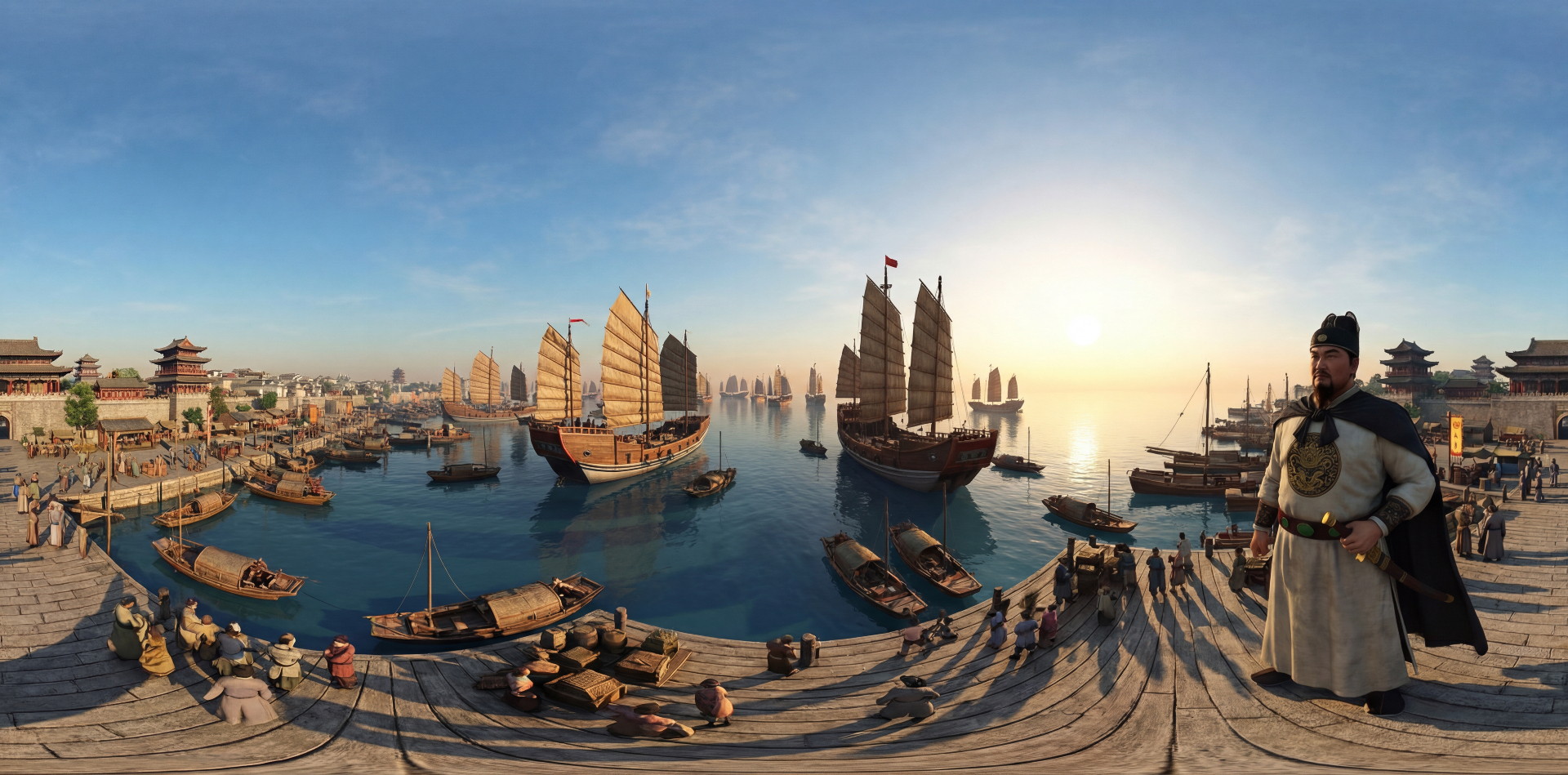
The fleets were armed but not built for naval combat; their purpose was spectacle and logistics on an unprecedented scale. A single voyage could carry 27,000 men, including translators, physicians, astrologers and soldiers, organised with a bureaucratic thoroughness, down to ration schedules and shipboard rank, that matched the sheer scale of the ships themselves.
The Ming interpreter Ma Huan sailed on several voyages and left the fullest surviving eyewitness account, describing the trading protocols, coinage, crops and customs of ports from Java to Calicut in a level of ethnographic detail no other source from the period matches, written partly because he could read Arabic and speak directly with local officials.
The wind was fair and favourable, and the sea-route was calm; the ships proceeded as if they were walking on level ground.
A giraffe, and then silence
The fourth voyage reached Hormuz; later ones touched the Swahili coast, bringing back a giraffe from Malindi that the Ming court took, via a stretch of translation, as the mythical qilin, an auspicious beast said to appear only under virtuous rulers. It was as close as the fleet came to popular legend at home, though the real purpose remained tribute diplomacy rather than natural history or exploration for its own sake.
After Yongle's death in 1424 and Zheng He's own death around 1433 on the seventh voyage, court factions who saw the fleet as ruinously expensive won out over its eunuch sponsors. Shipyards were run down, ocean-going construction was banned by imperial edict, and much of the fleet's records were later destroyed or lost — just as Portuguese ships began probing the same waters from the other direction, unaware how far China had already sailed.
Ma Huan's book, the Yingya Shenglan, survived that purge of the archives largely by accident, copied and recopied by scholars who valued it as travel writing long after the state itself had lost interest in the voyages it described, leaving it as one of the few detailed windows historians now have into what the fleets actually encountered abroad.
What everyone says
The treasure fleet was meant to conquer and colonise the lands it visited.
What the evidence says
Unlike the European voyages that followed a few decades later, the fleets sought tribute and prestige, not territory or permanent trading colonies. They fought only when local rulers attacked or defied them, and left no forts or garrisons behind on any of the coasts they reached.
Stone in the mud, stone at the temple
In 1957 workers at the old Longjiang shipyard dredged up a rudder post more than eleven metres long, evidence used ever since to argue the largest treasure ships really could have reached the dimensions Ming records claimed, since a rudder of that size implies a hull built to match it rather than an isolated exaggeration.
Two stone inscriptions, at Liujiagang and Changle, were carved by Zheng He's own crews before the later voyages, listing the ports visited and thanking the goddess Tianfei for safe passage — the closest thing to a first-person official record of the fleet's own itinerary to survive the later destruction of the court's archives.
The Hongxi Emperor halted the voyages entirely in 1424, only for his successor Xuande to revive them once more for a seventh and final expedition in 1431, a brief reprieve before the conservative faction at court prevailed for good and the shipyards that built the fleet were left to rot.
How it unfolded
1405
The first treasure fleet departs Nanjing under Zheng He's command.
1413–15
The fourth voyage reaches Hormuz and the Persian Gulf, far beyond earlier routes.
1420· the scene
The scene here: new ships under construction at the Longjiang yards outside Nanjing.
1421–33
Later voyages reach the Swahili coast; a giraffe is brought back to court in 1414.
1424
The Yongle Emperor dies; court opposition to the costly voyages grows sharply.
1433
Zheng He dies on the seventh voyage; the program is wound down soon after.