An empire of tribute, not territory
The Aztec, or Mexica, empire ruled through a network of tributary city-states rather than direct occupation, which meant many of its subjects resented Tenochtitlan's demands for goods, labour and sacrificial captives sent as tribute each year. The Tlaxcalans, longtime rivals never fully conquered by the Mexica despite repeated campaigns against them, saw Cortés less as a liberator than as useful leverage against an old and bitter enemy.
Without Tlaxcalan and other Indigenous forces, who eventually outnumbered the Spanish by a wide margin at every stage of the campaign, the conquest as it happened would have been impossible. Spanish accounts written afterward tended to minimise this contribution, casting a few hundred conquistadors as the whole story rather than as the smallest fraction of a much larger coalition army.
Cortés had burned his own ships at Veracruz months earlier, according to the veteran soldier Bernal Díaz del Castillo, to remove any option of retreat for men already muttering about turning back to Cuba and abandoning the expedition — a gamble that made the march inland as much a mutiny prevented as a conquest planned in advance.
~400
Spanish soldiers who entered the city with Cortés
150,000–250,000
estimated population of Tenochtitlan
1520
year smallpox reached the city
May–Aug 1521
length of the final siege
A reception, then a hostage-taking
Moctezuma II met Cortés on the causeway with gifts and formal ceremony, choosing negotiation over immediate confrontation for reasons debated ever since — caution about an unfamiliar and well-armed force is a more credible explanation than the old myth that he mistook Cortés for a returning god. Within a week Cortés had taken him hostage inside his own palace, under the pretext of an attack elsewhere on the coast.
That standoff held for months, funding the Spanish through Aztec tribute while Moctezuma nominally still ruled and issued orders to his own people. It collapsed after a massacre of Aztec nobles by Spanish troops during a festival in 1520, provoking an uprising in which Moctezuma was killed, reportedly stoned by his own subjects, and the Spanish were driven from the city during what they later called the Noche Triste.
Díaz del Castillo, writing decades later as an old man in Guatemala, recalled the city on first sight as something almost unbelievable, comparing it to the enchanted palaces of chivalric romance because, he said, nothing in his own experience gave him better words to describe what he and his companions were seeing.
We were amazed and said that it was like the enchantments they tell of in the legend of Amadis... some of our soldiers even asked whether the things we saw were not a dream.
Smallpox finished what battle could not
Cortés regrouped with fresh Tlaxcalan reinforcements, and a smallpox epidemic, introduced from an infected soldier in a separate Spanish landing, swept through the city in 1520, killing a large share of the population including the emperor who succeeded Moctezuma within months. Neither side had any experience treating the disease, which spread along trade routes faster than any army could march.
The final siege, from May to August 1521, cut off the city's food and fresh water and reduced much of it to rubble before it fell after weeks of house-by-house fighting. Mexico City rose directly on the ruins, and the Templo Mayor lay buried and forgotten under later colonial streets until electrical workers struck a carved stone disc in 1978.
Excavations at that site since 1978 have recovered thousands of offerings — jade beads, shell, sacrificial knives, the bones of eagles and jaguars — giving archaeologists a far more detailed picture of Mexica ritual life than the Spanish chronicles alone ever provided or could have provided.
What everyone says
Moctezuma believed Cortés was the returning god Quetzalcoatl.
What the evidence says
This story appears mainly in accounts written decades after the conquest, largely by Spanish or Spanish-influenced chroniclers, and most historians now treat it as a later narrative device rather than a contemporary belief held by Moctezuma or his court.
A city built on water
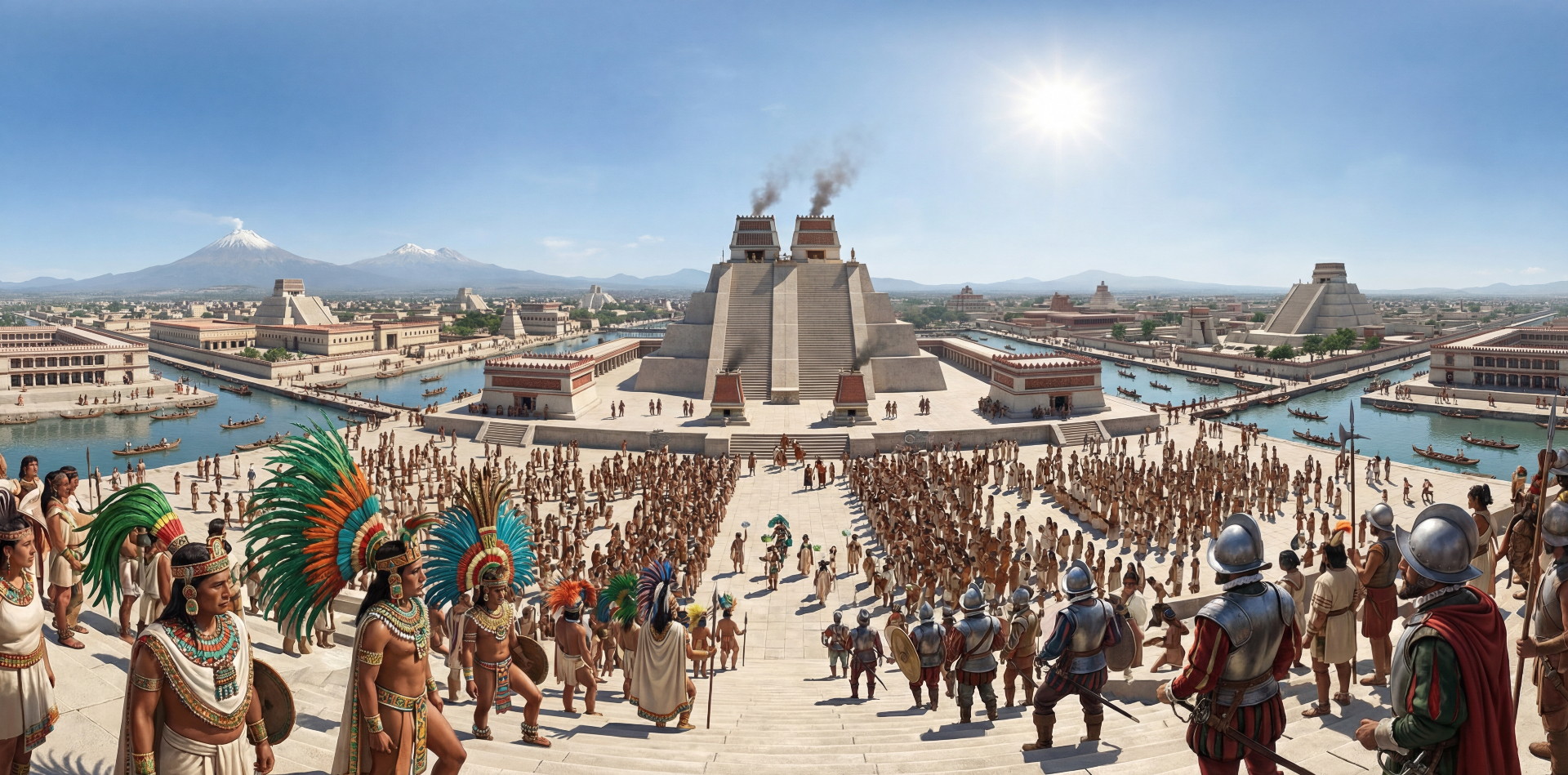
Three causeways of packed earth and stone linked the island city to the mainland, wide enough for ten horses abreast according to Díaz del Castillo, while a separate aqueduct carried fresh water from the springs at Chapultepec across the lake in a channel the Spanish found more impressive than anything comparable in Seville.
Chinampas, artificial garden plots built up from lakebed mud and woven reed rafts anchored with willow roots, fed the city's dense population year-round with maize, beans and flowers, an intensive form of agriculture that let Tenochtitlan support a population Spanish soldiers initially refused to believe when they first tallied it.
Díaz del Castillo devoted several pages of his chronicle to the market at Tlatelolco alone, recalling separate sections for gold, feathers, slaves, cacao beans used as currency, and cooked food, staffed by officials who policed weights and measures and settled disputes on the spot, a scale of daily commerce he compared directly and favourably to the markets of Constantinople and Rome that soldiers in his own company had actually seen with their own eyes.
How it unfolded
1519· the scene
Cortés lands on the coast, burns his ships, and allies with the Tlaxcalans.
8 Nov 1519
The scene here: Cortés meets Moctezuma on the causeway into Tenochtitlan.
Nov 1519
Cortés takes Moctezuma hostage inside the imperial palace within the week.
1520
A massacre of nobles triggers uprising; Moctezuma dies; smallpox arrives soon after.
1521
A months-long siege ends with the city's fall in August after fierce resistance.
1978
Electrical workers rediscover the Templo Mayor buried beneath Mexico City.