A prize, and a rival already scratched
The Daily Mail had offered £1,000, roughly a year's salary for a well-paid professional at the time, for the first aeroplane crossing of the Channel back in 1908, a sum large enough to draw serious competition once aircraft became reliable enough to attempt it. Blériot's chief rival, Hubert Latham, flying a more powerful Antoinette monoplane, had already tried and ditched in the water on 19 July when his engine failed roughly halfway across, and was waiting at Calais for a replacement aircraft to arrive when Blériot took off first at dawn.
Blériot himself was in poor shape for the flight: he had badly burned his foot in a crash days earlier during testing and needed help simply walking to his aircraft and climbing into the cockpit, a fact contemporary reports noted with some astonishment given the ordeal he was about to attempt on a foot that could barely work the rudder bar.
He had already crashed and rebuilt several prototypes over the preceding two years, working through numbered designs up to the Type XI, financing much of the work himself from profits made selling acetylene headlamps for early motor cars, a business entirely unrelated to aviation that nonetheless kept his experiments funded through repeated crashes and near-bankruptcies along the way.
36 min
duration of the crossing, Calais to Dover
£1,000
prize offered by the Daily Mail
25 hp
output of the Anzani three-cylinder engine
~38 km
approximate distance flown across the Channel
Thirty-six minutes, no compass
He took off from a field at Les Baraques near Calais at around 4:40am on 25 July 1909 and followed the French navy destroyer Escopette, sent ahead as a rough guide, since his aircraft carried no compass and no instruments beyond a rudimentary fuel gauge. He lost sight of the destroyer in haze roughly ten minutes into the crossing and continued essentially on guesswork and dead reckoning, only correcting course once he glimpsed the white cliffs of the English coast ahead of him.
His three-cylinder Anzani engine, producing only about 25 horsepower and still an untested design prone to overheating on the ground, ran hot enough mid-flight to genuinely worry him, having already failed during earlier test flights that summer; a brief rain shower that crossed his path partway across is credited by some accounts with cooling the cylinders just enough to keep the propeller turning until he reached the English coast.
The Blériot XI he flew weighed barely 300 kilograms fully loaded, was built largely from ash, bamboo and fabric held together with piano wire, and cruised at roughly 45 miles an hour, figures so modest by later standards that early aviation historians still marvel the airframe held together at all across 38 kilometres of open, choppy water with no possibility of rescue had it come down.
I have no need to see further ahead than that. My motor is running. That's the goal.
A crash landing and an immediate panic
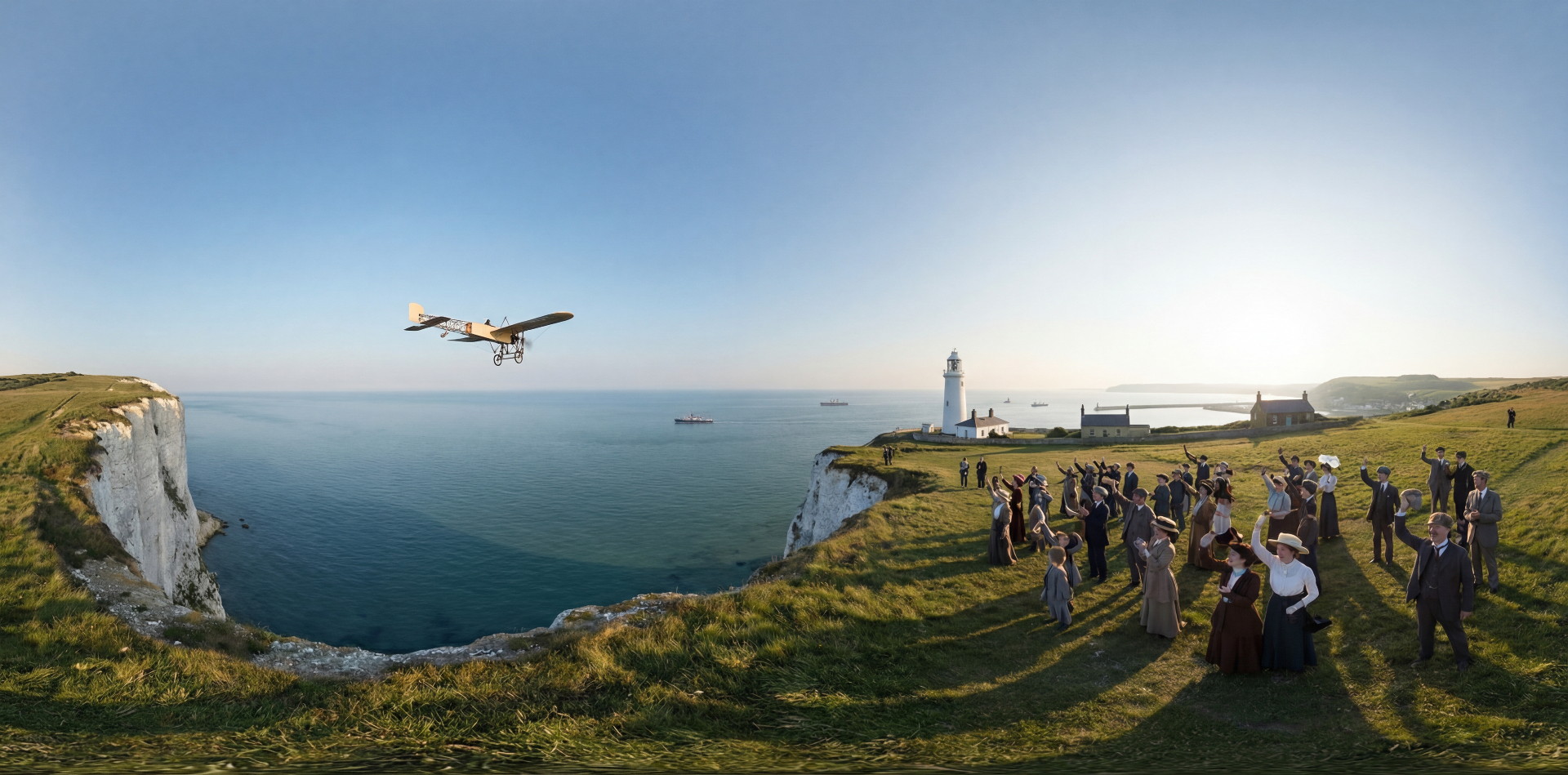
He spotted the white cliffs, then a large French tricolour being waved by Charles Fontaine, a journalist for Le Matin, near Dover Castle to mark the intended landing spot agreed in advance, and put the aircraft down hard in Northfall Meadow in a gusting crosswind, damaging the undercarriage and propeller on touchdown after roughly thirty-six minutes airborne, having covered the crossing without ever climbing much above 250 feet.
British newspapers reacted less with unalloyed celebration than genuine alarm: a nation that had relied on the Channel as a natural moat for defence against invasion for centuries had just watched it become crossable in well under an hour by a single unarmed civilian aircraft, and a public debate over Britain's aerial vulnerability, and the need for a dedicated air arm, began within days of the landing.
Crowds mobbed the landing field within the hour, souvenir hunters began stripping fabric from the damaged wings before officials intervened, and Blériot, still limping badly on his bandaged foot, was reportedly more concerned about the damage to his propeller than about the sudden fame descending on him, insisting on inspecting the aircraft himself before he would speak properly to the assembled reporters and photographers.
What everyone says
Blériot navigated the crossing with careful instrumentation.
What the evidence says
He carried no compass and only the crudest instruments, following a destroyer he lost sight of in haze and finishing the flight largely by eye — a fact that made the crossing more alarming to contemporaries, not less.
A fortune made overnight, a doctrine changed
Blériot collected the £1,000 Daily Mail prize and, within weeks, orders for his monoplane design poured in from militaries and private buyers across Europe eager to own the aircraft that had conquered the Channel; his small Paris workshop grew rapidly into one of the era's leading aircraft manufacturers, eventually producing hundreds of Type XI machines, on the strength of that single thirty-six-minute flight.
The crossing directly shaped British defence thinking: within three years the Royal Flying Corps had been established in 1912, driven partly by politicians and military planners who cited Blériot's flight repeatedly in parliamentary debate as proof the Channel could no longer be relied upon as an impassable strategic barrier against a determined enemy.
The Blériot XI he flew that morning is preserved today at the Musée des Arts et Métiers in Paris, still recognisable despite its repairs as the fragile wood-and-fabric machine that made a nation reconsider its own geography, and its own defences, in the space of a single thirty-six-minute flight across open water.
How it unfolded
1908
The Daily Mail announces its Channel-crossing prize.
19 Jul 1909· the scene
Hubert Latham's attempt ends with a ditching mid-Channel.
25 Jul, dawn
Blériot, foot bandaged, takes off from near Calais.
25 Jul, ~5:12am
The scene here: a hard landing at Northfall Meadow, Dover.
Within days
British press debate aerial defence for the first time.
1912
The Royal Flying Corps is founded, citing the Channel's new vulnerability.