A prize that had already killed men
Hotelier Raymond Orteig had offered $25,000 in 1919 for the first nonstop flight between New York and Paris, and by 1927 the prize had claimed six lives in failed attempts, including the French aces Nungesser and Coli, who vanished over the Atlantic just twelve days before Lindbergh took off.
Lindbergh was an unlikely favourite: a 25-year-old airmail pilot with no fame and a syndicate of St Louis businessmen behind him, flying a single-engine Ryan monoplane built in sixty days specifically to save weight over safety margins other competitors insisted on.
Rival teams backed by far larger fortunes and multi-engine aircraft were still finishing repairs or recovering from crashes at Roosevelt Field that same week, which meant Lindbergh's smaller, cheaper machine — built for about $10,580 — was simply ready to fly first when a favourable weather window opened. Richard Byrd and Clarence Chamberlin, both flying larger, better-financed aircraft, were still delayed by mechanical trouble and legal disputes with backers when Lindbergh's single engine turned over at Roosevelt Field, a runway so soft with recent rain that his overloaded plane barely cleared the telephone wires at its edge. Among the dead competitors was the French ace Charles Nungesser, whose own attempt from the opposite direction vanished over the Atlantic without wreckage ever being found, a loss that briefly made Lindbergh's own single-engine gamble look even more reckless to the American press covering it.
33h 30m
flight time, Roosevelt Field to Le Bourget
5,800 km
approximate great-circle distance flown, alone
$25,000
Orteig Prize won for the crossing
~150,000
estimated crowd waiting at Le Bourget
No window, no radio, no sleep
The Spirit of St Louis carried a fuel tank where the forward windscreen should have been, so Lindbergh flew leaning out a side window or watching a periscope, navigating by compass headings and dead reckoning over featureless ocean with no radio to call for help if the single engine failed.
He fought sleep for over a day, at one point flying just above the waves to stay alert on the cold air, and later described hallucinating translucent figures in the cabin offering him navigational advice — a detail he left out of his first accounts and only admitted decades later.
He carried four sandwiches and two canteens of water for the entire crossing, deliberately minimal, reasoning that he would not need much food if the flight succeeded and would not need any if it failed. He landed having eaten less than half a sandwich, later joking that he had simply not been hungry enough over the Atlantic to bother with the rest.
Well, I made it.
A private pilot becomes a public figure overnight
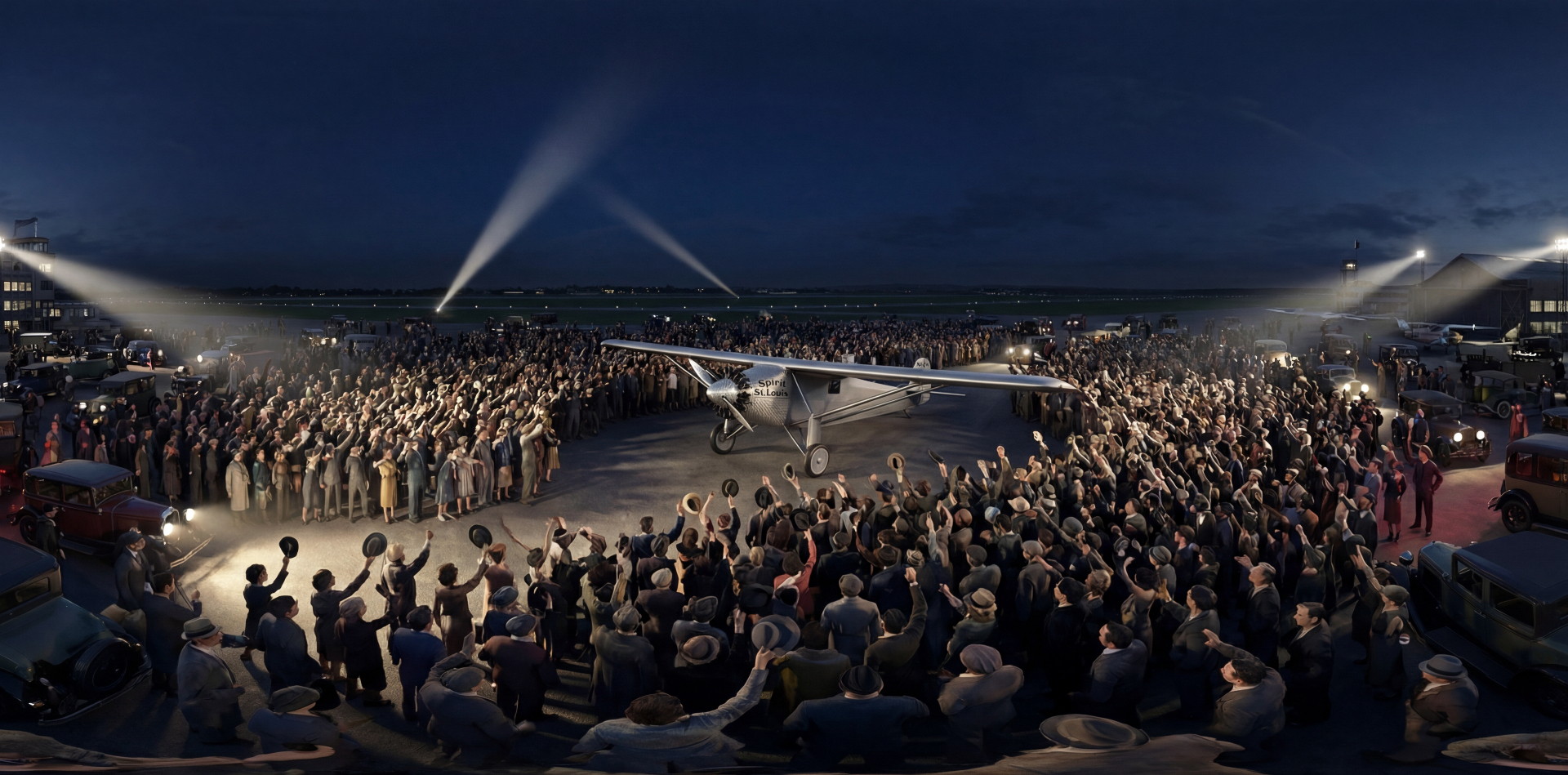
He landed at Le Bourget at 10:22pm on 21 May 1927 to a crowd estimated at 150,000, who broke through the fences and mobbed the plane before Lindbergh had even switched off the engine; souvenir hunters tore pieces from the fabric skin. He had to be rescued by French police and airmen.
The reception at home outstripped even that. New York gave him the largest ticker-tape parade the city had yet held, Congress created a special Medal of Honor for him, and Time named him its first Man of the Year. He used the fame to campaign, effectively, for commercial aviation's future.
President Coolidge sent a US Navy cruiser, the Memphis, to bring both Lindbergh and his aircraft home rather than risk another transatlantic flight, a decision that itself made front-page news and signalled how quickly the government had folded his safety into a matter of national prestige. New York's parade on 13 June drew an estimated four million people along Broadway and up Fifth Avenue, more paper reportedly thrown from windows that single afternoon than had greeted any previous visiting dignitary in the city's history.
What everyone says
Lindbergh made the first transatlantic flight.
What the evidence says
John Alcock and Arthur Brown flew nonstop from Newfoundland to Ireland in 1919, eight years earlier. Lindbergh's flight was the first solo nonstop crossing, and the first directly linking New York and Paris — a narrower but still remarkable record.
What the flight actually changed
Within eighteen months of the crossing, American investment in aviation stocks and airline ventures multiplied several times over, and passenger and airmail routes expanded rapidly as the public appetite Lindbergh had proven made flying commercially viable rather than merely a stunt.
Lindbergh's later career complicated the hero's story: his prewar isolationism and 1938 acceptance of a Nazi medal drew lasting criticism, and by the time of his 1974 death his public standing had cooled considerably from the adulation of 1927.
The Spirit of St Louis itself never flew commercially again. Lindbergh donated it to the Smithsonian in 1928, and it has hung in the National Air and Space Museum's entrance hall ever since, one of the most recognisable single aircraft in the world, still bearing the sixty-three original hand-painted names of his financial backers along its fuselage. Roosevelt Field itself, the sodden Long Island runway he struggled off in May 1927, is a shopping mall today, its history marked only by a small plaque near the parking structure, a quieter fate than the aircraft that left it.
How it unfolded
1919
Raymond Orteig offers $25,000 for a nonstop New York–Paris flight.
1919
Alcock and Brown make the first-ever nonstop transatlantic flight, Newfoundland to Ireland.
8–9 May 1927· the scene
Nungesser and Coli vanish attempting the crossing from Paris.
20 May 1927, dawn
Lindbergh takes off from Roosevelt Field, New York, overloaded with fuel.
21 May 1927, night
The scene here: landing at Le Bourget as the crowd breaks through the fences.
June 1927
New York gives Lindbergh the city's largest ticker-tape parade to date.