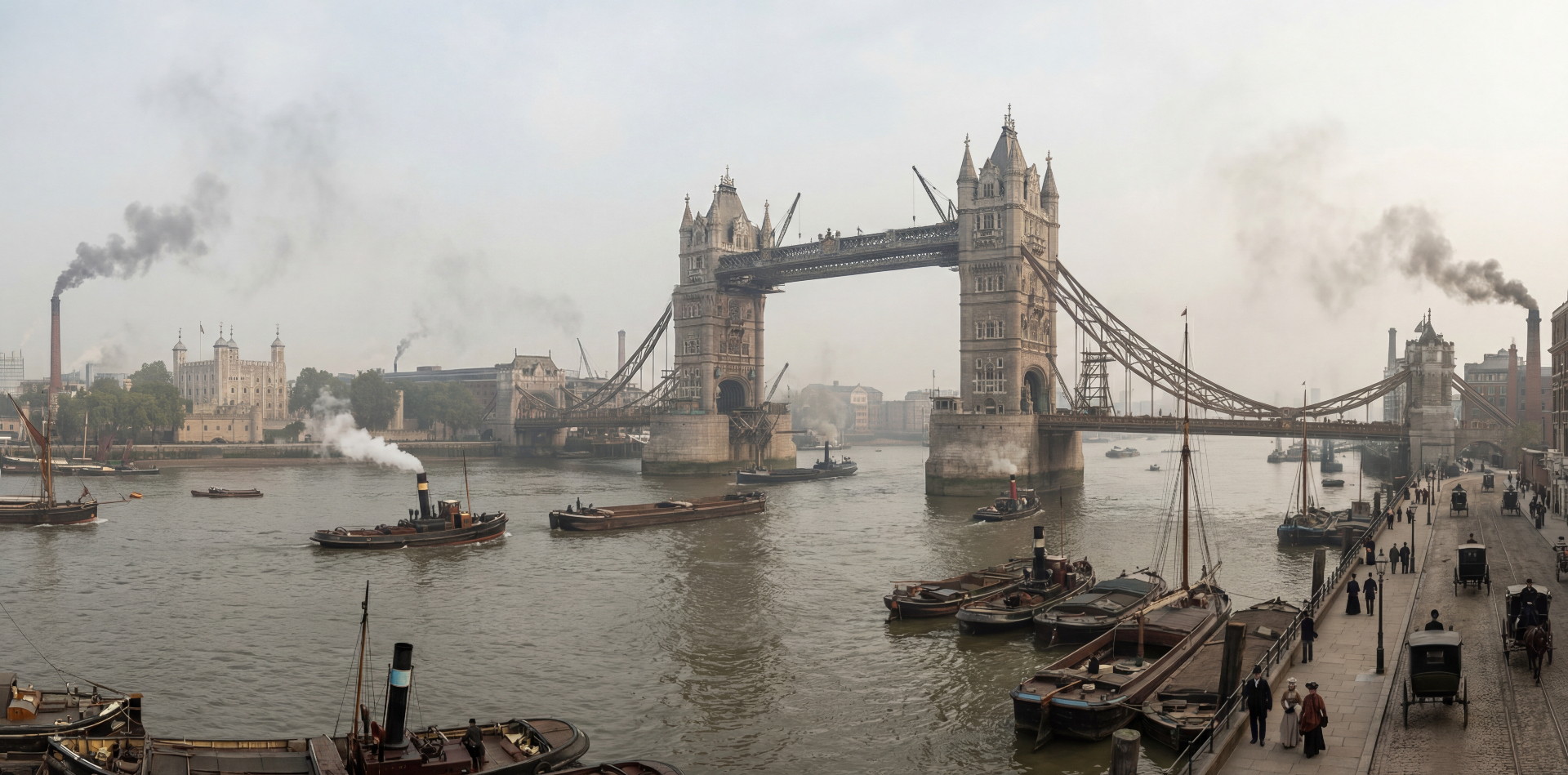
A bridge that has to move
By the 1870s London Bridge and the Pool of London below it carried so much shipping that merchants east of the bridge were petitioning Parliament for a new crossing further downstream, one that could accommodate tall-masted vessels without blocking them entirely. A fixed high-level bridge was ruled out on cost and gradient grounds; a plain opening bridge risked looking industrial and crude standing directly beside the medieval Tower of London next to it. The solution, chosen after a public design competition that ran for years, was a bascule bridge dressed in Gothic stone to match its ancient neighbour.
Horace Jones, the City Architect, designed the exterior; John Wolfe Barry, son of the Houses of Parliament's architect Charles Barry, engineered the steel frame that actually carries the load. Around 11,000 tons of steel form that frame, hidden entirely behind Cornish granite and Portland stone cladding so the bridge would read as medieval stonework rather than the modern industrial structure it in fact was.
The competition drew more than fifty submitted designs, judged over eight years of parliamentary wrangling before Jones's Gothic-clad bascule was finally chosen in 1884, a delay that reflected genuine disagreement over whether a working dock crossing should look modern, classical, or medieval at all. Jones died in 1887, three years into construction, and Wolfe Barry took over full direction of the project, seeing it through to completion in his place.
8 yrs
construction time, 1886 to 1894
~1,000
workers employed on the build
61 m
length of each bascule leaf
~1 min
typical time to raise both bascules fully
Steam, water, and a minute to open
Six hydraulic accumulators, driven by a pair of stationary steam engines and boilers housed in the bridge's own piers, stored pressure that could raise both bascule leaves in about a minute when a ship needed to pass. In its Edwardian heyday the bridge lifted around 6,000 times a year, a routine interruption to road traffic several times a day that Londoners simply built into their journeys, timing carriage and cart crossings around the shipping schedule of the Pool.
The high-level walkways connecting the two towers, more than 40 metres above the river, were meant to let pedestrians cross even while the bascules were raised for shipping, but they became a haunt for prostitutes, pickpockets and would-be suicides, and closed to the public in 1910 after decades of poor use. They did not reopen until 1982, this time refitted as a glass-floored viewing gallery for tourists rather than a practical shortcut across the river.
Each bascule leaf, weighing over a thousand tonnes, was counterbalanced so precisely that the steam engines needed only a modest output to lift it, storing energy gradually in the accumulators between openings rather than generating full lifting force on demand. Engineers of the day praised the system as proof that hydraulic power, then still a relatively new industrial technology, could rival direct steam drive for heavy, repeated lifting work on this scale.
A monstrous and preposterous heap of Sham, Sham Rococo, Sham Gothic, Sham Everything.
Outliving the docks it served
The original steam-driven hydraulic system ran, largely unaltered, until 1976, when it was finally switched to electric and oil-hydraulic power after 82 years of continuous steam operation, though the historic accumulators and engines remain preserved in place in the bridge's engine rooms and are open to visitors today. Containerisation moved London's working docks downriver toward Tilbury from the 1960s onward, emptying the Pool of London of the freighters and colliers the bridge had been built specifically to admit.
Today the bascules still rise on request, but for pleasure cruisers, historic tall ships and the occasional naval vessel rather than the coal barges and merchant steamers that queued below it in 1905, leaving a genuinely functioning piece of Victorian engineering doing largely ceremonial duty for a working port that moved elsewhere decades ago.
In 1912 a pilot named Frank McClean famously flew his Short biplane between the raised bascules and the high-level walkway above them to avoid a collision after misjudging his approach along the Thames, an unauthorised stunt that became one of the bridge's most retold stories precisely because it treated a piece of solemn Victorian infrastructure as an impromptu aerial obstacle course, and he was never prosecuted for it.
What everyone says
Tower Bridge is the same as London Bridge.
What the evidence says
They are different crossings roughly half a mile apart. London Bridge is the plain, functional crossing upstream; Tower Bridge, with its Gothic towers and lifting bascules, sits beside the Tower of London and is the one most photographs actually show.
A silhouette that became shorthand for London
The bridge was formally opened by the Prince of Wales, later Edward VII, on 30 June 1894, in a ceremony attended by thousands of spectators lining both banks of the Thames, and within a generation its twin Gothic towers had become the visual shorthand for London on postcards, posters and film reels, arguably eclipsing the plainer, older London Bridge upstream in public recognition entirely, despite that older crossing carrying the more famous name.
It survived the Blitz with only minor damage despite the London docks around it being one of the Luftwaffe's priority targets night after night, and the bascules were kept operational throughout the Second World War specifically because naval and merchant traffic still needed to pass upriver to feed and supply a besieged capital.
It remains a functioning bridge under the City of London Corporation's care, raised on request for qualifying vessels several hundred times a year, still bound by the same basic bascule principle Wolfe Barry engineered in the 1880s, now driven by oil hydraulics rather than steam, with the original Victorian machinery preserved as a museum exhibit alongside the working modern system it replaced.
How it unfolded
1876
A parliamentary committee agrees a new downstream crossing is needed.
1884
Horace Jones's Gothic design wins the public competition.
1886
Construction begins on the piers and towers.
30 Jun 1894
The bridge opens, engineered by John Wolfe Barry.
1905· the scene
The scene here: the bridge at full working capacity in a crowded Pool of London.
1976
The original steam hydraulic system is replaced with electric power.