The line, not the car
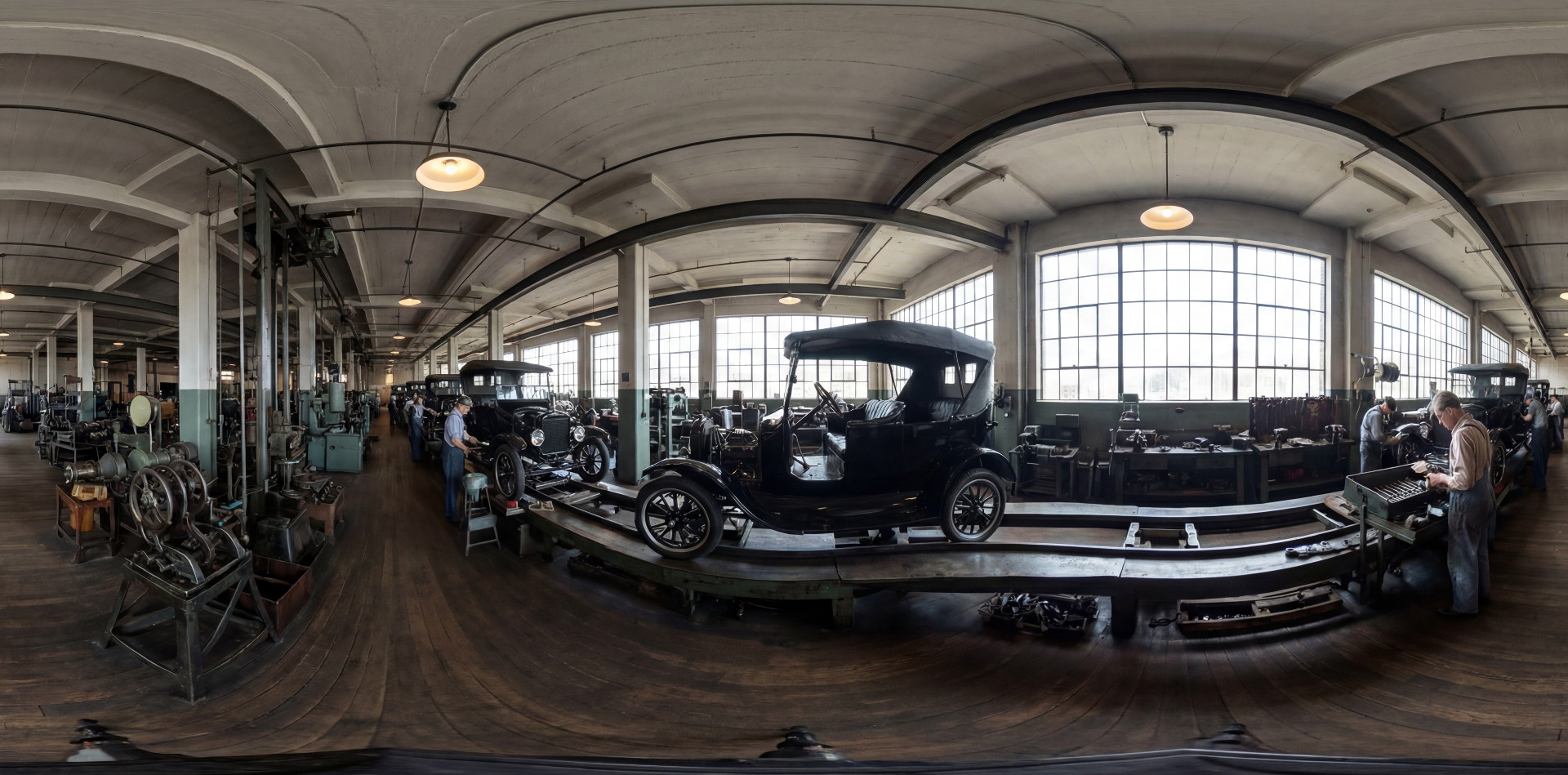
Ford's engineers had studied Chicago's meatpacking disassembly lines and continuous-flow systems already used in flour milling and canning. Applied to cars from 1913 at Highland Park, the innovation was moving the work to stationary men rather than sending men to a stationary chassis, breaking assembly into thousands of single, repeatable motions.
The results were almost absurd against the old craft-shop method. A Model T chassis that had taken over twelve hours to assemble by hand fell to about ninety minutes, then further as the line was refined through the late 1910s, letting Ford cut prices year after year while competitors held theirs steady.
Ford's production chief, William Klann, is credited with the original spark, borrowed after watching Swiggart's Chicago slaughterhouse hang carcasses on an overhead trolley. Turning disassembly into assembly meant timing each of the roughly eighty-four discrete steps a chassis went through, then arranging workers along the belt in that exact sequence. Frederick Taylor's stopwatch studies of efficient motion, already circulating among American manufacturers, gave Ford's engineers the vocabulary and method to break each task down to seconds rather than minutes, with some stations reduced to a single repeated action lasting under ten seconds. Ford himself was dismissive of the history his own museum would later enshrine; asked about it by the Chicago Tribune in 1916, during a libel suit he had brought against the paper, he told the courtroom that "history is more or less bunk," a line the press seized on as anti-intellectualism when he meant something narrower — that history taught from dates and dead kings mattered less to him than the living record of tools, machines and ordinary work he would spend the 1920s collecting.
90 min
to assemble a Model T chassis on the moving line, down from 12+ hrs
$5
daily wage introduced in 1914, roughly double the industry rate
15m
Model Ts built in total between 1908 and 1927
400%
annual staff turnover at Highland Park before the wage rise
Buying loyalty at five dollars a day
The line was brutal to work, and Highland Park's turnover before 1914 ran near 400 per cent a year — Ford had to hire roughly ten men to keep one. In January 1914 he doubled the going wage to five dollars a day for qualified workers, a decision the business press called reckless and rivals called ruinous.
It was neither. Turnover collapsed, absenteeism fell, and the higher wage meant assembly-line workers could plausibly buy the very cars they built — a feedback loop Ford was happy to publicise as enlightened, even though the five dollars came with conditions enforced by a company Sociological Department inspecting workers' homes and habits.
Inspectors could and did dock or deny the profit-sharing bonus that made up half of the five dollars if a man drank too heavily, kept an untidy household, or failed to learn English quickly enough in Ford's own night classes — welfare capitalism with a supervisor's clipboard attached to it. Roughly sixty investigators worked the Sociological Department at its peak, visiting workers' homes unannounced and filing reports that could cost a man half his pay if his habits displeased them.
You can have any color you want as long as it's black.
One colour, millions of cars
From 1914 the Model T was sold only in black, because Japan black asphalt-based enamel was the fastest-drying paint available and colour choice would have slowed the line the whole system depended on. It stayed that way until 1926, when rivals' colour ranges finally forced Ford to relent.
By 1920 Ford's Michigan plants were building close to a million cars a year, and the price of a Model T runabout had fallen from $850 in 1908 toward the low $300s. Fifteen million would be built in total before production ended in 1927.
The scale forced Ford into vertical integration few rivals could match: the River Rouge complex, under construction through the 1920s, eventually took in iron ore and rubber at one end and rolled finished cars out the other, a single-site ambition that became as famous as the Model T itself.
What everyone says
Henry Ford invented the assembly line.
What the evidence says
Continuous-flow production existed already in flour mills, canneries and Chicago's disassembly-line slaughterhouses. Ford's contribution was combining an interchangeable-parts car with a moving line and stationary, specialised workers at industrial scale — engineering and management, not a single invention.
What the system left behind
The five-dollar day is often credited with helping create an American mass consumer market, since other manufacturers had to raise wages to compete for labour, feeding purchasing power back into an economy increasingly built around installment-plan goods like the automobile itself.
Ford's own instincts curdled with success: he fought unionisation into the 1940s, ran an intrusive company culture long after the Sociological Department was quietly disbanded in 1921, and later used his wealth to fund and publish antisemitic material that stains his reputation permanently.
The Rouge complex and Highland Park equipment now sit largely inside the Henry Ford Museum and Greenfield Village in Dearborn, preserved as the birthplace of mass production even as the labour bargain that made it survivable remains one of the more contested parts of the story. Ford opened Greenfield Village in 1929, having entire historic buildings dismantled brick by brick and shipped to Dearborn for re-erection, among them the Wright brothers' Ohio bicycle shop and the courthouse where Lincoln once practised law. Its centrepiece was a reconstruction of Thomas Edison's Menlo Park laboratory, rebuilt using original equipment Ford tracked down and, reportedly, several railcars of New Jersey soil hauled in so the ground itself would match. Edison, then eighty-two, presided over its dedication on 21 October 1929, the Light's Golden Jubilee marking fifty years since the incandescent bulb, in a ceremony broadcast nationally and attended by Herbert Hoover. Visitors can still watch period machinery run, a reminder of how quickly a factory floor once considered radical became an industrial museum piece within a single working lifetime.
How it unfolded
1908
The Model T launches at $850, still built by craft methods.
1913
The first moving assembly line starts at Highland Park.
January 1914
Ford introduces the $5 day and an 8-hour shift.
1920· the scene
The scene here: Michigan plants nearing a million cars a year.
1926
Falling sales against colourful rivals finally end the black-only policy.
1927
Model T production ends after 15 million units; the Model A replaces it.