Six openings between 1830 and 1883 that rebuilt distance
Industrial-Age Engineering: Six Openings That Rebuilt Distance
Fifty-three years separate the first passenger railway from the first steel-wire suspension bridge, and almost everything that makes the modern world legible happened inside them. These six scenes are all opening days: the moment a piece of infrastructure stopped being a construction site and started being a route. That is the most datable state a structure ever occupies — the crowd, the ceremonial locomotive, the unballasted track and the not-yet-weathered stone all belong to one specific year, and none of them survive a decade.
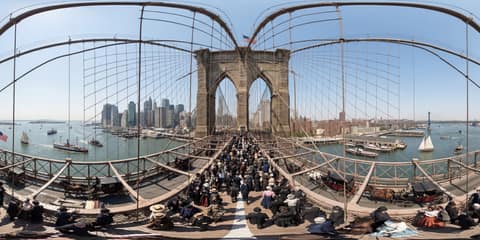
Before 1830 the fastest a person or a letter could move over land was the speed of a horse, and it had been for four thousand years. The Liverpool and Manchester Railway carried passengers between two cities at an average that made the stagecoach obsolete within a year of opening. By 1869 a single rail line crossed North America and a lock-free cut let ships skip Africa entirely; by 1883 a bridge carried the daily traffic of a ferry fleet across the East River. Every scene in this guide is a place where a journey time collapsed, which is why each one drew a crowd worth painting.
The material changes faster than the style
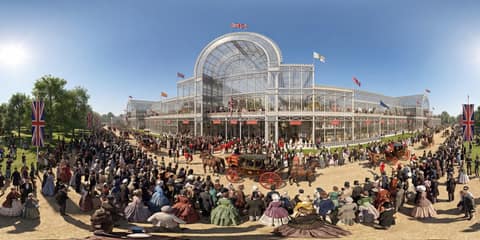
The half-century covered here is the exact window in which cast iron gives way to wrought iron and then to steel, and the switch is visible in the scene rather than hidden inside it. Crystal Palace in 1851 is a standardised cast-iron kit holding 300,000 panes of sheet glass. Brooklyn Bridge in 1883 hangs a deck from steel wire that would have been unavailable, at that strength and price, a decade earlier. If you can tell what the load-bearing member is made of, you have already narrowed the year to about twenty.
An opening day is a dated document
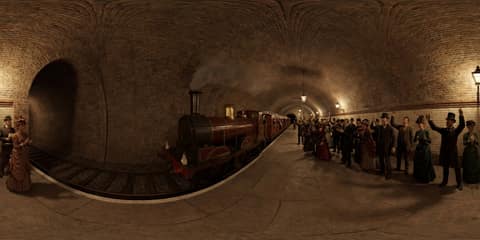
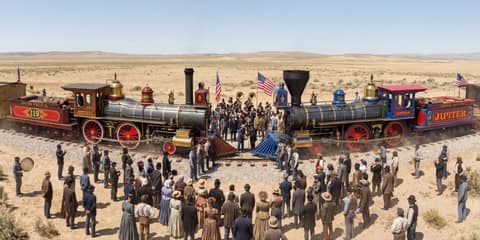
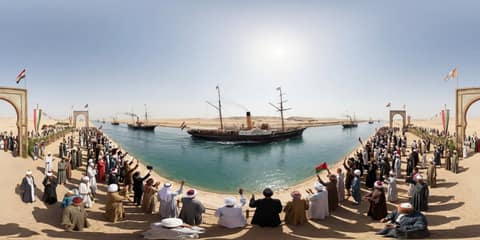
These are not generic Victorian views. A ceremonial convoy of steam yachts flying royal standards at Port Said only happened in November 1869. Two specific locomotives, Jupiter and No. 119, only stood nose to nose at Promontory Summit for one afternoon in May of the same year. The gas-lit wooden carriages under Paddington belong to the years before electrification, and the bare high-desert grade at Promontory belongs to the years before ballast was laid. Learn the ceremony and you get the year for free.
The 6 scenes, oldest first
Each one is a real place with real coordinates, rebuilt as a 360° panorama. Read the story, or drop into the scene with no caption and try to date it from what you can see.
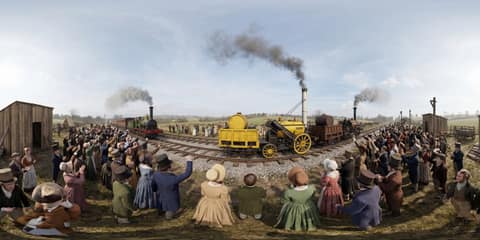
Between Liverpool and Manchester, Lancashire, England
The start of the whole sequence: the first railway built to carry passengers between two cities on a timetable, and the first to kill an MP on its opening day.
What dates it: Twin tracks on stone sleeper blocks, with no ballast shoulder — early permanent way.
Not infrastructure but a proof of method — a building assembled from catalogue parts in thirty-nine weeks, with full-grown elms left standing inside it.
What dates it: Standardised cast-iron frames and 300,000 panes of sheet glass, assembled like a kit.
Early permanent way used stone sleeper blocks with no ballast shoulder — that is 1830s practice, visible at Liverpool and Manchester. Freshly laid timber ties on a bare grade, as at Promontory in 1869, means a line built at speed for land grants and not yet finished properly. Deep ballast and continuous rail are later.
Count the chimneys and check their height
A tall, thin locomotive chimney with a small four-wheel engine underneath is pre-1850. By the 1860s American practice has the balloon stack and the cowcatcher, and British practice has larger driving wheels and a shorter stack. Steam under a station roof at all rules out anything after mainline electrification.
Ask whether the iron is cast or drawn
Cast iron is thick, ornamented and works in compression — columns, arches, the Crystal Palace frame. Wire rope and rolled steel are thin and work in tension: cables, hangers, trusses. A structure holding itself up with something thin enough to look fragile is late in this period, not early.
Find the spoil and the dredgers
A canal or cutting in this era leaves visible evidence of how it was dug: bucket-ladder dredgers moored in the channel, and spoil banks running the length of the cut. Suez has both, and they are the reason it reads as an 1860s scene rather than a modern waterway.
Check what the new route replaced, still in shot
Opening-day scenes almost always contain the thing being made obsolete — sailing ships and steam ferries under Brooklyn Bridge, stagecoach-bodied carriages on the first railway, telegraph poles racing the rails west. Overlap between the old and the new is the strongest single hint that you are looking at a first day rather than a later one.
Industrial-age engineering questions and answers
What counts as industrial-age engineering here?
Work opened between 1750 and 1900 whose method is documented well enough to rebuild the site honestly — the six scenes in this guide all fall between 1830 and 1883, which is where the surviving photographic and engineering record is densest.
How do you date a railway scene to a decade?
Track first, then locomotive. Stone sleeper blocks and no ballast is 1830s; timber ties on a raw grade is a line built fast, typically 1860s American; a tall thin chimney on a small four-wheel engine is early, a balloon stack and cowcatcher is mid-century American practice.
Why is Crystal Palace in an engineering collection rather than an architecture one?
Because the building was the exhibit. Its cast-iron frame and 300,000 identical panes were an argument about prefabrication, and it was taken down and re-erected at Sydenham — which is a machine's behaviour, not a monument's.
Can I play these scenes instead of reading them?
Yes. Every scene here is a live round: you get the 360° view with no caption, and you place it on the world map and set the year. Reading the guide first is legitimate practice — the dating cues above are the ones the rounds actually reward.