A headline made of light bulbs
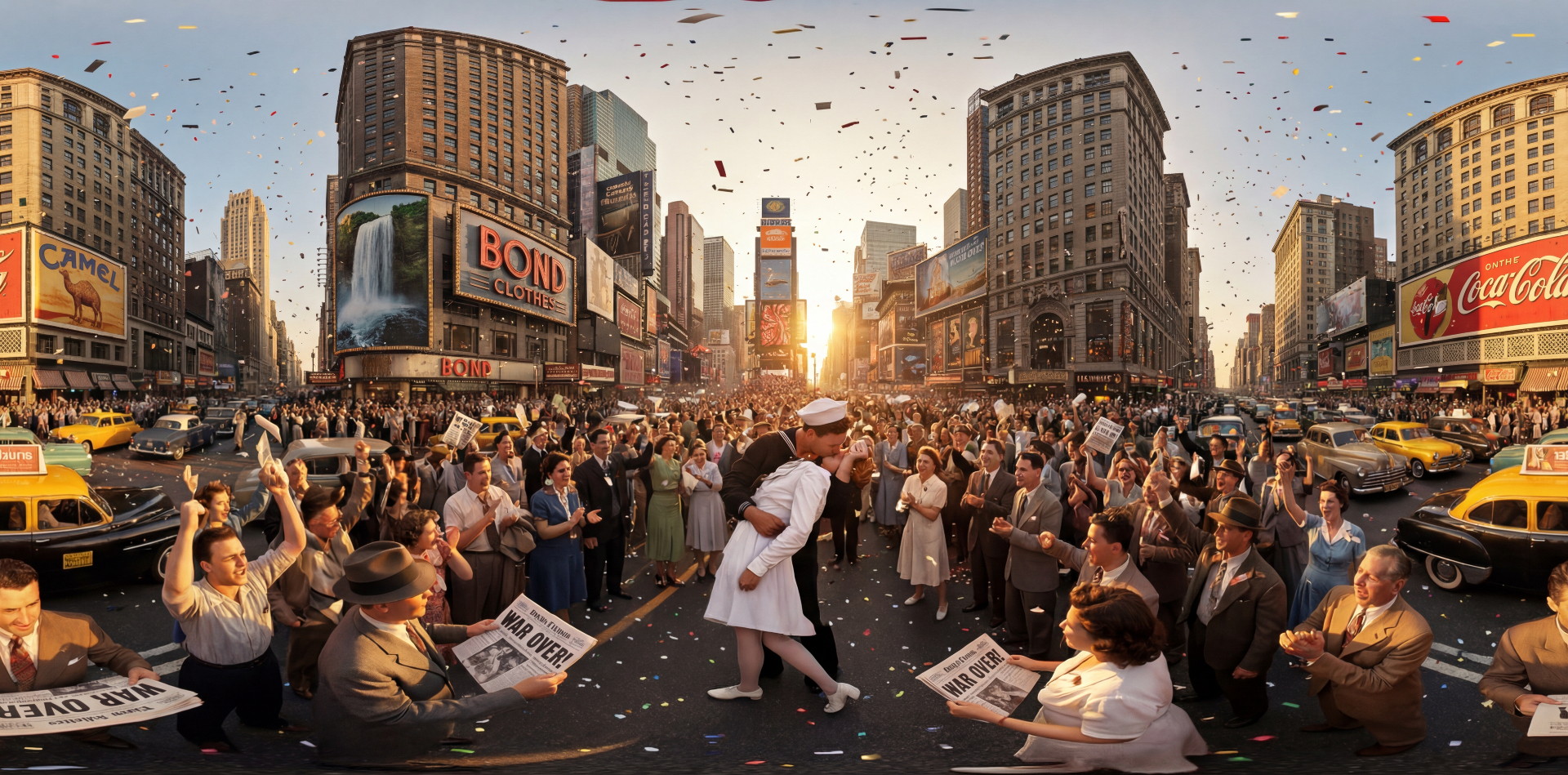
Word of Japan's surrender broke in New York on the news zipper wrapped around the Times Tower, the same electric bulletin board that had carried war news for years, at around 7pm on 14 August 1945. The square filled within minutes as offices and bars emptied and the celebration that had been building for weeks finally had its date.
It was not the formal end of the war — that came on 2 September, with the surrender signed aboard the USS Missouri in Tokyo Bay — but 14 August, timed to the announcement reaching American radio and newspapers, is the day crowds actually filled the streets, and the one popular memory has kept.
President Truman had announced the surrender from the White House at seven o'clock that evening, telling reporters gathered in the Oval Office that Japan had accepted terms of unconditional surrender, and within the hour department stores across Manhattan began closing early, sending tens of thousands of additional workers straight into an already swelling Times Square. Traffic across Manhattan reportedly stopped entirely for several hours as subway exits around the square became too congested for riders to climb the stairs, and police later estimated roughly two million people passed through Times Square before the crowds finally thinned near dawn.
4 frames
shot by Eisenstaedt in around fifteen seconds
14 Aug
1945, the day celebrations filled Times Square
19 days
between the Times Square celebration and the formal Tokyo Bay surrender
70,000,000+
estimated wartime deaths worldwide by 1945
Four frames, fifteen seconds
Life photographer Alfred Eisenstaedt was moving through the crowd when he saw a sailor kissing every woman near him regardless of who she was, and began shooting quickly, capturing four frames in roughly fifteen seconds without asking either person's name. He simply moved on afterward, as photographers on a breaking story do.
Life ran one frame the following week without a caption identifying the couple, and for over a decade nobody thought to ask who they were. It became one of the most reproduced photographs of the twentieth century before its subjects had any public identity at all.
Eisenstaedt was not alone: US Navy photographer Victor Jorgensen captured the same kiss from a slightly different angle within seconds, a frame published by The New York Times under the title 'Kissing the War Goodbye', proof that at least two cameras caught the same fifteen seconds independently. Jorgensen's version, taken from a different angle a moment later, shows more of the surrounding crowd and confirms neither photographer staged the embrace, since both men were working the same stretch of pavement purely by coincidence.
The President of the United States announced at 7 o'clock this evening that Japan has surrendered unconditionally.
A dispute that was never really resolved
From the 1960s onward, dozens of people came forward claiming to be the sailor or the nurse, and researchers spent decades trying to match faces, moles and dental records from the grainy frame. George Mendonsa and Greta Zimmer Friedman became the most widely publicised identifications, but neither claim rests on evidence Eisenstaedt himself could confirm, since he never recorded a name.
Friedman later said she did not know the man and had simply been grabbed; some historians have noted the image, examined outside its era's celebratory framing, shows a kiss she had no chance to consent to. The uncertainty over identity and the more recent discomfort with the moment itself sit uneasily alongside its status as a symbol of joy.
A bronze and later fibreglass sculpture based on the photograph, Unconditional Surrender, has been installed in several American cities since 2005, sparking recurring debate about whether a monument should celebrate an image whose central act neither participant appears to have chosen mutually.
What everyone says
The photograph shows a sailor kissing his girlfriend, or a nurse he knew.
What the evidence says
Eisenstaedt never learned either person's name, and Greta Zimmer Friedman, one of the most widely accepted identifications, said in later interviews that she was a dental assistant in a nurse's-style uniform, a stranger to the sailor, and had been grabbed without warning — not a couple's reunion but an anonymous, one-sided moment in a crowd.
What the square remembers
Times Square still marks the anniversary each August, and the photograph remains one of Life magazine's most licensed images, reprinted on posters, mugs and postcards long after the physical square itself had been rebuilt around it several times over.
Eisenstaedt kept shooting for Life into the 1970s and always maintained he never learned the sailor's or the nurse's real name, treating the anonymity less as a mystery to solve than as proof the moment belonged to everyone in the crowd rather than two specific people.
The four original negatives are held in the Life Photo Collection archive, alongside contact sheets showing the sailor kissing several other women in the same minutes — a detail rarely reproduced, and one that complicates the single romantic image most people still carry of that afternoon. Rationing of sugar, meat and gasoline did not end that same night; several controls stayed in place for months afterward, since the wartime economy could not simply be switched off the moment the fighting stopped, whatever the mood in Times Square suggested.
How it unfolded
6–9 August 1945· the scene
Atomic bombs are dropped on Hiroshima and Nagasaki.
14 August 1945
The scene here: surrender news breaks and the square fills within minutes.
14 August 1945, evening
Eisenstaedt shoots his four frames of the kiss for Life.
2 September 1945
Japan's formal surrender is signed aboard the USS Missouri.
1960s onward
Multiple claimants come forward identifying themselves in the photograph.
1980–2012
Mendonsa and Friedman gain wide, though unconfirmed, acceptance as the pair.