A republic emptying itself
By 1961 the German Democratic Republic was losing people at a rate that threatened to hollow it out: doctors, engineers, teachers, whole families walking into West Berlin's S-Bahn stations and simply not coming back. Berlin was the one place in the Iron Curtain where the border could still be crossed on foot, since the rest of the inner-German frontier had already been fenced and mined years earlier, and the East German state was bleeding out through this single remaining gap. Party economists calculated that the outflow, if unchecked, would collapse industrial output within a decade.
Walter Ulbricht denied any such plan at a press conference on 15 June, telling foreign journalists 'no one has the intention of building a wall.' Khrushchev had approved the operation days earlier; the phrase became one of the century's more quoted lies almost as soon as it was spoken.
Roughly 2.7 million East Germans had already crossed west since 1949, most of them young and skilled, and East Berlin's factories were reporting empty benches on Monday mornings. Party planners feared that within a few more years there would be no economy left worth defending.
155 km
total length of the border fortifications around West Berlin
2.7m
East Germans who had left via Berlin since 1949
43,000+
border troops and militia mobilised on the first weekend
28 yrs
the wall stood, August 1961 to November 1989
A Sunday chosen on purpose
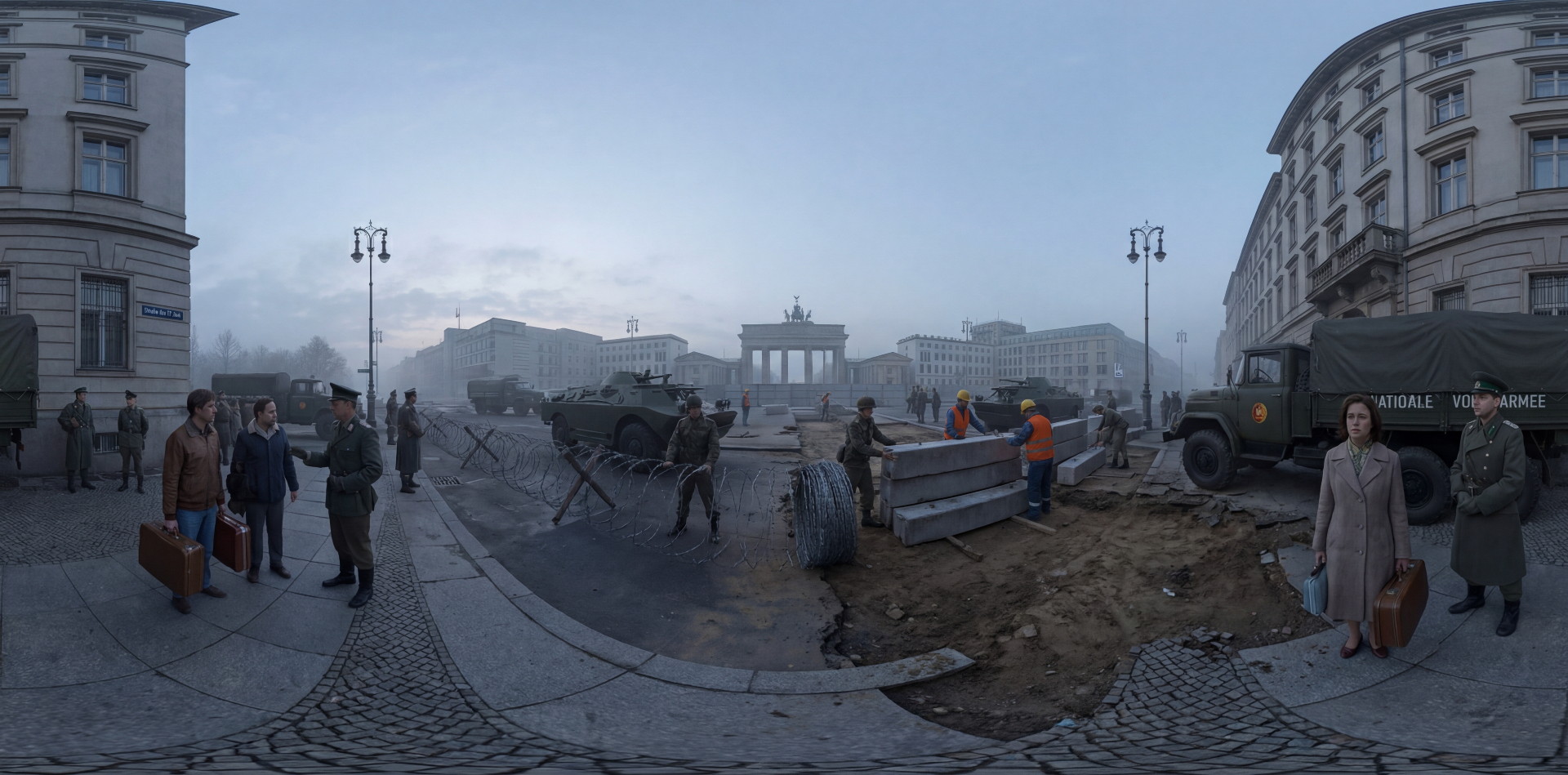
Operation Rose began just after midnight on Sunday 13 August, precisely because Sunday gave the authorities a head start: ministries and Western embassies were closed, and East Berliners who worked in the West would not discover the closure until Monday morning. East German troops and factory militia strung barbed wire along 155 kilometres of sector boundary and started tearing up crossing points street by street.
The wire hardened fast. Within days, workers were laying concrete blocks; within weeks, whole apartment blocks that straddled the line had their western-facing doors and ground-floor windows bricked shut, so residents leaned out of upper windows to jump, or were pulled back inside by police.
More than 43,000 troops and armed militia had been mobilised for the first weekend alone, far more than the operation's planners expected to need, because nobody in East Berlin's command structure knew how the population, or the Western powers, would react to soldiers sealing off half a city overnight. Washington's response was slow and cautious, and it took days before American tanks even rolled up to Checkpoint Charlie in a show of resolve that changed nothing on the ground.
Niemand hat die Absicht, eine Mauer zu errichten.
Twenty-eight years of it
Kennedy's response was to accept the wall rather than risk war over it, telling aides privately that a wall was 'a hell of a lot better than a war.' He came to Berlin in 1963 anyway, and again the crowds heard a president say Berlin belonged to the free world. The wall itself went through four generations of design before its final concrete form, the Grenzmauer-75, with its rounded pipe coping meant to defeat grappling hooks.
It fell in a single confused evening on 9 November 1989, after a spokesman misread a briefing note live on television and announced that travel restrictions were lifted 'immediately, without delay.' Crowds simply walked up to the checkpoints and the guards, with no orders to shoot, opened the gates.
Chunks of the Grenzmauer-75 were pickaxed apart for souvenirs within days by so-called wall-peckers, and most of the 155 kilometres was demolished within a year using industrial machinery once the initial rush had passed. A handful of stretches were deliberately preserved, among them the section on Bernauer Strasse, where the ground itself still records where the death strip used to run.
What everyone says
The wall went up as a single concrete structure overnight.
What the evidence says
The first barrier was barbed wire and paving stones, hastily strung across streets and canals. The familiar concrete wall came in stages over years, with the final reinforced version not appearing until the mid-1970s.
The death strip's long evolution
The barrier that began as wire and rubble grew, over its lifetime, into a system nearly 160 metres deep in places: an inner wall, a raked strip of sand to show footprints, tank traps, dog runs, floodlights and 302 watchtowers manned around the clock. At least 140 people died trying to cross it, drowned in canals, shot by border guards under standing orders, or killed in accidents involving the fortifications themselves; the true toll is still debated because East German records were incomplete or destroyed.
Escapes grew inventive as the barrier hardened: tunnels dug from cellars in the West, a homemade hot-air balloon that carried two families over in 1979, and cars with hollowed-out chassis smuggled people through checkpoints. Each successful attempt tended to provoke a fresh round of fortification, so the wall's design was, in effect, a running argument with the people trying to beat it.
Today the Bernauer Strasse memorial preserves roughly 1.4 kilometres of the former border strip, including a reconstructed section of the death strip itself, watchtower and all, alongside a documentation centre built for visitors who want to see how the fortifications actually worked rather than just where the wall once stood.
How it unfolded
15 June 1961· the scene
Ulbricht denies any plan to build a wall, on the record.
12–13 Aug 1961
The scene here: overnight, wire and torn-up streets seal the border.
17 Aug 1961
Concrete blocks begin replacing the improvised wire barriers.
1975
The final design, the Grenzmauer-75, starts replacing earlier versions.
9 Nov 1989
A garbled press announcement leads crowds to the checkpoints; guards let them through.