Five American scenes, from Griffin's Wharf to the Reflecting Pool
American Turning Points: Five Scenes That Changed the Country
Two of these scenes are acts of destruction, one is a night river crossing, one is a defeat and one is a march. What they share is that each was staged, in the theatrical sense: the participants understood they were making an image as well as an argument. That is why they can be dated from the inside — the costumes on Griffin's Wharf, the printed placards on the Mall and the neon coming back on in Times Square are all deliberate, and deliberate things are specific to their year.
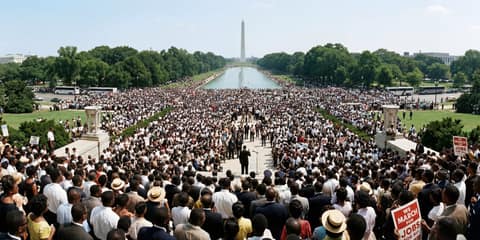
Nearly two centuries separate the earliest and latest scene here and the venue barely changes: a wharf, a river, a mission courtyard, a square, a reflecting pool. American turning points happen in places where a crowd can gather and be counted, which is a habit rather than an accident. The Boston Tea Party was performed by men who knew the harbour was overlooked; the March on Washington chose the Lincoln Memorial precisely because of what stood at the top of the steps.
The famous painting is usually wrong
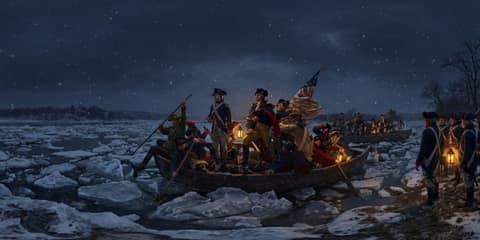
Emanuel Leutze put Washington upright in a small rowboat in daylight; the actual crossing used broad, shallow Durham cargo boats, poled through ice, at night, in freezing rain, hours behind schedule, with field artillery going over alongside the infantry. The Alamo was a mission compound with a chapel and low adobe walls, never a fortress. Getting the scene right rather than the picture right is the difference between a plausible guess and a correct one.
How the backdrop dates the moment
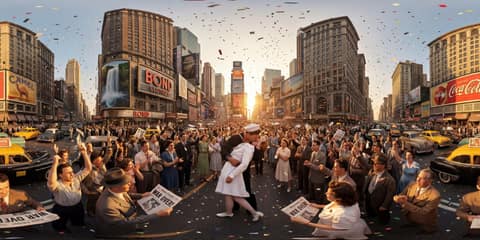
The two twentieth-century scenes are datable almost entirely from the architecture behind the people. Times Square in 1945 has the Times Tower zipper running the surrender headline, streetcar tracks in the roadway and no pedestrian plazas. The Mall in 1963 has neither the Vietnam Veterans Memorial nor the World War II Memorial, both of which are unmissable in any later view of the same sightline. Learn which monuments were not there yet and the century collapses to a decade.
The 5 scenes, oldest first
Each one is a real place with real coordinates, rebuilt as a 360° panorama. Read the story, or drop into the scene with no caption and try to date it from what you can see.
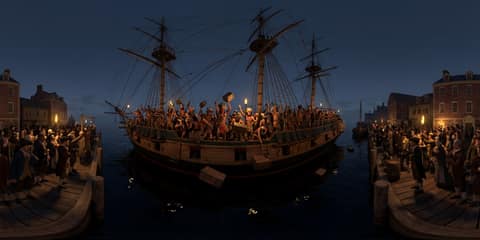
Political theatre with an audience: costumes worn as a statement rather than a disguise, and hatchets used so the tea would soak instead of floating off for salvage.
What dates it: Three moored merchantmen — the Dartmouth, Eleanor and Beaver — worked by lantern light.
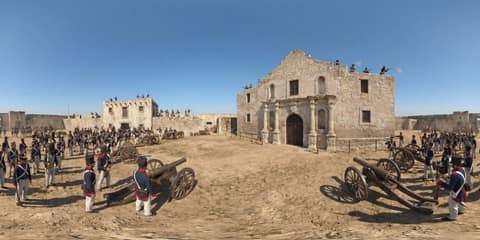
Mission San Antonio de Valero, San Antonio de Béxar, Texas
A siege inside somebody else's architecture: a Spanish mission compound with gun platforms improvised against the walls and Mexican artillery close in on the town side.
What dates it: A Spanish mission compound with a chapel, long barracks and low adobe walls — never designed as a fortress.
Merchantmen worked by lantern light with chests being broken open on deck is 1773. Flat, shallow Durham boats poled through river ice at night is December 1776. Watercraft is the most reliable dating evidence in early American scenes because rigs and hull types changed on a documented schedule.
Check whether the defences were built or improvised
The Alamo reads as a fortress in popular memory and as a mission in the scene: a chapel, a long barracks and low adobe walls with earthworks and gun platforms thrown up inside them. Improvised defence inside civilian architecture is a siege, and sieges are short and well dated.
Look for uniforms in a civilian crowd
Service uniforms scattered through an ordinary street crowd, with neon lit after years of dim-out, places a scene in the last months of the Second World War rather than after it. Wartime restrictions leave visible traces — blackout paint, dimmed signage, ration-era vehicles.
Count the memorials that are missing
On the National Mall, absence dates the view. No Vietnam Veterans Memorial means before 1982; no World War II Memorial means before 2004. The same trick works on any capital: the newest monument in shot sets the earliest possible year.
Read the signage, not the slogans
Printed union and church placards at the March on Washington show it was a labour coalition as much as a civil rights one, and printed placards themselves indicate an organised, permitted march rather than a spontaneous one. Hand-lettered signs, by contrast, tend to mean a crowd that assembled faster than its printers could.
American turning points questions and answers
Why is V-J Day in a collection about battles and revolutions?
Because the collection tracks the moments where power visibly shifts, and the end of a war is one of them. The scene is a crowd rather than a battlefield, which is the point — the fighting is elsewhere and what you can see is a country reacting to it.
What is the fastest way to date an American street scene?
Vehicles, then roadway, then signage. Streetcar tracks in the carriageway, kerbside parking without meters and neon rather than backlit plastic all narrow a mid-century view to about a decade before you have looked at a single person.
Are these scenes photographs?
No — each one is a 360° panorama reconstructed from the documented record of the place: the surviving buildings, the recorded weather, the vessels and vehicles known to have been present. The clue lists on each page state exactly what the reconstruction is built on.
Where can I play the American scenes together?
The United States collection at /play/united-states runs the country's scenes as a set, and every scene in this guide is also available as a single round from its own page.