An army about to vanish
By December 1776, Washington's Continental Army had been driven out of New York, across New Jersey, and over the Delaware into Pennsylvania, shrinking from around 20,000 men earlier that year to perhaps 6,000 fit for duty, many of them barefoot, ill-clothed and without proper winter tents. Most enlistments expired on 31 December, and Washington expected the army to simply dissolve if he did not act first, leaving him with no force at all to defend Philadelphia or continue the war into 1777.
Thomas Paine, marching with the retreating army, wrote The American Crisis that December — ‘these are the times that try men's souls’ — and Washington had it read aloud to his troops just before they crossed, timing morale to the moment he needed it most, an unusually deliberate piece of stage management for a commander not otherwise known for theatrics.
Congress itself had already fled Philadelphia for Baltimore, expecting the city to fall, and had granted Washington near-dictatorial emergency powers over the army — an authority he used sparingly but which reflected how close to collapse the rebellion's cause was judged to be. Loyalist sentiment was rising in New Jersey as Continental fortunes sank, with local militia bands switching allegiance or simply going home, further narrowing Washington's window to act before what remained of his force dissolved outright. General William Howe, confident the campaign season was effectively over, had already dispersed his own army into scattered winter cantonments across New Jersey, leaving the Trenton garrison more isolated than Washington's spies initially dared to hope.
2,400
men who made the Delaware crossing
18
field guns ferried across with the troops
~900
Hessian soldiers captured at Trenton
45 min
approximate duration of the Battle of Trenton
Nine hours behind schedule
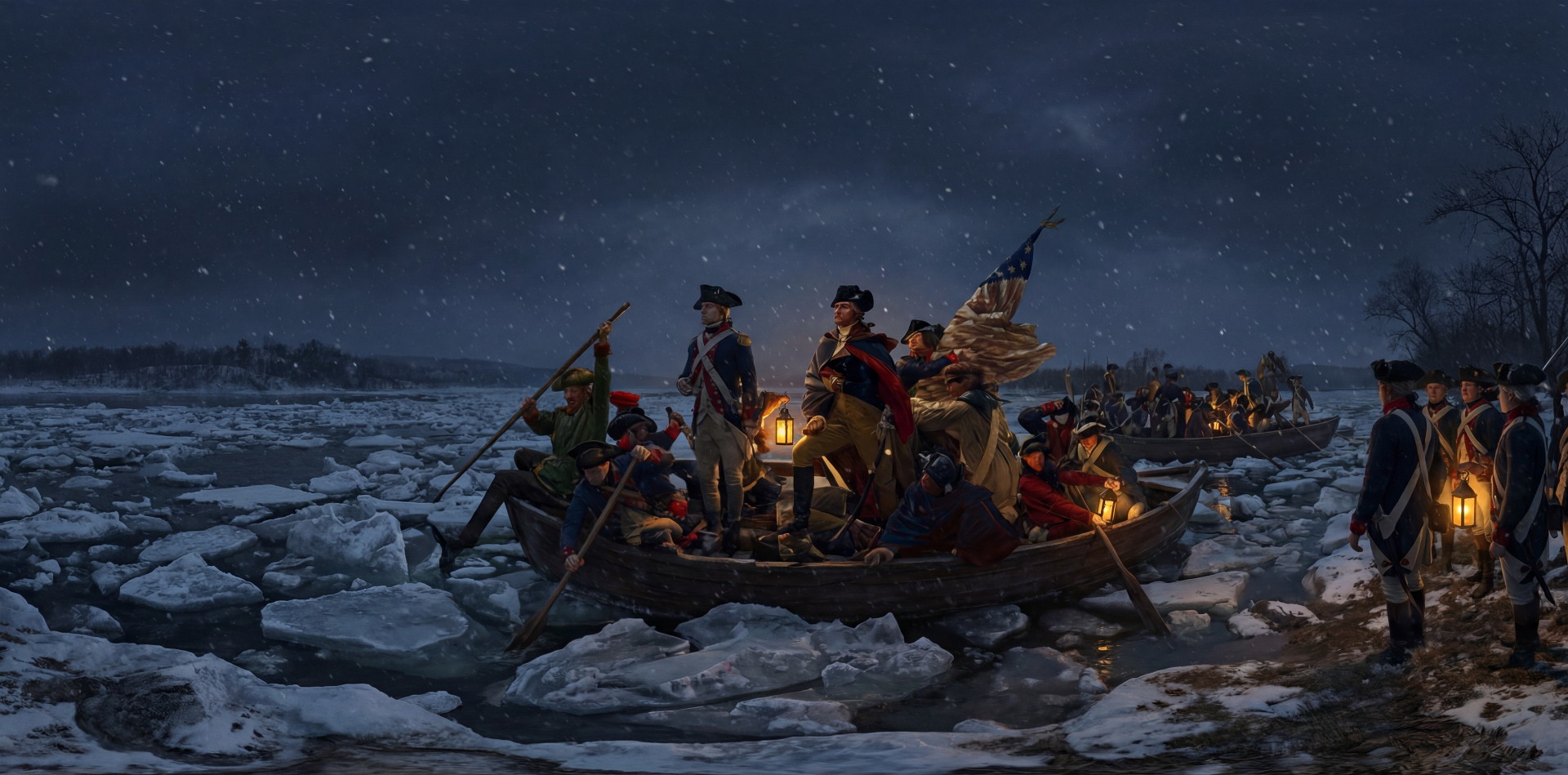
The plan called for three crossing points and an attack before dawn; ice and weather scuttled two of the three crossings entirely, leaving Washington's single force of about 2,400 men, plus horses and eighteen field guns, to cross alone in Durham boats — broad, shallow cargo vessels roughly 40 to 60 feet long, ordinarily used to haul iron ore and grain down the river, not the small rowboat shown in Emanuel Leutze's famous 1851 painting.
The crossing, planned for midnight, was not complete until around 3am, and the nine-mile march to Trenton in a driving sleet storm left the force arriving hours later than intended — after sunrise rather than before it.
Colonel John Glover's regiment of Massachusetts fishermen and sailors from Marblehead, experienced in handling boats in rough water, managed the actual ferrying, working the poles and oars through floating ice for hours without losing a single soldier or gun to the river, even as a nor'easter brought driving sleet and near-freezing temperatures down on the crossing itself. The same regiment had earlier ferried the beaten army off Long Island under cover of fog in August, making this their second decisive night on the water within four months.
These are the times that try men's souls.
An hour that changed the arithmetic
The Hessian garrison at Trenton, roughly 1,500 men under Colonel Johann Rall, was caught unprepared despite earlier warnings; the fighting was over within about 45 minutes, with Rall mortally wounded and some 900 Hessians captured for negligible American losses, most of it fought in driving snow through the town's streets rather than in open field.
Washington followed it with a second victory at Princeton on 3 January. The twin wins revived flagging enlistments and colonial morale after a string of defeats, convincing France and other observers the American cause was not yet lost.
Washington reportedly offered a bounty to persuade soldiers whose enlistments had just expired to stay another six weeks, paying it partly from funds and silver he borrowed personally, since Congress's own treasury had almost nothing left to offer, a debt Robert Morris helped him settle by scraping together hard currency from Philadelphia merchants within days of being asked.
What everyone says
Leutze's famous painting accurately depicts the crossing.
What the evidence says
It shows daylight rather than night, a small rowboat rather than broad Durham cargo boats, an 1777 flag that did not yet exist, and Washington standing upright in conditions that would have capsized the boat.
A painting more famous than the crossing
Emanuel Leutze painted his depiction in Düsseldorf in 1851, seventy-five years after the fact and using the Rhine, not the Delaware, as his visual reference, which is part of why the geography and the ice in the picture bear little resemblance to reports from the night itself. Leutze, a German-American history painter, intended the work partly as encouragement to the European revolutionaries of 1848, using an American subject to argue for liberty movements closer to home.
The original canvas was damaged in an Allied bombing raid on Germany during the Second World War; the version now hanging in the Metropolitan Museum of Art is a second, nearly identical copy Leutze painted afterward for American buyers.
The Delaware crossing site itself, at McConkey's Ferry, is preserved today as a state park on both the Pennsylvania and New Jersey banks, and a re-enactment crossing in replica Durham boats is still staged there every Christmas Day, drawing thousands of spectators to watch costumed volunteers pole the same stretch of river Glover's men crossed in 1776.
How it unfolded
Nov–Dec 1776· the scene
Continental Army retreats across New Jersey after losses around New York.
23 Dec 1776
Paine's The American Crisis is published and read to the troops.
Night, 25–26 Dec 1776
The scene here: crossing the ice-choked Delaware in a sleet storm.
26 Dec 1776, dawn
Continental forces surprise and defeat the Hessian garrison at Trenton.
3 Jan 1777
Washington wins a second victory at Princeton.